
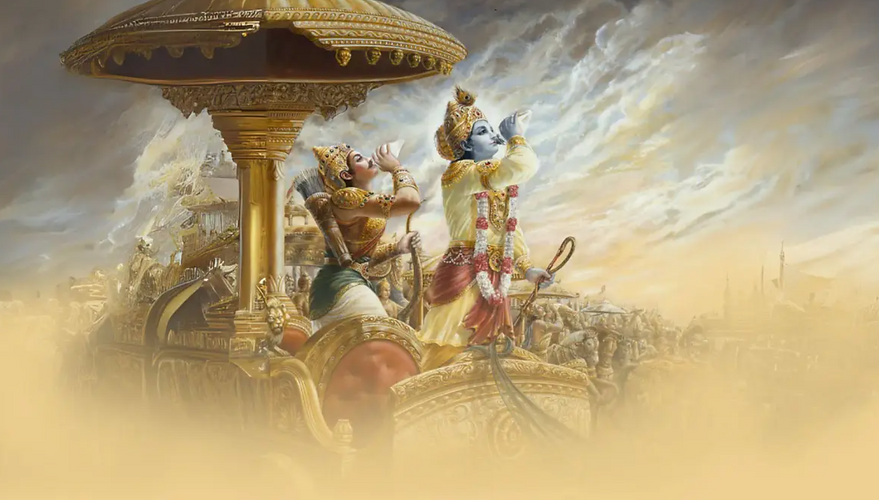
Bhagvad Gita Chapter 18
भगवद् गीता अध्याय १८
Bhagvad Gita Chapter 17 - Moksha Sannyasa Yoga
भगवद गीता का अध्याय १८ - मोक्षसंन्यास योग
Introduction
Chapter 18 is the grand conclusion of the Bhagavad Gita. After guiding Arjuna through seventeen chapters covering Karma Yoga, Jnana Yoga, Dhyana Yoga, Bhakti Yoga, and the nature of the Self, Shri Krishna now brings all these teachings together into one complete philosophy of life.
Arjuna begins the chapter with an important question:
What is the difference between Sannyasa (renunciation) and Tyaga (relinquishment)?
Many people believe that spiritual life means giving up work, family, or worldly responsibilities. Shri Krishna immediately clarifies this misunderstanding. He explains that true renunciation is not abandoning action but abandoning attachment, selfish desires, and the ego that claims ownership over actions.
From this point onward, Krishna revisits many of the central teachings of the Gita and presents them in a clear and integrated manner. He explains the nature of renunciation, the importance of performing one's Swadharma, the five causes behind every action, the influence of the three Gunas (Sattva, Rajas, and Tamas) on knowledge, action, the doer, intellect, determination, and happiness. He also explains how every individual has unique qualities and duties according to their nature, and why lasting fulfilment comes from performing one's own Dharma rather than imitating someone else's path.
As the chapter progresses, Shri Krishna gradually shifts from philosophy to devotion. He teaches that while sincere effort, right knowledge, and disciplined action are essential, the highest freedom ultimately comes through complete surrender to God. The famous verse "Sarva-dharman parityajya mam ekam sharanam vraja" (18.66) becomes the climax of the entire Bhagavad Gita, where Krishna invites Arjuna to let go of ego, fear, and false dependence, and place complete trust in the Divine.
The chapter concludes with Arjuna's transformation. The confusion that had paralysed him in the first chapter has disappeared. His clarity has returned, his doubts have been resolved, and he is ready to perform his duty with courage and wisdom. Sanjaya then ends the Bhagavad Gita by declaring that wherever the wisdom of Shri Krishna and the righteous action of Arjuna come together, there will always be prosperity, victory, well-being, and Dharma.
Chapter 18 is therefore not merely the final chapter of the Bhagavad Gita—it is the culmination of its entire message. It reminds us that liberation is not found by escaping life, but by living it with right understanding, selfless action, unwavering devotion, and complete surrender to the Divine.
Key Themes of Chapter 18
-
The difference between Sannyasa (renunciation) and Tyaga (relinquishment).
-
Why attachment—not action—is the real cause of bondage.
-
The five causes behind every action.
-
The influence of Sattva, Rajas, and Tamas on every aspect of human life.
-
The importance of Swadharma and performing one's natural duties.
-
The path from Karma Yoga to knowledge, devotion, and surrender.
-
The role of Divine grace in attaining liberation.
-
Krishna's final call to complete surrender.
-
Arjuna's transformation from confusion to clarity.
-
The timeless union of Divine wisdom (Krishna) and right action (Arjuna).
Central Message of Chapter 18:
Liberation is not achieved by running away from the world. It is attained by performing one's duties without attachment, guided by wisdom, strengthened by devotion, and ultimately surrendered to God.
भगवद्गीता का अठारहवाँ अध्याय सम्पूर्ण गीता का समापन ही नहीं, बल्कि उसका सार भी है। पिछले सत्रह अध्यायों में श्रीकृष्ण ने अर्जुन को कर्मयोग, ज्ञानयोग, भक्तियोग, ध्यानयोग, आत्मा, प्रकृति, गुण, धर्म और ईश्वर के अनेक गहन सिद्धांतों का उपदेश दिया। अब इस अंतिम अध्याय में वे इन सभी शिक्षाओं को एक सूत्र में पिरोकर जीवन का संपूर्ण दर्शन प्रस्तुत करते हैं।
अध्याय की शुरुआत अर्जुन के एक महत्वपूर्ण प्रश्न से होती है—
"संन्यास और त्याग में क्या अंतर है?"
बहुत से लोग मानते हैं कि आध्यात्मिक जीवन का अर्थ है संसार, परिवार या कर्मों का त्याग कर देना। लेकिन श्रीकृष्ण इस भ्रम को दूर करते हुए बताते हैं कि सच्चा संन्यास कर्मों का त्याग नहीं, बल्कि कर्मों के प्रति आसक्ति, स्वार्थ और अहंकार का त्याग है।
इसके बाद श्रीकृष्ण गीता के अनेक प्रमुख सिद्धांतों को पुनः स्पष्ट करते हैं। वे बताते हैं कि प्रत्येक कर्म के पाँच कारण होते हैं, मनुष्य के ज्ञान, कर्म, कर्ता, बुद्धि, धृति और सुख पर सत्त्व, रजस और तमस—इन तीनों गुणों का प्रभाव पड़ता है। वे यह भी समझाते हैं कि प्रत्येक व्यक्ति का अपना स्वभाव (स्वधर्म) होता है और वास्तविक सफलता दूसरों का जीवन जीने में नहीं, बल्कि अपने स्वधर्म का पालन करने में है।
जैसे-जैसे अध्याय आगे बढ़ता है, श्रीकृष्ण कर्म और ज्ञान से आगे बढ़कर पूर्ण भक्ति और शरणागति की ओर ले जाते हैं। वे बताते हैं कि मनुष्य को अपने कर्तव्यों का पालन पूरी निष्ठा से करना चाहिए, लेकिन अंततः अपने अहंकार, भय और फल की चिंता को भगवान के चरणों में समर्पित कर देना चाहिए।
इसी अध्याय में भगवद्गीता का सबसे प्रसिद्ध श्लोक आता है—
"सर्वधर्मान् परित्यज्य मामेकं शरणं व्रज।" (18.66)
यह गीता का चरम संदेश है। यहाँ श्रीकृष्ण अर्जुन को धर्म छोड़ने के लिए नहीं, बल्कि अहंकार, झूठे सहारों और सीमित धारणाओं को छोड़कर पूर्ण रूप से ईश्वर की शरण में आने का आह्वान करते हैं।
अध्याय के अंत में अर्जुन कहता है—
"नष्टो मोहः स्मृतिर्लब्धा…"
अर्थात् उसका मोह समाप्त हो चुका है, उसके सभी संदेह दूर हो गए हैं और अब वह अपने धर्म का पालन करने के लिए तैयार है।
इसके बाद संजय इस दिव्य संवाद की महिमा का वर्णन करते हैं और अंत में अपना प्रसिद्ध निष्कर्ष देते हैं—
"जहाँ योगेश्वर श्रीकृष्ण हैं और जहाँ धनुर्धर अर्जुन हैं, वहाँ निश्चित रूप से श्री, विजय, कल्याण और धर्म की स्थापना होती है।"
यह केवल महाभारत युद्ध का निष्कर्ष नहीं, बल्कि सम्पूर्ण मानव जीवन का शाश्वत सिद्धांत है।
अतः अध्याय 18 केवल भगवद्गीता का अंतिम अध्याय नहीं है, बल्कि उसके समस्त उपदेशों का सार है। यह हमें सिखाता है कि मोक्ष संसार छोड़ने से नहीं, बल्कि सही समझ, निष्काम कर्म, अटूट भक्ति और पूर्ण शरणागति के साथ जीवन जीने से प्राप्त होता है।
अध्याय 18 के मुख्य विषय
-
संन्यास और त्याग का वास्तविक अर्थ।
-
कर्म नहीं, बल्कि आसक्ति ही बंधन का कारण है।
-
प्रत्येक कर्म के पाँच कारण।
-
सत्त्व, रजस और तमस का ज्ञान, कर्म, कर्ता, बुद्धि, धृति और सुख पर प्रभाव।
-
स्वधर्म का महत्व और अपने स्वभाव के अनुसार कर्म करना।
-
कर्मयोग से ज्ञानयोग, भक्तियोग और अंततः शरणागति की यात्रा।
-
मोक्ष प्राप्ति में ईश्वर की कृपा का महत्व।
-
श्रीकृष्ण का अंतिम संदेश—पूर्ण शरणागति।
-
अर्जुन का मोह से स्पष्टता और संदेह से निश्चय की ओर परिवर्तन।
-
श्रीकृष्ण के दिव्य ज्ञान और अर्जुन के धर्मपूर्ण कर्म का अद्भुत समन्वय।
अध्याय 18 का केंद्रीय संदेश
मोक्ष संसार से भागने में नहीं, बल्कि अपने कर्तव्य को बिना आसक्ति के निभाने, विवेक से जीवन जीने, भक्ति से हृदय को पवित्र करने और अंततः स्वयं को पूर्ण रूप से भगवान के चरणों में समर्पित कर देने में है।
Bhagavad Gita 18.1
अर्जुन उवाच
संन्यासस्य महाबाहो तत्त्वमिच्छामि वेदितुम् ।
त्यागस्य च हृषीकेश पृथक्केशिनिषूदन ॥ १८.१ ॥
Translation
Arjuna said:
"O mighty-armed Krishna, O Hrishikesha, O slayer of Keshi, I wish to understand the true nature of Sannyasa (renunciation) and Tyaga (letting go). Please explain how they differ."
Meaning
As the Bhagavad Gita reaches its final chapter, Arjuna asks one last question. Throughout the previous seventeen chapters, Shri Krishna has spoken about Karma Yoga, detachment, duty, knowledge, devotion, and renunciation. Yet Arjuna seeks complete clarity regarding two words that appear similar but carry different meanings—Sannyasa and Tyaga.
Many people believe that spirituality means giving up family, career, wealth, or worldly responsibilities. Others think that success requires complete attachment to work and its results. Arjuna stands between these two ideas, wondering which path truly leads to liberation.
His question reflects a confusion that still exists today. Should we leave the world to become spiritual, or should we continue fulfilling our responsibilities? Can someone living an ordinary life attain inner freedom?
With this question, Arjuna prepares the ground for Shri Krishna's final and most practical teachings. Krishna will explain that liberation is not achieved by escaping life but by transforming the way we live it. What binds us is not our work but our attachment to it. What creates suffering is not responsibility but ego, desire, and expectation.
This opening verse reminds us that asking sincere questions is the beginning of wisdom. Just as Arjuna sought clarity before taking action, we too must seek understanding before making life's important decisions.
भावार्थ
अर्जुन ने कहा:
"हे महाबाहु श्रीकृष्ण! हे हृषीकेश! हे केशी दैत्य का वध करने वाले! मैं संन्यास और त्याग का वास्तविक स्वरूप जानना चाहता हूँ। कृपया मुझे बताइए कि इन दोनों में क्या अंतर है।"
अर्थ
भगवद् गीता के अंतिम अध्याय की शुरुआत अर्जुन के एक अत्यंत महत्वपूर्ण प्रश्न से होती है। पिछले सत्रह अध्यायों में श्रीकृष्ण ने कर्म, ज्ञान, भक्ति, योग, वैराग्य और कर्तव्य जैसे अनेक विषयों पर विस्तार से समझाया है। फिर भी अर्जुन के मन में एक संशय शेष रह जाता है। वह जानना चाहता है कि संन्यास और त्याग में वास्तव में अंतर क्या है।
आज भी यही प्रश्न हम सभी के मन में उठता है। क्या आध्यात्मिक बनने के लिए घर-परिवार, नौकरी और संसार छोड़ना आवश्यक है? या फिर अपने सभी कर्तव्यों का पालन करते हुए भी मुक्ति प्राप्त की जा सकती है?
बहुत से लोग समझते हैं कि संसार छोड़ देना ही संन्यास है। दूसरी ओर कुछ लोग मानते हैं कि जीवन में केवल सफलता और उपलब्धियाँ ही सबसे महत्वपूर्ण हैं। अर्जुन इन दोनों विचारों के बीच खड़ा है और सही मार्ग जानना चाहता है।
यही कारण है कि वह अंतिम बार श्रीकृष्ण से स्पष्ट उत्तर माँगता है। यह केवल अर्जुन का प्रश्न नहीं है, बल्कि हर उस व्यक्ति का प्रश्न है जो जिम्मेदारियों और आध्यात्मिकता के बीच संतुलन बनाना चाहता है।
यह श्लोक हमें एक महत्वपूर्ण शिक्षा देता है कि ज्ञान की शुरुआत सही प्रश्न पूछने से होती है। जब तक मन में जिज्ञासा नहीं होगी, तब तक वास्तविक समझ भी नहीं आएगी। अर्जुन ने अपने अहंकार को छोड़कर प्रश्न किया, इसलिए वह सत्य को जानने योग्य बना। इसी प्रकार यदि हम भी खुले मन से जीवन के प्रश्नों के उत्तर खोजें, तो सही दिशा अवश्य प्राप्त होगी।
Bhagavad Gita 18.2
श्रीभगवानुवाच
काम्यानां कर्मणां न्यासं संन्यासं कवयो विदुः ।
सर्वकर्मफलत्यागं प्राहुस्त्यागं विचक्षणाः ॥ १८.२ ॥
Translation
Shri Krishna said:
"The wise understand Sannyasa as giving up actions performed for selfish desires. The learned describe Tyaga as giving up attachment to the fruits of all actions."
Meaning
Shri Krishna immediately removes Arjuna's confusion by defining these two important concepts.
Sannyasa means giving up actions driven by selfish desires—actions performed solely to gain wealth, status, pleasure, recognition, or personal benefit. It is the renunciation of desire-driven action.
Tyaga, however, is something deeper. It does not ask us to stop working or abandon our duties. Instead, it asks us to give up our attachment to the results of every action. We continue to perform our responsibilities sincerely, but without allowing success or failure to disturb our inner peace.
This distinction is one of the most practical teachings of the Bhagavad Gita.
A teacher should teach wholeheartedly, but not become dependent on appreciation. A doctor should treat every patient sincerely without allowing personal success or failure to define their peace. A parent should raise children with love without expecting them to fulfil every dream they have.
Our suffering rarely comes from the work itself. It comes from expecting life to unfold exactly the way we want.
Shri Krishna teaches that the problem is never action—it is attachment. Duties performed with sincerity purify the mind, while attachment to their outcomes creates anxiety, frustration, fear, pride, and disappointment.
True freedom begins not when we stop acting, but when we stop allowing results to control our happiness.
भावार्थ
श्रीभगवान ने कहा:
"ज्ञानी पुरुष कामना से किए जाने वाले कर्मों का त्याग करना ही संन्यास कहते हैं। और सभी कर्मों के फल के प्रति आसक्ति छोड़ देना ही त्याग कहलाता है।"
अर्थ
अर्जुन के प्रश्न का उत्तर देते हुए श्रीकृष्ण सबसे पहले संन्यास और त्याग की स्पष्ट परिभाषा बताते हैं।
वे कहते हैं कि संन्यास का अर्थ है उन कर्मों का त्याग करना जो केवल अपनी इच्छाओं, स्वार्थ, सुख-सुविधा, प्रसिद्धि या लाभ प्राप्त करने के लिए किए जाते हैं। ऐसे कर्म जिनका उद्देश्य केवल "मुझे क्या मिलेगा?" हो, वे कामना-प्रधान कर्म हैं।
दूसरी ओर त्याग का अर्थ कर्म छोड़ना नहीं है। इसका अर्थ है कर्म करते हुए उसके फल के प्रति अपनी आसक्ति छोड़ देना। अर्थात् अपने कर्तव्य पूरी निष्ठा से करना, लेकिन परिणाम को लेकर चिंता, भय, अहंकार या निराशा में न पड़ना।
यही भगवद् गीता की सबसे व्यावहारिक शिक्षाओं में से एक है।
एक शिक्षक का कर्तव्य पढ़ाना है, लेकिन यदि वह केवल प्रशंसा की अपेक्षा से पढ़ाए तो उसका मन अशांत रहेगा। एक चिकित्सक का कर्तव्य उपचार करना है, लेकिन यदि हर परिणाम को अपनी सफलता या असफलता से जोड़ ले, तो वह कभी मानसिक शांति नहीं पा सकेगा। इसी प्रकार माता-पिता का कर्तव्य अपने बच्चों का पालन-पोषण करना है, लेकिन यदि वे अपने हर सपने को बच्चों से पूरा करवाना चाहें, तो संबंधों में तनाव आ जाएगा।
श्रीकृष्ण बताते हैं कि बंधन कर्म से नहीं, कर्म के फल की आसक्ति से उत्पन्न होता है। कर्म करना हमारा अधिकार और कर्तव्य है, लेकिन परिणाम अनेक कारणों पर निर्भर करता है। इसलिए जो व्यक्ति अपना सर्वश्रेष्ठ प्रयास करता है और फिर परिणाम को स्वीकार कर लेता है, वही वास्तविक त्यागी है।
इस प्रकार श्रीकृष्ण स्पष्ट करते हैं कि आध्यात्मिक जीवन का अर्थ संसार से भागना नहीं, बल्कि संसार में रहते हुए आसक्ति से मुक्त होकर अपना कर्तव्य निभाना है। यही सच्चा त्याग है और यही कर्मयोग का सार है।
Bhagavad Gita 18.3
त्याज्यं दोषवदित्येके कर्म प्राहुर्मनीषिणः ।
यज्ञदानतपःकर्म न त्याज्यमिति चापरे ॥ १८.३ ॥
Translation
"Some wise people declare that all actions should be abandoned because they are imperfect and lead to bondage. Others say that acts of sacrifice, charity, and austerity should never be given up."
Meaning
Shri Krishna now presents two different schools of thought that existed even during his time.
One group believed that all actions ultimately create bondage. Since every action produces consequences, they argued that the safest path is to give up action altogether.
Another group held a different opinion. They believed that actions such as Yajna (selfless service and sacrifice), Dana (charity), and Tapas (self-discipline) are sacred and should never be abandoned because they purify the mind and uplift both the individual and society.
This debate continues even today.
Some people believe peace comes from withdrawing from responsibilities. Others believe that meaningful work, service, generosity, and discipline are essential for personal growth.
Shri Krishna introduces both perspectives because true understanding requires examining every viewpoint before arriving at the truth.
The Bhagavad Gita does not reject action. Instead, it teaches us to examine the intention behind action.
Actions driven by greed, ego, or selfish desire create bondage. Actions performed as service, duty, and worship purify the heart.
The question is therefore not "Should I act?"
The real question is "Why am I acting?"
When intention changes, the same action transforms from a source of bondage into a path toward liberation.
भावार्थ
"कुछ विद्वान कहते हैं कि सभी कर्म दोषयुक्त हैं, इसलिए उनका त्याग कर देना चाहिए। जबकि अन्य विद्वानों का मत है कि यज्ञ, दान और तप जैसे कर्मों का कभी त्याग नहीं करना चाहिए।"
अर्थ
श्रीकृष्ण अब उस समय प्रचलित दो अलग-अलग विचारों का उल्लेख करते हैं। एक मत यह था कि प्रत्येक कर्म किसी न किसी प्रकार का बंधन उत्पन्न करता है। इसलिए यदि मुक्ति चाहिए, तो सभी कर्मों का त्याग कर देना ही उचित है। उनका मानना था कि जब तक मनुष्य कर्म करता रहेगा, तब तक वह कर्मफल के बंधन से मुक्त नहीं हो सकता।
दूसरा मत इससे बिल्कुल भिन्न था। कुछ ज्ञानी कहते थे कि यज्ञ, दान और तप जैसे शुभ कर्म कभी नहीं छोड़ने चाहिए, क्योंकि यही कर्म मनुष्य के जीवन को पवित्र बनाते हैं और उसके भीतर छिपे स्वार्थ, अहंकार और आसक्ति को धीरे-धीरे समाप्त करते हैं।
आज भी यही भ्रम हमारे समाज में दिखाई देता है। कुछ लोग सोचते हैं कि आध्यात्मिक बनने के लिए संसार से दूर हो जाना आवश्यक है, जबकि कुछ लोग केवल कर्म करते रहते हैं लेकिन उसके पीछे का उद्देश्य भूल जाते हैं।
श्रीकृष्ण इस श्लोक में किसी एक पक्ष का समर्थन नहीं करते। वे पहले दोनों विचारों को सामने रखते हैं ताकि अर्जुन स्वयं समझ सके कि वास्तविक सत्य क्या है। गीता हमें सिखाती है कि किसी निष्कर्ष पर पहुँचने से पहले सभी पक्षों को समझना आवश्यक है।
यह श्लोक हमें एक महत्वपूर्ण प्रश्न पूछने के लिए प्रेरित करता है—क्या मेरा कर्म मुझे बाँध रहा है, या वही कर्म मुझे भीतर से शुद्ध भी कर सकता है?
उत्तर कर्म में नहीं, बल्कि कर्म के पीछे छिपी भावना में है। यदि कर्म स्वार्थ से प्रेरित है, तो वह बंधन बनेगा। यदि वही कर्म सेवा, कर्तव्य और समर्पण की भावना से किया जाए, तो वही मुक्ति का मार्ग बन सकता है।
Bhagavad Gita 18.4
निश्चयं शृणु मे तत्र त्यागे भरतसत्तम ।
त्यागो हि पुरुषव्याघ्र त्रिविधः सम्प्रकीर्तितः ॥ १८.४ ॥
Translation
"O best of the Bharatas, listen carefully to My conclusion regarding Tyaga. Renunciation has been described as being of three kinds."
Meaning
Before explaining what true renunciation is, Shri Krishna asks Arjuna to listen carefully.
This simple instruction carries a profound lesson.
Wisdom cannot be understood through assumptions or half-knowledge. Many people form opinions after hearing only a part of the truth. Spiritual knowledge demands patience, humility, and the willingness to listen completely before drawing conclusions.
Shri Krishna now reveals that not all renunciation is the same. Just as our actions are influenced by the three Gunas—Sattva, Rajas, and Tamas—our way of giving up things is also shaped by these qualities.
Some people renounce out of ignorance.
Some renounce out of fear or personal discomfort.
Very few renounce from wisdom.
Outwardly these people may appear similar, but inwardly their intentions are completely different.
This is why spirituality cannot be judged merely by external appearances. Two people may perform the same action, yet one moves closer to freedom while the other creates more bondage.
The Bhagavad Gita consistently teaches us to look beyond behaviour and understand the consciousness behind it.
True transformation always begins within.
In the next few verses, Shri Krishna explains how the three Gunas influence renunciation and how we can recognize genuine Tyaga in our own lives
भावार्थ
"हे भरतश्रेष्ठ! अब त्याग के विषय में मेरा निश्चित मत सुनो। हे पुरुषश्रेष्ठ! त्याग तीन प्रकार का कहा गया है।"
अर्थ
दोनों मतों का उल्लेख करने के बाद अब श्रीकृष्ण स्वयं अपना निष्कर्ष बताने जा रहे हैं। वे अर्जुन से कहते हैं—"अब ध्यान से सुनो।"
यह केवल अर्जुन के लिए नहीं, बल्कि हम सभी के लिए एक संदेश है।
जीवन में अक्सर हम अधूरी जानकारी के आधार पर निर्णय ले लेते हैं। किसी की बात का एक हिस्सा सुनकर अपनी राय बना लेते हैं। लेकिन आध्यात्मिक ज्ञान केवल सुनने से नहीं, बल्कि पूरे मन से समझने से प्राप्त होता है।
श्रीकृष्ण बताते हैं कि त्याग एक जैसा नहीं होता। जिस प्रकार प्रकृति के तीन गुण—सत्त्व, रजस और तमस—हमारे विचारों और कर्मों को प्रभावित करते हैं, उसी प्रकार हमारा त्याग भी इन्हीं गुणों से प्रभावित होता है।
कोई व्यक्ति अज्ञान के कारण त्याग करता है।
कोई भय, आलस्य या कठिनाइयों से बचने के लिए त्याग करता है।
और कोई व्यक्ति ज्ञान, विवेक तथा आंतरिक स्वतंत्रता के कारण त्याग करता है।
बाहरी रूप से तीनों एक जैसे दिखाई दे सकते हैं, लेकिन उनके भीतर की भावना पूरी तरह अलग होती है।
भगवद् गीता बार-बार यही सिखाती है कि किसी भी कर्म या व्यक्ति का मूल्यांकन केवल उसके बाहरी व्यवहार से नहीं किया जा सकता। वास्तविक महत्व उसके इरादे, चेतना और भावना का होता है।
अगले श्लोकों में श्रीकृष्ण विस्तार से बताएँगे कि सात्त्विक, राजसिक और तामसिक त्याग क्या होता है और सच्चा त्यागी कौन है।
Bhagavad Gita 18.5
यज्ञदानतपःकर्म न त्याज्यं कार्यमेव तत् ।
यज्ञो दानं तपश्चैव पावनानि मनीषिणाम् ॥ १८.५ ॥
Translation
"Acts of sacrifice, charity, and austerity should never be abandoned. They must certainly be performed because they purify even the wise."
Meaning
Having introduced different opinions about renunciation, Shri Krishna now gives His own conclusion.
Certain actions should never be abandoned because they elevate human life.
Yajna is not limited to ritual offerings. It represents every selfless action performed for a purpose greater than oneself.
Dana is not merely giving money. It is sharing our resources, knowledge, time, kindness, and abilities without expecting anything in return.
Tapas is the discipline that strengthens character. It is choosing what is right over what is easy, controlling our impulses, and remaining committed even when life becomes difficult.
These three practices gradually remove selfishness from the heart.
In today's world, Yajna may be serving society honestly through our profession. Dana may be mentoring someone, helping a stranger, or supporting a worthy cause. Tapas may be waking up early for exercise, controlling anger, reducing distractions, or speaking truth even when it is uncomfortable.
Notice that none of these require us to leave our homes or abandon our careers.
The Bhagavad Gita teaches that spirituality grows through the way we live every day.
A life of service makes us less self-centred.
A life of generosity softens the heart.
A life of discipline strengthens the mind.
Together, these become powerful instruments for inner purification, preparing us to live with greater wisdom, detachment, and peace.
भावार्थ
"यज्ञ, दान और तप जैसे कर्मों का त्याग नहीं करना चाहिए। इनका पालन अवश्य करना चाहिए, क्योंकि ये बुद्धिमान लोगों के मन को भी पवित्र करते हैं।"
अर्थ
अब श्रीकृष्ण अपना स्पष्ट निर्णय सुनाते हैं। वे कहते हैं कि कुछ ऐसे कर्म हैं जिन्हें कभी नहीं छोड़ना चाहिए। यज्ञ, दान और तप केवल धार्मिक अनुष्ठान नहीं हैं, बल्कि श्रेष्ठ जीवन जीने के तीन आधार हैं।
यज्ञ का अर्थ केवल अग्नि में आहुति देना नहीं है। यज्ञ का वास्तविक अर्थ है—अपने स्वार्थ से ऊपर उठकर किसी बड़े उद्देश्य के लिए कार्य करना। जब हम अपने परिवार, समाज, राष्ट्र या मानवता के हित में निस्वार्थ भाव से कार्य करते हैं, तब वह भी यज्ञ है।
दान केवल धन देने तक सीमित नहीं है। अपना समय देना, ज्ञान बाँटना, किसी का मार्गदर्शन करना, किसी ज़रूरतमंद की सहायता करना, किसी का दुःख सुन लेना—ये सब दान के ही रूप हैं।
तप का अर्थ स्वयं को कष्ट देना नहीं है। तप का अर्थ है अपने मन, वाणी और इन्द्रियों पर संयम रखना। जो सही है, उसे कठिन होने पर भी करना और जो गलत है, उसे आकर्षक होने पर भी छोड़ देना—यही तप है।
आज के जीवन में भी ये तीनों उतने ही आवश्यक हैं। ईमानदारी से अपना कार्य करना यज्ञ है। बिना किसी अपेक्षा के सहायता करना दान है। अपने क्रोध, आलस्य, इच्छाओं और आदतों पर नियंत्रण रखना तप है।
श्रीकृष्ण कहते हैं कि ये तीनों कर्म मनुष्य के भीतर छिपे अहंकार, स्वार्थ और आसक्ति को धीरे-धीरे समाप्त करते हैं। यही कारण है कि ये केवल साधारण कर्म नहीं, बल्कि आत्मशुद्धि के साधन हैं।
गीता हमें संसार छोड़ने की शिक्षा नहीं देती। वह हमें सिखाती है कि संसार में रहते हुए भी अपने कर्मों को इतना पवित्र बना दो कि वही तुम्हारी साधना बन जाए। यही यज्ञ है, यही दान है और यही तप है।
Bhagavad Gita 18.6
एतान्यपि तु कर्माणि सङ्गं त्यक्त्वा फलानि च ।
कर्तव्यानीति मे पार्थ निश्चितं मतमुत्तमम् ॥ १८.६ ॥
Translation
"O Partha, these acts of sacrifice, charity, and austerity should certainly be performed, giving up attachment and the desire for their fruits. This is My firm and highest conclusion."
Meaning
After presenting different opinions about renunciation, Shri Krishna now gives His final verdict.
He says that Yajna (selfless service), Dana (charity), and Tapas (discipline) should never be abandoned. However, they must be performed without attachment and without expecting anything in return.
This verse highlights one of the greatest principles of the Bhagavad Gita: the problem is not action, but attachment.
Many people perform good deeds expecting appreciation, recognition, respect, or even spiritual merit. They donate to be praised, serve to gain influence, or practise discipline merely to prove something to others. Although these actions appear noble, the attachment behind them prevents inner freedom.
True selfless action expects nothing.
Imagine planting a tree knowing you may never sit in its shade. Imagine helping someone without expecting gratitude. Imagine doing your work sincerely even when no one notices your effort. This is the spirit Shri Krishna is encouraging.
The world needs action. Families, societies, and nations thrive because people perform their responsibilities. What must disappear is the ego that constantly asks, "What will I get in return?"
When actions become expressions of duty instead of transactions for personal gain, they purify the mind and become a path to liberation.
This is why Shri Krishna calls this His firm and highest conclusion.
भावार्थ
"हे पार्थ! यज्ञ, दान और तप जैसे कर्मों को भी आसक्ति और फल की इच्छा का त्याग करके अवश्य करना चाहिए। यही मेरा निश्चित और सर्वोत्तम मत है।"
अर्थ
श्रीकृष्ण अब अपना अंतिम और स्पष्ट निर्णय सुनाते हैं। वे कहते हैं कि यज्ञ, दान और तप जैसे श्रेष्ठ कर्म कभी नहीं छोड़ने चाहिए। लेकिन इन्हें करते समय मन में किसी प्रकार की आसक्ति या फल की अपेक्षा नहीं होनी चाहिए।
यही भगवद् गीता का मूल संदेश है—समस्या कर्म में नहीं, बल्कि कर्म से जुड़ी आसक्ति में है।
अक्सर हम अच्छे कार्य भी किसी न किसी अपेक्षा से करते हैं। हम चाहते हैं कि लोग हमारी प्रशंसा करें, हमारा सम्मान करें या हमारे कार्य का प्रतिफल हमें अवश्य मिले। जब ऐसा नहीं होता, तो निराशा, क्रोध और दुःख उत्पन्न होता है।
श्रीकृष्ण कहते हैं कि सच्चा कर्म वही है जो केवल इसलिए किया जाए क्योंकि वह हमारा कर्तव्य है।
यदि आप किसी की सहायता करते हैं, तो बदले में धन्यवाद की अपेक्षा न रखें।
यदि आप समाज के लिए कुछ करते हैं, तो प्रसिद्धि की इच्छा न रखें।
यदि आप अपना कार्य पूरी ईमानदारी से करते हैं, तो केवल परिणाम के लिए नहीं, बल्कि इसलिए कि सही कार्य करना ही आपका धर्म है।
जब कर्म पूजा बन जाता है, तब उसका फल स्वयं मन की शांति बन जाता है।
यही कारण है कि श्रीकृष्ण इसे अपना "निश्चित और सर्वोत्तम मत" कहते हैं। कर्म करते रहना है, लेकिन उसके साथ जुड़ी हुई अपेक्षाओं को छोड़ देना ही वास्तविक त्याग है।
Bhagavad Gita 18.7
नियतस्य तु संन्यासः कर्मणो नोपपद्यते ।
मोहात्तस्य परित्यागस्तामसः परिकीर्तितः ॥ १८.७ ॥
Translation
"Renouncing one's prescribed duty is not proper. Giving up one's responsibilities out of ignorance or delusion is said to be Tamasic renunciation."
Meaning
Shri Krishna now begins explaining the three kinds of renunciation.
The first is Tamasic Tyaga, renunciation born from ignorance.
He makes it very clear that abandoning one's rightful duties is never true spirituality. When a person walks away from responsibilities because they are confused, careless, lazy, or unwilling to face life's challenges, that is not renunciation—it is escape.
Sometimes people avoid difficult conversations, neglect family responsibilities, quit meaningful work, or refuse to fulfil commitments while convincing themselves that they are seeking peace. But peace cannot be built on neglected responsibilities.
Running away from problems does not remove them. It only postpones them.
True spirituality never encourages irresponsibility. It teaches us to face life with greater wisdom, courage, and maturity.
A parent cannot abandon children in the name of spirituality. A leader cannot ignore responsibilities because they have become difficult. A student cannot stop learning simply because studies feel stressful.
Whenever we leave our duties because of confusion, fear, laziness, or emotional weakness, we are acting under the influence of Tamas.
Shri Krishna reminds us that liberation is not found by avoiding life. It is found by transforming the way we live it.
Duty may sometimes be difficult, but escaping from it never brings lasting peace.
भावार्थ
"अपने नियत कर्तव्यों का त्याग उचित नहीं है। जो व्यक्ति मोह या अज्ञान के कारण अपने कर्तव्य छोड़ देता है, उसका त्याग तामसिक कहा जाता है।"
अर्थ
अब श्रीकृष्ण त्याग के तीन प्रकारों का वर्णन प्रारम्भ करते हैं। सबसे पहले वे तामसिक त्याग की चर्चा करते हैं।
तामसिक त्याग वह है जिसमें व्यक्ति अपने कर्तव्यों से इसलिए भागता है क्योंकि वह भ्रमित है, आलसी है, जिम्मेदारी उठाना नहीं चाहता या कठिनाइयों का सामना करने से डरता है।
ऐसा व्यक्ति स्वयं को यह समझा सकता है कि उसने संसार का त्याग कर दिया है, जबकि वास्तव में उसने केवल अपनी जिम्मेदारियों से मुँह मोड़ा है।
आज के जीवन में भी यह स्थिति अनेक रूपों में दिखाई देती है।
कोई व्यक्ति परिवार की जिम्मेदारियों से बचने के लिए आध्यात्मिकता का बहाना बना लेता है।
कोई कठिन निर्णय लेने से बचता है।
कोई असफलता के डर से प्रयास ही छोड़ देता है।
श्रीकृष्ण स्पष्ट कहते हैं कि यह त्याग नहीं, बल्कि मोह है।
भगवद् गीता कभी भी कर्तव्य से भागने की शिक्षा नहीं देती। वह हमें सिखाती है कि परिस्थितियाँ चाहे जैसी भी हों, अपने धर्म और जिम्मेदारियों का पालन करना ही सच्चा मार्ग है।
जीवन की कठिनाइयों से भागना कभी समाधान नहीं बनता। समस्याएँ वहीं रहती हैं; केवल उनसे सामना करने का समय आगे बढ़ जाता है।
सच्चा साधक वह नहीं जो संसार छोड़ दे, बल्कि वह है जो संसार में रहकर भी अपने कर्तव्य निभाए और भीतर से शांत बना रहे।
Bhagavad Gita 18.8
दुःखमित्येव यत्कर्म कायक्लेशभयात्त्यजेत् ।
स कृत्वा राजसं त्यागं नैव त्यागफलं लभेत् ॥ १८.८ ॥
Translation
"If a person abandons action because it is difficult or causes discomfort, such renunciation is Rajasic. Such a person does not attain the true fruit of renunciation."
Meaning
The second type of renunciation is Rajasic Tyaga.
Here, a person does not abandon responsibilities out of ignorance but because they fear inconvenience, discomfort, criticism, failure, or hard work.
This kind of renunciation is driven by self-interest.
Many dreams remain unfulfilled because people give up the moment life becomes uncomfortable. A business becomes challenging, so they quit. A relationship requires patience, so they walk away. A spiritual practice demands discipline, so they stop.
Their decision is not based on wisdom but on comfort.
Shri Krishna reminds us that growth has always demanded effort.
No athlete becomes strong without training.
No musician masters an instrument without years of practice.
No meaningful relationship survives without patience.
Similarly, spiritual growth also requires discipline.
Rajasic renunciation seeks immediate comfort instead of lasting transformation.
Modern life often encourages us to choose the easiest path. The Bhagavad Gita encourages us to choose the right path—even when it is difficult.
Temporary discomfort should never become the reason to abandon meaningful responsibilities.
Real freedom lies beyond comfort.
When we continue performing our duties despite obstacles, we develop resilience, character, and inner strength.
The person who constantly runs away from difficulty never experiences the joy that comes from perseverance.
भावार्थ
"जो व्यक्ति केवल इस कारण अपने कर्तव्य छोड़ देता है कि वे कठिन हैं या उनसे शरीर को कष्ट होगा, उसका त्याग राजसिक कहलाता है। ऐसा व्यक्ति त्याग का वास्तविक फल प्राप्त नहीं करता।"
अर्थ
यहाँ श्रीकृष्ण राजसिक त्याग का वर्णन करते हैं।
राजसिक त्याग अज्ञान से नहीं, बल्कि सुविधा की चाह से उत्पन्न होता है। व्यक्ति अपने कर्तव्य इसलिए नहीं छोड़ता कि उसे सत्य का ज्ञान हो गया है, बल्कि इसलिए छोड़ता है क्योंकि वे कठिन, थकाने वाले या असुविधाजनक लगते हैं।
आज के समय में यह प्रवृत्ति बहुत सामान्य है।
लोग लक्ष्य तो बड़े रखते हैं, लेकिन कठिन परिश्रम से बचना चाहते हैं।
थोड़ी सी असफलता मिलते ही प्रयास छोड़ देते हैं।
रिश्तों में धैर्य रखने के बजाय अलग हो जाते हैं।
साधना में नियमितता कठिन लगे तो उसे छोड़ देते हैं।
श्रीकृष्ण बताते हैं कि केवल कठिन होने के कारण किसी कार्य को छोड़ देना त्याग नहीं है।
जीवन में जो भी मूल्यवान है, वह परिश्रम और धैर्य माँगता है।
अच्छा स्वास्थ्य अनुशासन से मिलता है।
ज्ञान अध्ययन से मिलता है।
विश्वास समय से बनता है।
आत्मिक विकास निरंतर अभ्यास से होता है।
यदि हम केवल सुविधा के आधार पर निर्णय लेने लगें, तो कभी भी अपने सर्वोत्तम स्वरूप तक नहीं पहुँच पाएँगे।
गीता हमें आसान रास्ता नहीं चुनना सिखाती; वह हमें सही रास्ता चुनना सिखाती है।
क्षणिक असुविधा से बचने के लिए यदि हम अपने कर्तव्य छोड़ दें, तो हम न संसार में सफल होंगे और न ही आध्यात्मिक जीवन में आगे बढ़ पाएँगे।
Bhagavad Gita 18.9
कार्यमित्येव यत्कर्म नियतं क्रियतेऽर्जुन ।
सङ्गं त्यक्त्वा फलं चैव स त्यागः सात्त्विको मतः ॥ १८.९ ॥
Translation
"O Arjuna, when a person performs prescribed duty simply because it ought to be done, giving up attachment and expectation of results, such renunciation is considered Sattvic."
Meaning
After explaining Tamasic and Rajasic renunciation, Shri Krishna now describes Sattvic Tyaga—the highest form of renunciation.
A Sattvic person performs duties because they are right, not because they guarantee success, praise, or reward.
The focus shifts from results to responsibility.
Imagine a doctor treating every patient with equal dedication, regardless of whether anyone notices. Imagine a teacher educating children with sincerity, not for awards but because education itself is sacred. Imagine someone caring for ageing parents out of gratitude rather than obligation.
This is Sattvic Tyaga.
The action remains exactly the same.
Only the inner attitude changes.
When expectations disappear, anxiety decreases.
When attachment reduces, fear fades.
When ego dissolves, peace naturally arises.
Shri Krishna never asks Arjuna to become inactive.
Instead, He asks him to become inwardly free while remaining fully active.
This teaching has enormous relevance today.
Much of our stress comes from trying to control outcomes that are beyond our control.
We can control our effort.
We cannot control every result.
A Sattvic person gives their best in every situation and then peacefully accepts whatever follows.
That acceptance is not weakness.
It is wisdom.
भावार्थ
"हे अर्जुन! जो व्यक्ति केवल यह समझकर अपना नियत कर्तव्य करता है कि यह मेरा कर्तव्य है, और उसके फल तथा आसक्ति का त्याग कर देता है, उसका त्याग सात्त्विक माना जाता है।"
अर्थ
अब श्रीकृष्ण सात्त्विक त्याग का वर्णन करते हैं, जो त्याग का सर्वोच्च रूप है।
सात्त्विक त्याग का अर्थ कर्म छोड़ना नहीं, बल्कि कर्म करते हुए मन को आसक्ति से मुक्त रखना है।
ऐसा व्यक्ति अपना कार्य इसलिए नहीं करता कि उसे पुरस्कार मिले, लोग उसकी प्रशंसा करें या उसे सफलता अवश्य मिले। वह केवल इसलिए कार्य करता है क्योंकि वही उसका धर्म और कर्तव्य है।
यही कर्मयोग का सार है।
एक चिकित्सक प्रत्येक रोगी का उपचार पूरी निष्ठा से करता है।
एक शिक्षक पूरे मन से विद्यार्थियों को पढ़ाता है।
माता-पिता अपने बच्चों का पालन-पोषण प्रेम से करते हैं।
वे अपना कर्तव्य निभाते हैं, लेकिन अपनी शांति को परिणाम पर निर्भर नहीं बनाते।
जब अपेक्षाएँ कम होती हैं, तो चिंता भी कम हो जाती है।
जब आसक्ति घटती है, तो भय भी समाप्त होने लगता है।
जब अहंकार कम होता है, तब मन में स्वाभाविक शांति आती है।
श्रीकृष्ण अर्जुन से युद्ध छोड़ने के लिए नहीं कहते। वे कहते हैं कि युद्ध करो, लेकिन भीतर से मुक्त रहो।
यही सात्त्विक त्याग है—पूरे मन से कर्म करना और फिर परिणाम को ईश्वर पर छोड़ देना।
यही जीवन को तनाव से शांति की ओर ले जाने का मार्ग है।
Bhagavad Gita 18.10
न द्वेष्ट्यकुशलं कर्म कुशले नानुषज्जते ।
त्यागी सत्त्वसमाविष्टो मेधावी छिन्नसंशयः ॥ १८.१० ॥
Translation
"One who neither dislikes unpleasant work nor becomes attached to pleasant work is a true renunciate. Filled with Sattva, wise, and free from doubt, such a person is established in true understanding."
Meaning
Shri Krishna concludes this section by describing the qualities of a genuine renunciate.
Such a person neither avoids difficult responsibilities nor becomes emotionally attached to enjoyable ones.
Most people naturally prefer pleasant tasks and avoid uncomfortable ones. We like recognition but dislike criticism. We enjoy success but resist failure. We welcome comfort but avoid sacrifice.
A wise person sees beyond these temporary experiences.
They understand that every responsibility has its place.
Some duties bring joy.
Others demand sacrifice.
Both are necessary for growth.
A parent may enjoy celebrating a child's achievements but must also patiently care for them during illness. A leader enjoys success but must also make difficult decisions during crises. A student enjoys graduation but must first embrace years of disciplined study.
Life is never made of pleasant moments alone.
True maturity is the ability to perform every responsibility with the same steadiness.
This verse teaches emotional balance.
When we stop dividing life into "I like this" and "I hate this," our decisions become guided by wisdom rather than emotion.
A Sattvic person acts according to what is right, not according to what feels comfortable.
Such a person becomes free from inner conflict because they are no longer controlled by likes and dislikes.
This inner balance is one of the greatest signs of spiritual maturity and marks the beginning of true freedom.
भावार्थ
"जो व्यक्ति कठिन या अप्रिय कर्मों से घृणा नहीं करता और सुखद कर्मों में आसक्त भी नहीं होता, वही सच्चा त्यागी है। वह सात्त्विक, बुद्धिमान और सभी संदेहों से मुक्त होता है।"
अर्थ
इस श्लोक में श्रीकृष्ण सच्चे त्यागी की पहचान बताते हैं।
सच्चा त्यागी वह नहीं जो केवल अपनी पसंद के कार्य करे और कठिन कार्यों से बचता रहे। वह हर परिस्थिति में अपने कर्तव्य को समान भाव से निभाता है।
जीवन में कुछ कार्य हमें अच्छे लगते हैं और कुछ नहीं। हम सफलता को स्वीकार करते हैं, लेकिन असफलता से बचना चाहते हैं। हम सम्मान चाहते हैं, लेकिन आलोचना से घबराते हैं। हम सुखद जिम्मेदारियाँ निभाते हैं, लेकिन कठिन जिम्मेदारियों से बचने का प्रयास करते हैं।
सात्त्विक व्यक्ति ऐसा नहीं करता।
वह जानता है कि जीवन केवल सुविधाओं का नाम नहीं है। कभी सेवा करनी होगी, कभी त्याग करना होगा, कभी संघर्ष करना होगा और कभी धैर्य रखना होगा।
वह हर परिस्थिति को अपने विकास का अवसर मानता है।
उसका निर्णय उसकी पसंद-नापसंद से नहीं, बल्कि उसके कर्तव्य और विवेक से होता है।
ऐसा व्यक्ति धीरे-धीरे मानसिक संतुलन प्राप्त कर लेता है। उसके भीतर न अत्यधिक उत्साह रहता है और न ही निराशा। वह परिस्थितियों के अनुसार नहीं बदलता, बल्कि अपने मूल्यों के अनुसार जीवन जीता है।
यही आंतरिक स्थिरता वास्तविक आध्यात्मिक परिपक्वता की पहचान है।
जब मन पसंद और नापसंद से ऊपर उठ जाता है, तब जीवन में शांति, स्पष्टता और स्वतंत्रता अपने आप आ जाती है। यही सच्चे त्यागी का स्वरूप है।
Bhagavad Gita 18.11
न हि देहभृता शक्यं त्यक्तुं कर्माण्यशेषतः ।
यस्तु कर्मफलत्यागी स त्यागीत्यभिधीयते ॥ १८.११ ॥
Translation
"For one who lives in a physical body, it is impossible to completely give up all actions. But one who renounces attachment to the fruits of actions is truly called a renunciate."
Meaning
Shri Krishna now removes another common misunderstanding about renunciation. Many people believe that becoming spiritual means stopping all worldly activities. Krishna clearly says that this is impossible. As long as we are alive, we are constantly performing actions. We breathe, think, speak, eat, walk, and make decisions every moment. Even choosing to do nothing is itself an action.
Therefore, the Bhagavad Gita does not ask us to stop acting. Instead, it asks us to change our relationship with action.
The real renunciate is not someone who escapes from work or responsibilities. A true renunciate performs every duty sincerely but does not allow their happiness to depend on the outcome. They do not become proud when successful or broken when things do not go as planned.
Think of a farmer who lovingly sows seeds. He waters the field, protects the crops, and works tirelessly. Yet he also knows that rain, weather, and nature are beyond his control. His responsibility is to give his best effort; the harvest is not entirely in his hands.
Life works the same way. We are responsible for our actions, not for controlling every result.
Shri Krishna teaches that freedom is not found by avoiding work, but by freeing ourselves from the constant expectation of rewards. When we learn to act with sincerity and accept results with maturity, work no longer becomes a burden. It becomes a path to inner peace.
भावार्थ
"जब तक मनुष्य शरीर धारण किए हुए है, तब तक वह सभी कर्मों का पूर्णतः त्याग नहीं कर सकता। लेकिन जो कर्मों के फल की आसक्ति का त्याग करता है, वही वास्तविक त्यागी कहलाता है।"
अर्थ
इस श्लोक में श्रीकृष्ण त्याग का वास्तविक अर्थ और भी स्पष्ट कर देते हैं। बहुत से लोग समझते हैं कि आध्यात्मिक बनने का अर्थ है सभी कर्म छोड़ देना। लेकिन श्रीकृष्ण कहते हैं कि जब तक मनुष्य इस शरीर में है, तब तक कर्मों का पूर्ण त्याग संभव ही नहीं है।
हम हर क्षण कुछ न कुछ करते रहते हैं। हम सोचते हैं, बोलते हैं, चलते हैं, खाते हैं, निर्णय लेते हैं और यहाँ तक कि विश्राम करते समय भी हमारा शरीर कार्य करता रहता है। इसलिए कर्मों से पूरी तरह अलग होना असंभव है।
यदि कर्म छोड़ना संभव नहीं है, तो फिर त्याग क्या है?
श्रीकृष्ण कहते हैं कि त्याग कर्मों का नहीं, बल्कि कर्मों के फल की आसक्ति का है।
यही गीता का मूल संदेश है।
एक किसान पूरी मेहनत से खेत में बीज बोता है। वह सिंचाई करता है, फसल की रक्षा करता है और अपना पूरा प्रयास करता है। लेकिन वर्षा होगी या नहीं, मौसम कैसा रहेगा और फसल कितनी होगी—यह सब उसके नियंत्रण में नहीं है।
उसी प्रकार जीवन में हमारा अधिकार केवल कर्म करने पर है, परिणाम पर नहीं।
जब हम अपने कर्तव्य पूरी निष्ठा से करते हैं और फिर परिणाम को सहज भाव से स्वीकार कर लेते हैं, तब कर्म हमें बाँधते नहीं, बल्कि मुक्त करते हैं।
श्रीकृष्ण हमें कर्म छोड़ने की नहीं, बल्कि अपेक्षाएँ छोड़ने की शिक्षा देते हैं। यही सच्चा त्याग है और यही कर्मयोग का हृदय है।
Bhagavad Gita 18.12
अनिष्टमिष्टं मिश्रं च त्रिविधं कर्मणः फलम् ।
भवत्यत्यागिनां प्रेत्य न तु संन्यासिनां क्वचित् ॥ १८.१२ ॥
Translation
"Those who remain attached to the fruits of actions experience three kinds of results—pleasant, unpleasant, and mixed. But those who have renounced attachment are not bound by these results."
Meaning
Every action produces a result, but not every result is the same. Sometimes our efforts bring success. Sometimes they end in disappointment. Most often, they produce a mixture of both. This is the natural law of Karma.
Shri Krishna explains that people who remain attached to these results become emotionally bound by them. When success comes, they become proud and attached. When failure comes, they become discouraged or lose confidence. When results are mixed, they remain anxious and confused.
A Karma Yogi experiences the same external situations but responds differently.
They understand that results are influenced by many factors beyond personal effort. Therefore, they focus on what they can control—the sincerity of their actions.
Imagine a teacher who gives their best to every student. Some students excel, some struggle, and others improve slowly. If the teacher measures their worth only through the students' results, they will constantly experience emotional highs and lows. But if they measure success by their own sincerity and dedication, they remain peaceful regardless of the outcome.
This verse reminds us that attachment creates bondage—not the result itself.
The more we depend on external outcomes for happiness, the more unstable our inner world becomes.
Freedom begins when effort becomes our focus and acceptance becomes our strength.
भावार्थ
"जो लोग कर्मों के फल से जुड़े रहते हैं, उन्हें तीन प्रकार के फल प्राप्त होते हैं—प्रिय, अप्रिय और मिश्रित। लेकिन जिसने फल की आसक्ति का त्याग कर दिया है, वह इन फलों से बँधता नहीं।"
अर्थ
श्रीकृष्ण बताते हैं कि प्रत्येक कर्म का कोई न कोई फल अवश्य मिलता है। कभी वह हमारी इच्छा के अनुसार होता है, कभी बिल्कुल विपरीत और कई बार दोनों का मिला-जुला रूप होता है।
जीवन में ऐसा ही होता है।
कभी हमें सफलता मिलती है।
कभी असफलता।
और अधिकतर परिस्थितियों में कुछ अच्छा और कुछ चुनौतीपूर्ण दोनों साथ-साथ मिलते हैं।
जो व्यक्ति इन परिणामों से अत्यधिक जुड़ा रहता है, उसका मन भी उन्हीं के साथ ऊपर-नीचे होता रहता है।
सफलता मिलती है तो अहंकार आ जाता है।
असफलता मिलती है तो निराशा घेर लेती है।
मिश्रित परिणाम आते हैं तो मन भ्रम और चिंता में पड़ जाता है।
लेकिन कर्मयोगी की दृष्टि अलग होती है।
वह जानता है कि परिणाम केवल उसके प्रयास पर निर्भर नहीं करते। परिस्थितियाँ, समय, अन्य लोग और अनेक अदृश्य कारण भी परिणाम को प्रभावित करते हैं।
इसलिए वह अपना पूरा ध्यान अपने कर्म पर देता है, परिणाम पर नहीं।
एक शिक्षक पूरे मन से विद्यार्थियों को पढ़ाता है। कुछ विद्यार्थी बहुत अच्छा करते हैं, कुछ सामान्य और कुछ अपेक्षित सफलता नहीं पाते। यदि शिक्षक अपनी शांति को केवल विद्यार्थियों के परिणामों से जोड़ देगा, तो वह कभी स्थिर नहीं रह पाएगा।
श्रीकृष्ण कहते हैं कि बंधन परिणामों से नहीं, परिणामों के प्रति हमारी आसक्ति से उत्पन्न होता है।
जब हम प्रयास पर ध्यान देते हैं और परिणाम को स्वीकार करना सीखते हैं, तभी मन वास्तविक शांति का अनुभव करता है।
Bhagavad Gita 18.13
पञ्चैतानि महाबाहो कारणानि निबोध मे ।
साङ्ख्ये कृतान्ते प्रोक्तानि सिद्धये सर्वकर्मणाम् ॥ १८.१३ ॥
Translation
"O mighty-armed Arjuna, understand from Me the five causes responsible for the accomplishment of every action, as described in Sankhya philosophy."
Meaning
Human beings often believe that they alone are responsible for everything they achieve. Success makes us say, "I did it." Failure makes us think, "Everything is my fault."
Shri Krishna now begins correcting both misunderstandings.
He explains that every action is completed through five different causes, not just one individual. In the following verses, He will describe these causes in detail.
This teaching is important because it transforms our relationship with both success and failure.
When things go well, we become humble because we recognise that many factors contributed to our achievement.
When things go wrong, we stop carrying unnecessary guilt because we understand that not everything was under our control.
Think of building a house. The owner may have the vision, but architects, workers, materials, weather, time, and countless unseen factors all play a role. No one can honestly claim complete ownership of the final result.
Life works in exactly the same way.
Our effort is essential, but it is never the only factor.
Recognising this truth reduces arrogance, softens self-judgment, and fills us with gratitude.
Shri Krishna is preparing Arjuna to act with confidence while remaining free from both ego and guilt.
भावार्थ
"हे महाबाहु अर्जुन! अब मुझसे उन पाँच कारणों को जानो, जिन्हें सांख्य दर्शन में प्रत्येक कर्म की सिद्धि का आधार बताया गया है।"
अर्थ
अब श्रीकृष्ण एक अत्यंत गहन सिद्धांत समझाने जा रहे हैं। सामान्यतः मनुष्य सोचता है कि जो कुछ उसने प्राप्त किया है, वह केवल उसी के प्रयास का परिणाम है। सफलता मिलती है तो वह कहता है, "मैंने किया।" और असफलता मिलने पर सोचता है, "सब मेरी ही गलती थी।"
श्रीकृष्ण इन दोनों धारणाओं को अधूरा बताते हैं।
वे कहते हैं कि किसी भी कर्म की सफलता के पीछे केवल एक व्यक्ति नहीं होता। उसके पीछे पाँच कारण कार्य करते हैं, जिनका वर्णन वे अगले श्लोकों में करेंगे।
यह ज्ञान हमारे जीवन की सोच बदल सकता है।
जब सफलता मिलती है, तब हम विनम्र बनते हैं क्योंकि हमें समझ आता है कि केवल हमारा प्रयास ही नहीं, बल्कि अनेक अन्य कारण भी उसके पीछे थे।
जब असफलता मिलती है, तब हम स्वयं को अनावश्यक दोष देना बंद कर देते हैं क्योंकि हमें पता चलता है कि सब कुछ हमारे नियंत्रण में नहीं था।
मान लीजिए कोई घर बनता है। केवल मालिक के चाहने से घर नहीं बन जाता। उसके साथ वास्तुकार, मजदूर, सामग्री, समय, मौसम और अनेक परिस्थितियाँ भी जुड़ी होती हैं।
इसी प्रकार जीवन की हर उपलब्धि अनेक कारणों का परिणाम होती है।
हमारा प्रयास आवश्यक है, लेकिन वह अकेला पर्याप्त नहीं है।
इस सत्य को समझने से अहंकार कम होता है, कृतज्ञता बढ़ती है और मन में संतुलन आता है।
श्रीकृष्ण अर्जुन को यह समझा रहे हैं कि कर्म पूरी निष्ठा से करो, लेकिन स्वयं को उसका एकमात्र कर्ता मत समझो। यही समझ मनुष्य को अहंकार और अपराधबोध—दोनों से मुक्त करती है।
Bhagavad Gita 18.14
अधिष्ठानं तथा कर्ता करणं च पृथग्विधम् ।
विविधाश्च पृथक्चेष्टा दैवं चैवात्र पञ्चमम् ॥ १८.१४ ॥
Translation
"The body, the individual doer, the various senses, different kinds of effort, and the divine factor—these are the five causes behind the accomplishment of every action."
Meaning
After introducing the idea that every action has multiple causes, Shri Krishna now explains what those five causes are.
The first is the body (Adhishthana)—the physical instrument through which every action takes place. Without the body, no worldly action can be performed.
The second is the individual doer (Karta)—the person who decides to act and initiates the action.
The third is the instruments (Karana)—our senses, mind, intellect, and abilities that make action possible.
The fourth is effort (Cheshta)—the determination, hard work, perseverance, and continuous actions that move us towards our goal.
The fifth is Daivam, the divine factor. This includes everything beyond our control—time, circumstances, opportunities, the actions of other people, and the unseen forces through which life unfolds.
This fifth cause is often forgotten. We tend to believe that success belongs entirely to us. But think about it. You did not choose where you were born, who raised you, which teachers guided you, what opportunities came your way, or what unexpected events shaped your life. Many invisible factors quietly contribute to every achievement.
This verse teaches both humility and responsibility.
We must give our best effort because our actions matter. But we must also recognise that we are not the sole creators of every outcome.
When success comes, gratitude replaces arrogance.
When failure comes, acceptance replaces unnecessary guilt.
The Bhagavad Gita reminds us that life is always a partnership between human effort and divine grace. We are responsible for doing our part sincerely, while trusting that the larger order of life will take care of the rest.
भावार्थ
"शरीर, कर्ता, विभिन्न इन्द्रियाँ, विविध प्रकार के प्रयास और पाँचवाँ दैव—ये किसी भी कर्म की सिद्धि के पाँच कारण हैं।"
अर्थ
पिछले श्लोक में श्रीकृष्ण ने बताया था कि किसी भी कर्म की सफलता के पीछे पाँच कारण होते हैं। अब वे उन पाँचों कारणों को विस्तार से समझाते हैं।
पहला कारण है—अधिष्ठान, अर्थात् शरीर। यही वह माध्यम है जिसके द्वारा हम संसार में सभी कर्म करते हैं। शरीर के बिना कोई भी भौतिक कर्म संभव नहीं है।
दूसरा कारण है—कर्ता, अर्थात् वह व्यक्ति जो निर्णय लेकर कर्म प्रारम्भ करता है।
तीसरा कारण है—करण, अर्थात् हमारी इन्द्रियाँ, मन, बुद्धि और वे सभी साधन जिनके माध्यम से कर्म सम्पन्न होता है।
चौथा कारण है—चेष्टा, अर्थात् निरंतर प्रयास, परिश्रम, धैर्य और लगन। बिना प्रयास के कोई भी लक्ष्य प्राप्त नहीं हो सकता।
और पाँचवाँ कारण है—दैव।
यही सबसे महत्वपूर्ण और सबसे अधिक अनदेखा किया जाने वाला कारण है।
दैव का अर्थ केवल भाग्य नहीं है। इसका अर्थ है वे सभी परिस्थितियाँ जो हमारे नियंत्रण से बाहर हैं—समय, अवसर, अन्य लोगों का सहयोग, प्रकृति, जीवन की अनपेक्षित घटनाएँ और ईश्वर की व्यवस्था।
हम अक्सर अपनी सफलता का पूरा श्रेय स्वयं को दे देते हैं। लेकिन क्या हमने अपना जन्मस्थान चुना? अपने माता-पिता चुने? अपने गुरु चुने? जीवन में मिलने वाले अवसर चुने? नहीं। इन सबका भी हमारी सफलता में महत्वपूर्ण योगदान होता है।
इस श्लोक का उद्देश्य हमें भाग्यवादी बनाना नहीं है, बल्कि विनम्र बनाना है।
हमें पूरी निष्ठा से प्रयास करना चाहिए क्योंकि हमारा कर्म आवश्यक है। लेकिन साथ ही यह भी समझना चाहिए कि हम अकेले किसी भी परिणाम के निर्माता नहीं हैं।
यह समझ आने पर सफलता में अहंकार नहीं आता और असफलता में अत्यधिक अपराधबोध भी नहीं होता।
भगवद् गीता हमें सिखाती है कि जीवन केवल पुरुषार्थ से नहीं चलता और केवल भाग्य से भी नहीं चलता। जीवन पुरुषार्थ और ईश्वर की व्यवस्था—दोनों का सुंदर समन्वय है।
हमारा कार्य है अपना श्रेष्ठ प्रयास करना।
परिणाम अनेक कारणों के सामूहिक प्रभाव से प्रकट होते हैं। यही समझ मनुष्य को विनम्र, संतुलित और शांत बनाती है।
Bhagavad Gita 18.15
शरीरवाङ्मनोभिर्यत्कर्म प्रारभते नरः ।
न्याय्यं वा विपरीतं वा पञ्चैते तस्य हेतवः ॥ १८.१५ ॥
Translation
"Whatever action a person performs through the body, speech, or mind—whether right or wrong—these five causes are always involved."
Meaning
After explaining the five causes of action, Shri Krishna now tells us that every action, whether good or bad, takes place through these five causes.
He also reminds us that actions are not limited to what we physically do. Every action originates through one of three instruments—the body, speech, or mind.
When we help someone, it is an action of the body.
When we encourage, praise, criticize, or speak harshly, it is an action of speech.
When we think, judge, envy, forgive, or wish well for others, these too are actions—performed by the mind.
The Bhagavad Gita therefore presents a much broader understanding of Karma. Karma is not only what our hands do; it also includes the words we speak and the thoughts we repeatedly entertain.
Shri Krishna also says that whether an action is righteous or unrighteous, these five causes—the body, the doer, the senses, effort, and the divine factor—are always involved.
This teaching encourages both awareness and responsibility.
Many people pay attention only to their outward behaviour while ignoring the quality of their thoughts and speech. Yet our inner world eventually shapes our outer actions.
A harsh word can hurt someone for years.
A kind sentence can restore someone's confidence.
A negative thought repeatedly entertained can eventually become harmful action.
Therefore, true self-transformation begins not only by changing what we do but also by purifying what we think and what we speak.
When the body performs noble actions, the speech becomes truthful and compassionate, and the mind remains pure and peaceful, our Karma gradually becomes a means of inner purification rather than bondage.
भावार्थ
"मनुष्य शरीर, वाणी और मन के द्वारा जो भी कर्म करता है—चाहे वह उचित हो या अनुचित—उन सभी कर्मों के पीछे ये पाँचों कारण ही कार्य करते हैं।"
अर्थ
पिछले श्लोक में श्रीकृष्ण ने कर्म के पाँच कारण बताए थे। अब वे स्पष्ट करते हैं कि हर प्रकार के कर्म, चाहे वे अच्छे हों या बुरे, इन्हीं पाँच कारणों से सम्पन्न होते हैं।
साथ ही वे हमें यह भी बताते हैं कि कर्म केवल शरीर से किए गए कार्यों तक सीमित नहीं हैं।
मनुष्य तीन माध्यमों से कर्म करता है—
शरीर, वाणी और मन।
जब हम किसी की सहायता करते हैं, सेवा करते हैं या कोई कार्य करते हैं, वह शरीर का कर्म है।
जब हम किसी की प्रशंसा करते हैं, किसी को प्रेरित करते हैं, झूठ बोलते हैं या कठोर शब्द कहते हैं, वह वाणी का कर्म है।
और जब हम किसी के लिए शुभ या अशुभ सोचते हैं, ईर्ष्या करते हैं, क्षमा करते हैं, प्रेम करते हैं या द्वेष रखते हैं, तब हम मन से कर्म कर रहे होते हैं।
यही कारण है कि भगवद् गीता में कर्म का अर्थ केवल बाहरी कार्य नहीं, बल्कि हमारे विचार, हमारी वाणी और हमारे व्यवहार—तीनों हैं।
अक्सर हम केवल अपने बाहरी आचरण पर ध्यान देते हैं, लेकिन अपने विचारों और शब्दों को महत्व नहीं देते। जबकि हर बड़ा कर्म पहले मन में जन्म लेता है, फिर वाणी में आता है और अंत में व्यवहार बन जाता है।
एक कठोर शब्द किसी के मन पर वर्षों तक घाव छोड़ सकता है।
एक प्रेमपूर्ण वाक्य किसी टूटे हुए व्यक्ति को फिर से जीने की प्रेरणा दे सकता है।
एक नकारात्मक विचार बार-बार दोहराया जाए तो वह एक दिन कर्म बन जाता है।
इसलिए श्रीकृष्ण हमें केवल अच्छे कर्म करने की शिक्षा नहीं देते, बल्कि अच्छा सोचने और अच्छा बोलने की भी शिक्षा देते हैं।
जब हमारा मन निर्मल होता है, वाणी मधुर और सत्य होती है तथा शरीर धर्म के अनुसार कार्य करता है, तब हमारे कर्म बंधन का कारण नहीं बनते, बल्कि आत्मशुद्धि और आध्यात्मिक उन्नति का साधन बन जाते हैं।
Bhagavad Gita 18.16
तत्रैवं सति कर्तारमात्मानं केवलं तु यः ।
पश्यत्यकृतबुद्धित्वान्न स पश्यति दुर्मतिः ॥ १८.१६ ॥
Translation
"Therefore, one who considers oneself to be the sole doer of every action, lacking true understanding, does not perceive reality as it is."
Meaning
Having explained the five causes behind every action, Shri Krishna now points out one of the greatest illusions of the human mind—the belief that "I alone am the doer."
Whenever we achieve success, we often say, "I built this." "I achieved this." "I made this happen." On the other hand, when things go wrong, we may also think, "Everything is my fault." Both extremes arise from the same misunderstanding—that we alone are responsible for every outcome.
Shri Krishna reminds us that this is incomplete knowledge.
Our effort certainly matters, but it is only one part of a much larger picture. Our body, abilities, education, family, opportunities, society, the support of others, timing, and countless unseen circumstances all contribute to every achievement.
Imagine a successful entrepreneur. They may have worked hard, but their success also depended on good health, a capable team, supportive mentors, market conditions, and opportunities that came at the right time. Likewise, when a project fails, it is not always because one person lacked effort. Many external factors may have influenced the result.
Recognising this truth protects us from two emotional traps—ego and guilt.
Success no longer makes us arrogant because we understand that many forces contributed to it.
Failure no longer destroys us because we realise that not everything was within our control.
The Bhagavad Gita does not ask us to deny our effort. It asks us to place our effort in the right perspective.
Do your work with complete sincerity, but never believe that you are the only force behind the outcome.
This understanding brings humility, gratitude, emotional balance, and freedom from unnecessary pride or self-blame.
भावार्थ
"इन सब कारणों के होते हुए भी जो व्यक्ति स्वयं को ही प्रत्येक कर्म का एकमात्र कर्ता मानता है, वह अविवेकी है और वस्तुओं को उनके वास्तविक स्वरूप में नहीं देखता।"
अर्थ
पिछले दो श्लोकों में श्रीकृष्ण ने बताया कि किसी भी कर्म की सिद्धि के पीछे पाँच कारण होते हैं। अब वे उस सबसे बड़े भ्रम को दूर करते हैं, जिसमें अधिकांश लोग जीवन भर जीते हैं।
वह भ्रम है—"सब कुछ मैंने ही किया है।"
जब हमें सफलता मिलती है, तो हम अक्सर कहते हैं—"यह मेरी मेहनत का परिणाम है।" "मैंने अकेले यह सब हासिल किया।" और जब असफलता मिलती है, तो हम सोचते हैं—"सब मेरी गलती थी।"
श्रीकृष्ण कहते हैं कि ये दोनों ही धारणाएँ अधूरी हैं।
हमारा प्रयास निश्चित रूप से आवश्यक है, लेकिन वह अकेला कारण नहीं है।
हमारा शरीर, हमारी बुद्धि, हमारे माता-पिता, गुरु, शिक्षा, समाज, सहयोग करने वाले लोग, सही समय, अनुकूल परिस्थितियाँ और ईश्वर की व्यवस्था—इन सभी का योगदान हमारे हर कर्म में होता है।
मान लीजिए कोई व्यक्ति एक सफल व्यवसाय खड़ा करता है। उसने मेहनत अवश्य की, लेकिन क्या वह अकेला था? उसे परिवार का सहयोग मिला, योग्य कर्मचारी मिले, सही अवसर मिले, स्वास्थ्य मिला और परिस्थितियाँ भी अनुकूल रहीं। इन सबके बिना केवल इच्छा और परिश्रम पर्याप्त नहीं होते।
इसी प्रकार यदि कोई कार्य सफल नहीं होता, तो उसका अर्थ यह नहीं कि सारी गलती केवल हमारी थी। कई बार परिस्थितियाँ, समय और अन्य कारण भी परिणाम को प्रभावित करते हैं।
इस श्लोक का उद्देश्य हमें अपने प्रयास का महत्व कम करना नहीं है, बल्कि अहंकार और अपराधबोध—दोनों से मुक्त करना है।
जब सफलता मिले, तो विनम्र रहें क्योंकि उसमें अनेक लोगों और ईश्वर की कृपा का भी योगदान है।
जब असफलता मिले, तो स्वयं को अनावश्यक दोष न दें। अपनी भूलों से सीखें, फिर आगे बढ़ें।
भगवद् गीता हमें सिखाती है कि हम कर्म के सहभागी हैं, उसके एकमात्र कर्ता नहीं।
यह समझ जीवन में गहरा संतुलन लाती है। अहंकार की जगह कृतज्ञता आती है, और आत्म-दोष की जगह स्वीकार्यता।
यही दृष्टि मनुष्य को शांत, परिपक्व और आध्यात्मिक रूप से मुक्त बनाती है।
Bhagavad Gita 18.17
यस्य नाहंकृतो भावो बुद्धिर्यस्य न लिप्यते ।
हत्वापि स इमाँल्लोकान्न हन्ति न निबध्यते ॥ १८.१७ ॥
Translation
"One who is free from the ego of doership and whose intellect remains unattached is not bound by actions. Even while performing difficult duties, such a person neither truly kills nor becomes bound by those actions."
Meaning
This is one of the most profound and often misunderstood verses of the Bhagavad Gita.
At first glance, it may seem as though Shri Krishna is saying that a person is not responsible for their actions. But that is not what He means.
Throughout the Gita, Shri Krishna has repeatedly emphasized that we must perform righteous actions (Dharma) and avoid unrighteous actions (Adharma). Here, He is describing the inner state of a person who performs their duty without ego, selfish motives, or personal attachment.
Such a person does not act out of hatred, revenge, greed, or personal gain. They act because it is the right thing to do.
Consider a surgeon performing a life-saving operation. Sometimes the surgeon must remove an organ or amputate a limb to save the patient's life. Outwardly, the act appears painful, but the intention is compassion, not harm.
Similarly, a judge may sentence a criminal to prison, a soldier may defend the nation, or a parent may discipline a child. These actions may appear harsh, yet they are performed out of responsibility rather than personal emotion.
The Bhagavad Gita teaches that what binds us is not merely the action itself, but the ego and attachment behind the action.
When we constantly think, "I am the doer," "This is my achievement," or "This action is for my benefit," we strengthen the ego and create bondage.
But when we perform our duties with humility, without selfish desires, and in alignment with Dharma, our actions become acts of service rather than expressions of ego.
This verse does not justify violence or irresponsible behaviour. It teaches that when action is guided by wisdom, righteousness, and selflessness, it purifies the individual instead of creating further bondage.
The highest Karma Yogi acts wholeheartedly, yet remains inwardly free.
भावार्थ (
"जिस व्यक्ति में 'मैं ही कर्ता हूँ' ऐसा अहंकार नहीं है और जिसकी बुद्धि कर्मों में आसक्त नहीं होती, वह अपने कर्तव्य का पालन करते हुए भी कर्मों से बँधता नहीं।"
अर्थ
यह भगवद् गीता के सबसे गहन और सबसे अधिक गलत समझे जाने वाले श्लोकों में से एक है।
पहली दृष्टि में ऐसा लग सकता है कि श्रीकृष्ण कह रहे हैं कि मनुष्य अपने कर्मों के लिए उत्तरदायी नहीं है। लेकिन वास्तव में उनका आशय बिल्कुल अलग है।
पूरी भगवद् गीता में श्रीकृष्ण ने बार-बार धर्म के अनुसार कर्म करने की शिक्षा दी है। इस श्लोक में वे उस व्यक्ति की आंतरिक अवस्था का वर्णन कर रहे हैं जो बिना अहंकार, बिना स्वार्थ और बिना व्यक्तिगत आसक्ति के अपना कर्तव्य निभाता है।
ऐसा व्यक्ति किसी से घृणा, बदले की भावना, लालच या निजी लाभ के लिए कर्म नहीं करता। वह केवल इसलिए कर्म करता है क्योंकि वही उसका धर्म है।
एक शल्य चिकित्सक (सर्जन) को कभी-कभी रोगी का जीवन बचाने के लिए शरीर का कोई अंग काटना पड़ता है। देखने में यह कठोर लगता है, लेकिन उसका उद्देश्य किसी को कष्ट देना नहीं, बल्कि जीवन बचाना होता है।
इसी प्रकार एक न्यायाधीश अपराधी को दंड देता है, एक सैनिक राष्ट्र की रक्षा करता है, या माता-पिता अपने बच्चे को अनुशासित करते हैं। इन कर्मों के पीछे व्यक्तिगत द्वेष नहीं, बल्कि कर्तव्य की भावना होती है।
श्रीकृष्ण कहते हैं कि बंधन केवल कर्म से नहीं होता, बल्कि कर्म के पीछे छिपे अहंकार और स्वार्थ से होता है।
जब हम सोचते हैं—"मैंने किया", "यह मेरी उपलब्धि है", "मुझे इसका लाभ मिलना चाहिए"—तब हमारा अहंकार बढ़ता है और वही हमें कर्मों से बाँधता है।
लेकिन जब हम अपने कर्तव्य को ईमानदारी, विनम्रता और समर्पण के साथ करते हैं, तब वही कर्म साधना बन जाता है।
इस श्लोक का अर्थ यह नहीं है कि कोई भी कार्य करके स्वयं को निर्दोष मान लिया जाए। श्रीकृष्ण कभी भी अधर्म या हिंसा का समर्थन नहीं करते। वे केवल यह समझाते हैं कि धर्म के अनुसार, निष्काम भाव से और अहंकार रहित होकर किया गया कर्म मनुष्य को बंधन में नहीं डालता।
यही कर्मयोग की पराकाष्ठा है—पूरी निष्ठा से कर्म करना, लेकिन भीतर से 'मैं' और 'मेरा' के भाव से मुक्त रहना। तब कर्म पूजा बन जाता है और जीवन मुक्ति की ओर बढ़ने लगता है।
Bhagavad Gita 18.18
ज्ञानं ज्ञेयं परिज्ञाता त्रिविधा कर्मचोदना ।
करणं कर्म कर्तेति त्रिविधः कर्मसंग्रहः ॥ १८.१८ ॥
Translation
"Knowledge, the object of knowledge, and the knower are the three factors that inspire action. Likewise, the instrument, the action, and the doer are the three components involved in every action."
Meaning
Having explained the five causes of action, Shri Krishna now describes how every action actually begins.
He says that before any action takes place, three things come together.
The first is Knowledge (Jñānam)—the understanding of what needs to be done.
The second is the Object of Knowledge (Jñeyam)—the goal or purpose that we wish to achieve.
The third is the Knower (Parijñātā)—the person who possesses the knowledge and decides to act.
Once these three come together, action begins. But every action also requires another three elements.
There must be an instrument (Karana), such as the body, mind, senses, or any external tools.
There must be the action itself (Karma).
And finally, there must be the doer (Karta) who performs it.
Consider a teacher preparing a lesson. The knowledge is the subject the teacher understands. The object of knowledge is educating the students. The knower is the teacher. The instruments include the teacher's voice, books, and classroom. Teaching is the action, and the teacher is the doer.
This verse reveals that nothing in life happens randomly. Every action follows a natural process.
The Bhagavad Gita encourages us to become conscious of this process. Before acting, we should ask ourselves:
Do I have the right knowledge?
Is my goal righteous?
Am I using the right means?
When these three are aligned with Dharma, our actions become wiser, more purposeful, and more beneficial.
True Karma Yoga is not merely about acting—it is about acting with right understanding, right intention, and right execution.
भावार्थ
"ज्ञान, ज्ञेय और ज्ञाता—ये तीन कर्म के प्रेरक हैं। इसी प्रकार करण, कर्म और कर्ता—ये तीन किसी भी कर्म के मुख्य आधार हैं।"
अर्थ
पाँच कारणों की चर्चा करने के बाद श्रीकृष्ण अब बताते हैं कि किसी भी कर्म की शुरुआत कैसे होती है।
वे कहते हैं कि प्रत्येक कर्म के पीछे पहले तीन प्रेरक तत्व होते हैं।
पहला है ज्ञान—अर्थात् किसी कार्य को करने की सही समझ।
दूसरा है ज्ञेय—वह उद्देश्य या लक्ष्य जिसे प्राप्त करना है।
तीसरा है ज्ञाता—वह व्यक्ति जो उस ज्ञान को जानता है और कर्म करने का निर्णय लेता है।
इन तीनों के मिलते ही कर्म की प्रेरणा उत्पन्न होती है।
इसके बाद किसी भी कर्म को पूरा करने के लिए फिर तीन और तत्व आवश्यक होते हैं।
करण—अर्थात् वे साधन जिनके द्वारा कर्म किया जाता है, जैसे शरीर, मन, इन्द्रियाँ या अन्य उपकरण।
कर्म—वह कार्य जो वास्तव में किया जा रहा है।
और कर्ता—वह व्यक्ति जो उस कर्म को करता है।
मान लीजिए एक शिक्षक विद्यार्थियों को पढ़ा रहा है।
शिक्षक के पास जो विषय का ज्ञान है, वह ज्ञान है।
विद्यार्थियों को शिक्षित करना उसका ज्ञेय, अर्थात् उद्देश्य है।
शिक्षक स्वयं ज्ञाता है।
उसकी वाणी, पुस्तकें, लेखन सामग्री और बुद्धि करण हैं।
पढ़ाना कर्म है।
और शिक्षक स्वयं कर्ता है।
इस श्लोक के माध्यम से श्रीकृष्ण बताते हैं कि जीवन में कोई भी कार्य अचानक नहीं होता। प्रत्येक कर्म एक निश्चित प्रक्रिया का परिणाम होता है।
यदि ज्ञान सही होगा, उद्देश्य श्रेष्ठ होगा और साधन उचित होंगे, तो कर्म भी श्रेष्ठ होगा।
इसलिए किसी भी कार्य को करने से पहले हमें स्वयं से तीन प्रश्न अवश्य पूछने चाहिए—
क्या मुझे इस कार्य का सही ज्ञान है?
क्या मेरा उद्देश्य धर्मपूर्ण और हितकारी है?
क्या मैं इसे सही साधनों और सही भावना से कर रहा हूँ?
जब ज्ञान शुद्ध होता है, उद्देश्य पवित्र होता है और कर्म धर्म के अनुसार किया जाता है, तब वही कर्मयोग बन जाता है।
श्रीकृष्ण हमें केवल कर्म करना नहीं सिखाते, बल्कि सही ज्ञान, सही उद्देश्य और सही साधनों के साथ कर्म करना सिखाते हैं। यही बुद्धिमान जीवन जीने की कला है।
Bhagavad Gita 18.19
ज्ञानं कर्म च कर्ता च त्रिधैव गुणभेदतः ।
प्रोच्यते गुणसङ्ख्याने यथावच्छृणु तान्यपि ॥ १८.१९ ॥
Translation
"Knowledge, action, and the doer are each of three kinds, according to the three Gunas. Now hear from Me how they are distinguished."
Meaning
Until now, Shri Krishna has explained the nature of action, the five causes behind every action, and the true meaning of renunciation. Now He introduces another profound teaching—everything we think, do, and become is influenced by the three Gunas: Sattva, Rajas, and Tamas.
He says that knowledge, action, and even the person performing the action are not all of the same quality. Their nature depends upon the predominance of the Gunas.
A person may possess knowledge, but that knowledge can either lead to wisdom or to arrogance.
Two people may perform exactly the same action, yet their intentions can be completely different. One may serve selflessly, while another may act only for fame or personal gain.
Similarly, two people may appear equally hardworking, but one is driven by peace and purpose, while the other is driven by ambition, competition, or fear.
This is why the Bhagavad Gita always asks us to look beyond the action itself and understand the quality of consciousness behind it.
Shri Krishna is preparing Arjuna for the next series of verses, where He will explain how the three Gunas influence our understanding, our actions, and our personality.
This teaching encourages deep self-reflection.
Instead of merely asking, "What am I doing?" we should also ask:
-
Why am I doing it?
-
What is driving my actions?
-
Is my knowledge bringing clarity or confusion?
The Bhagavad Gita teaches that real transformation does not begin by changing our outer actions alone. It begins by purifying the inner qualities that give rise to those actions.
When Sattva becomes dominant, our knowledge becomes clearer, our actions become purer, and our life naturally moves towards peace and liberation.
भावार्थ
"ज्ञान, कर्म और कर्ता—ये तीनों ही सत्त्व, रजस और तमस इन तीन गुणों के अनुसार तीन-तीन प्रकार के होते हैं। अब इन्हें मुझसे विस्तारपूर्वक सुनो।"
अर्थ
अब तक श्रीकृष्ण ने कर्म, त्याग और कर्म के पाँच कारणों का वर्णन किया। अब वे एक नए और अत्यंत महत्वपूर्ण विषय की ओर बढ़ते हैं—तीन गुणों (सत्त्व, रजस और तमस) का प्रभाव।
वे बताते हैं कि ज्ञान, कर्म और कर्ता—इन तीनों का स्वरूप भी एक जैसा नहीं होता। जिस व्यक्ति में जो गुण अधिक प्रबल होता है, उसी के अनुसार उसका ज्ञान, उसके कर्म और उसका व्यक्तित्व बनता है।
यही कारण है कि दो व्यक्ति एक जैसा कार्य करते हुए दिखाई दे सकते हैं, लेकिन उनके भीतर की भावना बिल्कुल अलग हो सकती है।
कोई व्यक्ति सेवा इसलिए करता है क्योंकि उसे दूसरों की भलाई में आनंद मिलता है।
दूसरा वही सेवा केवल प्रशंसा, प्रसिद्धि या सम्मान पाने के लिए करता है।
बाहरी कर्म एक जैसा है, लेकिन उसके पीछे की चेतना अलग है।
इसी प्रकार ज्ञान भी तीन प्रकार का हो सकता है।
एक ज्ञान ऐसा होता है जो मनुष्य को विनम्र, शांत और सबमें एकता देखने वाला बनाता है।
दूसरा ज्ञान अहंकार, प्रतियोगिता और स्वार्थ को बढ़ाता है।
और तीसरा ज्ञान अज्ञान, भ्रम और गलत धारणाओं में फँसा रहता है।
श्रीकृष्ण हमें केवल यह नहीं सिखाते कि क्या करना चाहिए, बल्कि यह भी सिखाते हैं कि किस भावना और किस चेतना से करना चाहिए।
यही कारण है कि वे अब अगले श्लोकों में विस्तार से बताएँगे कि सात्त्विक ज्ञान कैसा होता है, राजसिक कर्म कैसा होता है और तामसिक कर्ता की पहचान क्या है।
यह श्लोक हमें आत्मचिंतन करने के लिए प्रेरित करता है।
केवल यह मत पूछिए—
"मैं क्या कर रहा हूँ?"
बल्कि यह भी पूछिए—
"मैं यह क्यों कर रहा हूँ?"
"मेरे कर्म के पीछे कौन-सा गुण कार्य कर रहा है?"
जब मनुष्य अपने भीतर के गुणों को पहचानना शुरू करता है, तभी वास्तविक परिवर्तन प्रारम्भ होता है।
भगवद् गीता के अनुसार जीवन बदलने का सबसे प्रभावी तरीका बाहरी परिस्थितियों को बदलना नहीं, बल्कि अपने भीतर के गुणों को शुद्ध करना है। जब सत्त्व बढ़ता है, तब ज्ञान स्पष्ट होता है, कर्म पवित्र होते हैं और मनुष्य धीरे-धीरे शांति, संतुलन और मुक्ति की ओर बढ़ने लगता है।
Bhagavad Gita 18.20
सर्वभूतेषु येनैकं भावमव्ययमीक्षते ।
अविभक्तं विभक्तेषु तज्ज्ञानं विद्धि सात्त्विकम् ॥ १८.२० ॥
Translation
"That knowledge by which one sees the one imperishable Reality present equally in all living beings, though they appear divided, know that knowledge to be Sattvic."
Meaning
Having introduced the three Gunas, Shri Krishna now begins by describing the highest form of knowledge—Sattvic Knowledge.
According to the Bhagavad Gita, true knowledge is not merely gathering information or becoming intellectually brilliant. Real knowledge transforms the way we see the world.
A person with Sattvic knowledge understands that although people differ in appearance, language, religion, nationality, wealth, profession, and personality, the same Divine Consciousness resides within every living being.
On the surface, we appear separate.
One person may be rich, another poor.
One may be young, another old.
One may belong to one culture, another to a different one.
These differences belong to the body and personality, not to the Self.
The soul within every being is eternal, pure, and part of the same Divine Reality.
This understanding changes the way we live.
When we begin seeing the same Divine presence in everyone, hatred gradually disappears because there is no "other" to hate.
Jealousy reduces because every person's journey is unique.
Pride softens because we stop believing we are superior to others.
Compassion grows because another person's suffering no longer feels separate from our own.
This is why Sattvic knowledge naturally gives rise to qualities such as kindness, humility, forgiveness, and service.
In today's world, people are often divided by opinions, identities, beliefs, and labels. Shri Krishna reminds us that beneath all these differences lies one eternal truth—we are expressions of the same Divine Consciousness.
Seeing unity amidst diversity is not merely a philosophical idea; it is a way of living.
When this vision develops, relationships become healthier, conflicts reduce, and life is guided by love rather than division.
That is why Shri Krishna calls this the highest form of knowledge.
भावार्थ
"जिस ज्ञान के द्वारा मनुष्य सभी प्राणियों में एक ही अविनाशी तत्व को समान रूप से स्थित देखता है, जो अनेक रूपों में दिखाई देने पर भी वास्तव में अविभाजित है, उस ज्ञान को सात्त्विक ज्ञान जानो।"
अर्थ
अब श्रीकृष्ण सात्त्विक ज्ञान का वर्णन प्रारम्भ करते हैं। वे बताते हैं कि वास्तविक ज्ञान केवल अधिक जानकारी इकट्ठा कर लेना नहीं है। सच्चा ज्ञान वह है जो हमारी दृष्टि बदल दे।
सात्त्विक ज्ञान वाला व्यक्ति संसार में दिखाई देने वाले भेदों के पीछे छिपी एकता को देखता है।
हम सब अलग-अलग दिखाई देते हैं।
किसी का रंग अलग है।
किसी की भाषा अलग है।
किसी का धर्म, देश, संस्कृति, व्यवसाय या आर्थिक स्थिति अलग है।
लेकिन ये सभी भेद केवल शरीर और व्यक्तित्व तक सीमित हैं।
इन सबके भीतर जो आत्मा है, वह एक ही परम चेतना का अंश है।
यही सात्त्विक ज्ञान है—अनेकता में एकता को देखना।
जब यह दृष्टि विकसित होती है, तब हमारा व्यवहार भी बदलने लगता है।
हम लोगों का मूल्यांकन उनके पद, धन, जाति, धर्म या बाहरी पहचान से नहीं करते।
हम हर व्यक्ति में उसी दिव्य चेतना का दर्शन करने लगते हैं।
तब अहंकार कम होने लगता है क्योंकि हमें समझ आता है कि हम किसी से बड़े या छोटे नहीं हैं।
ईर्ष्या कम हो जाती है क्योंकि हर व्यक्ति अपनी अलग यात्रा पर है।
घृणा समाप्त होने लगती है क्योंकि हम सामने वाले को अपने से अलग नहीं मानते।
और करुणा स्वाभाविक रूप से उत्पन्न होती है क्योंकि दूसरे का दुःख भी अपना ही दुःख प्रतीत होने लगता है।
आज के समय में समाज अनेक प्रकार के विभाजनों से भरा हुआ है—धर्म, भाषा, विचारधारा, राजनीति, आर्थिक स्थिति और सामाजिक पहचान। श्रीकृष्ण हमें याद दिलाते हैं कि इन सभी भेदों के पीछे एक ही चेतना, एक ही आत्मा और एक ही परम सत्य विद्यमान है।
जब यह दृष्टि विकसित होती है, तब हमारा जीवन प्रतिस्पर्धा से सहयोग की ओर, स्वार्थ से सेवा की ओर और विभाजन से प्रेम की ओर बढ़ने लगता है।
यही कारण है कि श्रीकृष्ण सात्त्विक ज्ञान को सर्वोच्च ज्ञान कहते हैं। जो व्यक्ति सबमें एक ही परमात्मा का दर्शन करता है, वही वास्तव में ज्ञानवान है।
Bhagavad Gita 18.21
पृथक्त्वेन तु यज्ज्ञानं नानाभावान्पृथग्विधान् ।
वेत्ति सर्वेषु भूतेषु तज्ज्ञानं विद्धि राजसम् ॥ १८.२१ ॥
Translation
"But that knowledge by which one sees different beings as separate and independent from one another, know that knowledge to be Rajasic."
Meaning
After describing Sattvic Knowledge, Shri Krishna now explains Rajasic Knowledge.
A person with Rajasic knowledge sees only differences. They identify people primarily through external distinctions—wealth, status, religion, nationality, profession, caste, appearance, education, or social position. Their attention remains fixed on what separates people rather than on what unites them.
This way of seeing naturally gives rise to comparison, competition, and the constant desire to be superior.
When we define ourselves only by external identities, we begin measuring our worth against others. Someone else's success feels like our failure. Another person's achievements become a source of jealousy instead of inspiration. Relationships become transactional, driven by personal gain rather than genuine care.
Rajasic knowledge is not completely false because differences do exist. Every individual has unique talents, personalities, responsibilities, and life experiences. The mistake lies in believing that these differences are the whole truth.
Imagine the branches of a tree. Each branch grows in a different direction, carries different leaves, and bears different fruits. Outwardly they appear separate, but all are nourished by the same roots.
Similarly, every human being is unique, yet all are sustained by the same Divine Consciousness.
When we focus only on differences, division grows. When we recognise the deeper unity behind those differences, compassion naturally follows.
Shri Krishna is not asking us to ignore diversity. He is asking us not to lose sight of the deeper oneness that exists beneath it.
Rajasic knowledge sees diversity.
Sattvic knowledge sees unity within diversity.
That subtle shift in vision transforms the way we think, relate, and live.
भावार्थ
"लेकिन जो ज्ञान सभी प्राणियों को अलग-अलग, एक-दूसरे से पूर्णतः भिन्न और स्वतंत्र मानता है, उस ज्ञान को राजसिक ज्ञान जानो।"
अर्थ
सात्त्विक ज्ञान का वर्णन करने के बाद अब श्रीकृष्ण राजसिक ज्ञान की व्याख्या करते हैं।
राजसिक ज्ञान वाला व्यक्ति संसार को केवल भिन्नताओं के आधार पर देखता है। उसकी दृष्टि लोगों की बाहरी पहचान पर अधिक केंद्रित रहती है—जैसे धन, पद, जाति, धर्म, भाषा, देश, शिक्षा, व्यवसाय या सामाजिक प्रतिष्ठा।
वह लोगों के बीच समानता से अधिक अंतर देखता है।
यही दृष्टि धीरे-धीरे तुलना, प्रतिस्पर्धा, ईर्ष्या और अहंकार को जन्म देती है।
जब हम स्वयं को केवल अपनी बाहरी पहचान से जोड़ लेते हैं, तब दूसरों की सफलता हमें असुरक्षित महसूस कराने लगती है। हम लोगों को सहयोगी नहीं, बल्कि प्रतियोगी के रूप में देखने लगते हैं। रिश्ते भी प्रेम और सम्मान पर नहीं, बल्कि स्वार्थ और लाभ पर आधारित होने लगते हैं।
श्रीकृष्ण यह नहीं कहते कि भिन्नताएँ हैं ही नहीं। वास्तव में प्रत्येक व्यक्ति का स्वभाव, क्षमता, अनुभव और जीवन-यात्रा अलग होती है। समस्या भिन्नताओं में नहीं है। समस्या तब होती है जब हम उन्हीं भिन्नताओं को सम्पूर्ण सत्य मान लेते हैं।
एक वृक्ष की कल्पना कीजिए।
उसकी शाखाएँ अलग-अलग दिशाओं में फैली होती हैं। पत्तियाँ अलग होती हैं, फल अलग हो सकते हैं, लेकिन उन सबकी जड़ एक ही होती है।
इसी प्रकार हम सब बाहरी रूप से अलग दिखाई देते हैं, लेकिन हमारी आत्मा एक ही परम चेतना से जुड़ी हुई है।
राजसिक ज्ञान केवल शाखाओं को देखता है।
सात्त्विक ज्ञान शाखाओं के साथ-साथ उनकी एक ही जड़ को भी देखता है।
यह श्लोक हमें सिखाता है कि विविधता का सम्मान करना चाहिए, लेकिन उसके कारण विभाजन नहीं पैदा करना चाहिए।
जब हम केवल भेद देखते हैं, तो दूरी बढ़ती है।
जब हम भेदों के पीछे छिपी एकता को पहचानते हैं, तो प्रेम, सहयोग और करुणा अपने आप विकसित होने लगते हैं।
यही राजसिक और सात्त्विक ज्ञान के बीच का मूल अंतर है।
Bhagavad Gita 18.22
यत्तु कृत्स्नवदेकस्मिन्कार्ये सक्तमहैतुकम् ।
अतत्त्वार्थवदल्पं च तत्तामसमुदाहृतम् ॥ १८.२२ ॥
Translation
"That knowledge by which a person becomes attached to a single limited idea as though it were the whole truth, without reason, without understanding reality, and without seeing the bigger picture—that knowledge is called Tamasic."
Meaning
After explaining Sattvic and Rajasic knowledge, Shri Krishna now describes the lowest form of knowledge—Tamasic Knowledge.
A person with Tamasic knowledge sees only a small part of reality and mistakes it for the whole truth. They refuse to look beyond their limited beliefs, even when evidence or wisdom suggests otherwise.
This kind of knowledge is clouded by ignorance.
Such a person becomes rigid in their thinking. They judge situations without understanding the complete picture. They accept information without questioning it and reject new perspectives simply because they are unfamiliar.
In today's world, Tamasic knowledge appears in many forms.
Someone reads a headline and immediately forms a strong opinion without knowing the full story.
A person judges another based on appearance, religion, profession, or a single mistake, without understanding their circumstances.
Someone blindly follows traditions, rumours, or beliefs without asking whether they are true or beneficial.
This narrow vision creates misunderstanding, prejudice, conflict, and suffering.
Imagine trying to understand an entire ocean by looking at a single drop of water. The drop is real, but it does not represent the whole ocean.
Similarly, Tamasic knowledge mistakes a small fragment of reality for the complete truth.
The Bhagavad Gita encourages us to develop an open, thoughtful, and discerning mind. True wisdom requires humility—the willingness to admit that we may not yet know everything.
As our understanding expands, our judgments become kinder, our decisions become wiser, and our vision becomes clearer.
Tamasic knowledge limits us.
Sattvic knowledge liberates us by helping us see reality as it truly is.
भावार्थ
"जो ज्ञान किसी एक छोटी-सी बात या सीमित दृष्टिकोण को ही सम्पूर्ण सत्य मान लेता है, जो तर्क और वास्तविकता से रहित है तथा सत्य के व्यापक स्वरूप को नहीं समझता, वह तामसिक ज्ञान कहलाता है।"
अर्थ
अब श्रीकृष्ण तामसिक ज्ञान का वर्णन करते हैं, जो ज्ञान का सबसे निम्न स्तर है।
तामसिक ज्ञान वाला व्यक्ति सत्य के केवल एक छोटे से हिस्से को ही सम्पूर्ण सत्य मान लेता है। वह वास्तविकता को उसके व्यापक रूप में नहीं देख पाता। उसकी सोच सीमित होती है और वह अपनी मान्यताओं से इतना जुड़ जाता है कि नए विचारों या सत्य को स्वीकार करने के लिए तैयार नहीं होता।
ऐसा ज्ञान अज्ञान, भ्रम और संकीर्ण सोच से उत्पन्न होता है।
तामसिक व्यक्ति बिना पूरी जानकारी के निर्णय ले लेता है। वह किसी व्यक्ति, घटना या परिस्थिति को केवल एक पक्ष से देखकर निष्कर्ष निकाल देता है।
आज के समय में भी यह प्रवृत्ति बहुत सामान्य है।
कोई व्यक्ति केवल एक समाचार देखकर पूरी घटना का निर्णय कर लेता है।
कोई किसी के पहनावे, जाति, धर्म, भाषा या आर्थिक स्थिति के आधार पर उसके चरित्र का मूल्यांकन करने लगता है।
कोई बिना समझे किसी अफवाह, अंधविश्वास या परंपरा को ही अंतिम सत्य मान लेता है।
ऐसी सोच मनुष्य को सत्य से दूर ले जाती है और समाज में भ्रम, पूर्वाग्रह तथा विभाजन पैदा करती है।
कल्पना कीजिए कि कोई व्यक्ति समुद्र की केवल एक बूंद देखकर यह दावा करे कि उसने पूरे समुद्र को जान लिया है। बूंद समुद्र का हिस्सा अवश्य है, लेकिन वह पूरा समुद्र नहीं है।
ठीक इसी प्रकार तामसिक ज्ञान वास्तविकता के एक छोटे हिस्से को ही सम्पूर्ण सत्य मान लेता है।
श्रीकृष्ण हमें ऐसी संकीर्ण दृष्टि से ऊपर उठने की प्रेरणा देते हैं। वे सिखाते हैं कि वास्तविक ज्ञान वह है जो मन को खुला, विवेकपूर्ण और जिज्ञासु बनाए।
जब हम सत्य को सम्पूर्णता में देखने का प्रयास करते हैं, तब हमारे निर्णय अधिक संतुलित होते हैं, हमारे संबंध अधिक मधुर बनते हैं और हमारा जीवन अधिक शांत होता है।
तामसिक ज्ञान मनुष्य को सीमित कर देता है, जबकि सात्त्विक ज्ञान उसे व्यापक दृष्टि, विवेक और अंततः मुक्ति की ओर ले जाता है।
Bhagavad Gita 18.23
नियतं सङ्गरहितमरागद्वेषतः कृतम् ।
अफलप्रेप्सुना कर्म यत्तत्सात्त्विकमुच्यते ॥ १८.२३ ॥
Translation
"That action which is performed as one's duty, free from attachment, without attraction or hatred, and without any desire for its rewards, is called Sattvic action."
Meaning
Having explained the three kinds of knowledge, Shri Krishna now begins describing the three kinds of action (Karma). He starts with Sattvic Karma, the highest form of action.
A Sattvic action is performed simply because it is the right thing to do. It is not driven by personal gain, emotional likes and dislikes, or the desire for recognition and reward.
The person performing such an action does not ask,
"What will I get from this?"
Instead, they ask,
"Is this my duty? Is this the right thing to do?"
This is the essence of Karma Yoga.
Consider a doctor who treats every patient with equal care, regardless of the patient's status or ability to pay. Think of a teacher who sincerely educates every student without seeking praise. Imagine someone caring for ageing parents, not because they expect appreciation, but because love and responsibility naturally call for it.
These actions are performed out of Dharma, not out of personal ambition.
Shri Krishna also says that Sattvic action is free from attachment, attraction, and hatred. Such a person does not work only when they enjoy the task, nor do they avoid responsibilities because they are unpleasant. They remain steady in both comfortable and difficult situations.
Finally, a Sattvic person is not obsessed with the results. This does not mean they lack goals or commitment. Rather, they give their best effort while accepting that the outcome depends on many factors beyond their control.
This verse reminds us that the purity of an action is determined not merely by what we do, but by why and how we do it.
When duty becomes greater than desire, work becomes worship. And when actions are performed with sincerity, detachment, and selflessness, they no longer bind us—they become a path to inner freedom.
भावार्थ
"जो कर्म कर्तव्य समझकर किया जाता है, जो आसक्ति, राग-द्वेष और फल की इच्छा से रहित होता है, वह सात्त्विक कर्म कहलाता है।"
अर्थ
अब श्रीकृष्ण तीन प्रकार के कर्मों का वर्णन प्रारम्भ करते हैं। सबसे पहले वे सात्त्विक कर्म की पहचान बताते हैं।
सात्त्विक कर्म वह है जो केवल इसलिए किया जाए क्योंकि वह हमारा कर्तव्य है। उसके पीछे न स्वार्थ हो, न अहंकार, न किसी से विशेष लगाव और न किसी के प्रति द्वेष।
ऐसा व्यक्ति कर्म करते समय यह नहीं सोचता कि "मुझे इससे क्या मिलेगा?" बल्कि वह स्वयं से पूछता है—"क्या यह मेरा धर्म और कर्तव्य है?"
यही कर्मयोग का वास्तविक स्वरूप है।
एक चिकित्सक सभी रोगियों का समान भाव से उपचार करता है, चाहे वे धनी हों या निर्धन।
एक शिक्षक पूरे समर्पण से हर विद्यार्थी को शिक्षा देता है, चाहे उसकी प्रशंसा हो या नहीं।
कोई व्यक्ति अपने वृद्ध माता-पिता की सेवा इसलिए करता है क्योंकि वह उन्हें अपना कर्तव्य और प्रेम मानता है, न कि किसी पुरस्कार या प्रशंसा की अपेक्षा से।
ऐसे सभी कर्म सात्त्विक कर्म हैं।
श्रीकृष्ण आगे कहते हैं कि सात्त्विक कर्म राग और द्वेष से मुक्त होता है।
अर्थात् व्यक्ति केवल वही कार्य नहीं करता जो उसे पसंद हों और न ही वह कठिन या अप्रिय कार्यों से भागता है। वह सुखद और कठिन—दोनों प्रकार की परिस्थितियों में अपने कर्तव्य का पालन समान भाव से करता है।
साथ ही, वह कर्म के फल के पीछे भी नहीं भागता।
इसका अर्थ यह नहीं कि उसके जीवन में कोई लक्ष्य नहीं होता। बल्कि वह पूरी निष्ठा और उत्कृष्टता के साथ अपना कर्म करता है, लेकिन अपनी शांति को परिणाम पर निर्भर नहीं बनाता।
यह श्लोक हमें सिखाता है कि कर्म की महानता केवल उसके परिणाम से नहीं, बल्कि उसके पीछे की भावना से तय होती है।
जब कर्तव्य, स्वार्थ से बड़ा हो जाता है...
जब सेवा, प्रसिद्धि से बड़ी हो जाती है...
और जब कर्म, फल की अपेक्षा से मुक्त हो जाता है...
तब वही कर्म सात्त्विक कर्म बन जाता है।
ऐसा कर्म मनुष्य को बाँधता नहीं, बल्कि उसके मन को शुद्ध करता है और उसे धीरे-धीरे आंतरिक शांति तथा मुक्ति की ओर ले जाता है।
Bhagavad Gita 18.24
यत्तु कामेप्सुना कर्म साहङ्कारेण वा पुनः ।
क्रियते बहुलायासं तद्राजसमुदाहृतम् ॥ १८.२४ ॥
Translation
"But the action that is performed with the desire to enjoy its results, or with ego, and with great strain, is said to be Rajasic."
Meaning
After describing Sattvic action, Shri Krishna now explains Rajasic action.
Rajasic action is driven primarily by personal desire and ego. The person's main motivation is not duty or service, but achieving success, recognition, wealth, power, or personal satisfaction.
Such a person constantly asks:
"What will I gain from this?"
"How will this benefit me?"
"Will people admire me?"
The action itself may be impressive, but the intention behind it is centred on personal achievement.
Shri Krishna also mentions that Rajasic action is often performed with great strain and restlessness. This does not mean that hard work is wrong. The Gita never discourages sincere effort. Rather, it points to the mental burden that accompanies such action.
A person driven by Rajas finds it difficult to rest. Their mind is always chasing the next goal, the next promotion, the next achievement, or the next source of validation. Even after succeeding, satisfaction is short-lived because another desire immediately takes its place.
In today's world, this mindset is common. Someone may work long hours only to earn praise, compete relentlessly to prove they are better than others, or constantly seek approval through social media, titles, or possessions. Although they may achieve external success, inner peace often remains elusive.
The Bhagavad Gita does not condemn ambition or excellence. It only cautions against allowing ego and desire to become the driving force behind our actions.
When our identity depends on success, every failure becomes painful.
When our happiness depends on recognition, criticism becomes unbearable.
Rajasic action keeps the mind in a constant cycle of expectation, anxiety, and dissatisfaction.
Shri Krishna encourages us to transform our actions by replacing ego with humility, desire with duty, and restlessness with inner balance. Then work becomes a source of growth rather than stress.
भावार्थ
"जो कर्म फल की इच्छा से या अहंकार के साथ, अत्यधिक परिश्रम और मानसिक बेचैनी के साथ किया जाता है, वह राजसिक कर्म कहलाता है।"
अर्थ
सात्त्विक कर्म का वर्णन करने के बाद अब श्रीकृष्ण राजसिक कर्म की पहचान बताते हैं।
राजसिक कर्म वह है जो कामना, स्वार्थ और अहंकार से प्रेरित होकर किया जाता है। ऐसे व्यक्ति का मुख्य उद्देश्य अपना कर्तव्य निभाना नहीं, बल्कि धन, पद, प्रसिद्धि, शक्ति, प्रशंसा या व्यक्तिगत लाभ प्राप्त करना होता है।
वह हर कार्य करते समय यह सोचता है—
"मुझे इससे क्या मिलेगा?"
"लोग मेरे बारे में क्या सोचेंगे?"
"क्या इससे मेरी प्रतिष्ठा बढ़ेगी?"
उसका ध्यान कर्म से अधिक उसके फल पर रहता है।
श्रीकृष्ण आगे कहते हैं कि ऐसा कर्म बहुत अधिक मानसिक और शारीरिक तनाव के साथ किया जाता है।
यहाँ परिश्रम की निंदा नहीं की गई है। गीता कभी भी मेहनत करने से नहीं रोकती। समस्या मेहनत में नहीं, बल्कि उस बेचैनी में है जिसके साथ कर्म किया जाता है।
राजसिक व्यक्ति का मन कभी शांत नहीं रहता।
एक लक्ष्य पूरा होता है तो दूसरा सामने आ जाता है।
एक सफलता मिलती है तो उससे बड़ी सफलता की इच्छा पैदा हो जाती है।
प्रशंसा मिलती है तो और अधिक प्रशंसा की चाह बढ़ जाती है।
इस प्रकार उसका जीवन निरंतर अपेक्षाओं और इच्छाओं की दौड़ बन जाता है।
आज के समय में यह प्रवृत्ति बहुत सामान्य है।
कोई व्यक्ति केवल पदोन्नति के लिए काम करता है।
कोई केवल प्रसिद्धि पाने के लिए समाज सेवा करता है।
कोई सोशल मीडिया पर केवल प्रशंसा और मान्यता पाने के लिए सामग्री बनाता है।
बाहरी सफलता मिलने के बाद भी भीतर संतोष नहीं आता, क्योंकि इच्छाओं का अंत नहीं होता।
श्रीकृष्ण हमें महत्वाकांक्षा छोड़ने के लिए नहीं कहते। वे केवल यह सिखाते हैं कि महत्वाकांक्षा अहंकार में न बदल जाए और सफलता हमारी शांति का आधार न बन जाए।
जब कर्म का उद्देश्य केवल स्वार्थ और उपलब्धि रह जाता है, तब मन हमेशा चिंता, तुलना और असंतोष में उलझा रहता है।
लेकिन जब वही कर्म कर्तव्य, सेवा और समर्पण की भावना से किया जाता है, तब वही कर्मयोग बन जाता है और मन को शांति प्रदान करता है।
Bhagavad Gita 18.25
अनुबन्धं क्षयं हिंसामनपेक्ष्य च पौरुषम् ।
मोहादारभ्यते कर्म यत्तत्तामसमुच्यते ॥ १८.२५ ॥
Translation
"That action which is undertaken out of delusion, without considering its consequences, loss, harm to others, or one's own capability, is called Tamasic action.
Meaning
After explaining Sattvic and Rajasic actions, Shri Krishna now describes Tamasic action.
A Tamasic action is performed without awareness, wisdom, or foresight. The person acts impulsively, without stopping to think about the consequences of their decisions. They neither consider whether the action is right nor whether it may harm themselves or others.
Shri Krishna points out four things that such a person ignores:
-
Anubandham – the long-term consequences of the action.
-
Kshayam – the loss or damage it may cause.
-
Himsa – the suffering or harm it may inflict on others.
-
Paurusham – whether they have the ability, strength, or resources to carry it through.
When these factors are ignored, actions are driven by Moha (delusion) rather than wisdom.
This can be seen in everyday life.
A person may spend recklessly without thinking about future financial security.
Someone may speak harshly in anger without considering how deeply their words might hurt another person.
A business owner may make risky decisions without proper planning.
A student may neglect studies believing there will always be enough time later.
In each case, the action is not guided by careful thought but by impulse, ignorance, or carelessness.
The Bhagavad Gita teaches that every action should be preceded by reflection.
Before acting, we should ask:
Will this benefit or harm others?
Am I acting out of clarity or emotion?
Am I capable of fulfilling this responsibility?
What will be the long-term consequences of this decision?
Tamasic action reminds us that good intentions alone are not enough. Wisdom requires us to think before we act.
When awareness guides our actions, we avoid unnecessary suffering for ourselves and for those around us.
भावार्थ (Hindi)
"जो कर्म मोहवश किया जाता है, जिसमें उसके परिणाम, हानि, दूसरों को होने वाले कष्ट या अपनी क्षमता का विचार नहीं किया जाता, वह तामसिक कर्म कहलाता है।"
अर्थ (Hindi)
सात्त्विक और राजसिक कर्मों का वर्णन करने के बाद अब श्रीकृष्ण तामसिक कर्म की पहचान बताते हैं।
तामसिक कर्म वह है जो मोह, अज्ञान और अविवेक के कारण किया जाता है। ऐसा व्यक्ति कोई भी कार्य करने से पहले उसके परिणामों पर विचार नहीं करता। वह यह नहीं सोचता कि उसके निर्णय से स्वयं का, दूसरों का या समाज का क्या प्रभाव पड़ेगा।
श्रीकृष्ण कहते हैं कि तामसिक व्यक्ति चार बातों की उपेक्षा करता है।
पहली—अनुबन्ध, अर्थात् उस कर्म के भविष्य में होने वाले परिणाम।
दूसरी—क्षय, अर्थात् उस कर्म से होने वाली हानि या नुकसान।
तीसरी—हिंसा, अर्थात् उस कर्म से किसी अन्य व्यक्ति को होने वाला दुःख या कष्ट।
चौथी—पौरुष, अर्थात् क्या मेरे पास इस कार्य को पूरा करने की क्षमता, योग्यता और साधन हैं या नहीं।
इन सब पर विचार किए बिना जो कर्म किया जाता है, वह मोहजनित कर्म है।
आज के जीवन में भी ऐसे उदाहरण बहुत मिलते हैं।
कोई व्यक्ति बिना सोचे-समझे क्रोध में ऐसे शब्द बोल देता है जो वर्षों तक रिश्तों में दूरी पैदा कर देते हैं।
कोई अपनी आय से अधिक खर्च करता है और बाद में आर्थिक संकट में फँस जाता है।
कोई बिना तैयारी के बड़े निर्णय ले लेता है और फिर उनके परिणामों से जूझता रहता है।
कोई स्वास्थ्य की उपेक्षा करता रहता है और जब बीमारी बढ़ जाती है, तब पछताता है।
इन सभी स्थितियों में समस्या कर्म करने की नहीं, बल्कि बिना विवेक के कर्म करने की है।
श्रीकृष्ण हमें सिखाते हैं कि हर कर्म से पहले रुककर विचार करना भी आध्यात्मिकता का एक महत्वपूर्ण भाग है।
अपने आप से पूछिए—
क्या यह निर्णय सही है?
क्या इससे किसी को हानि तो नहीं होगी?
क्या मैं इसके परिणाम स्वीकार करने के लिए तैयार हूँ?
क्या मेरे पास इसे पूरा करने की क्षमता है?
जब कर्म विवेक, जागरूकता और उत्तरदायित्व के साथ किया जाता है, तब वह जीवन में शांति और प्रगति लाता है।
लेकिन जब कर्म केवल आवेश, अज्ञान या लापरवाही से किया जाता है, तब वही कर्म दुःख और बंधन का कारण बन जाता है।
तामसिक कर्म हमें सिखाता है कि केवल कर्म करना पर्याप्त नहीं है; सही सोच, सही समय और सही विवेक के साथ कर्म करना ही सच्चा कर्मयोग है।
Bhagavad Gita 18.26
मुक्तसङ्गोऽनहंवादी धृत्युत्साहसमन्वितः ।
सिद्ध्यसिद्ध्योर्निर्विकारः कर्ता सात्त्विक उच्यते ॥ १८.२६ ॥
Translation
"The doer who is free from attachment, free from ego, endowed with determination and enthusiasm, and who remains unchanged in success and failure, is called a Sattvic doer."
Meaning
After explaining the three types of actions, Shri Krishna now begins describing the three types of doers (Karta). He first explains the qualities of a Sattvic doer.
A Sattvic doer is someone who performs their responsibilities with dedication but without becoming attached to them. They work wholeheartedly, yet they do not allow their identity or happiness to depend on the outcome.
The first quality Shri Krishna mentions is freedom from attachment (Mukta-saṅga). Such a person gives their best effort but is not emotionally dependent on success, praise, or recognition.
The second quality is freedom from ego (Anahamvadi). They do not constantly think, "I alone achieved this." Instead, they remain humble, recognising that every achievement is supported by many visible and invisible factors.
The third quality is determination and enthusiasm (Dhriti and Utsaha). A Sattvic person is neither lazy nor careless. They approach every responsibility with discipline, energy, and perseverance, even when circumstances become difficult.
Finally, Shri Krishna says that a Sattvic doer remains calm in both success and failure. Success does not inflate their ego, and failure does not break their spirit. They understand that while effort is in their hands, results are influenced by many factors beyond their control.
Imagine a gardener who lovingly cares for a garden every day. Some plants bloom beautifully, while others may not survive. Yet the gardener continues tending the garden with the same care because the joy lies in nurturing, not merely in the outcome.
This is the spirit of Karma Yoga.
A Sattvic doer works with excellence, humility, enthusiasm, and emotional balance. Such a person transforms every action into a means of inner growth and gradually moves towards peace and liberation.
भावार्थ
"जो कर्ता आसक्ति से मुक्त हो, अहंकार से रहित हो, धैर्य और उत्साह से युक्त हो तथा सफलता और असफलता में समान भाव रखे, वह सात्त्विक कर्ता कहलाता है।"
अर्थ
अब श्रीकृष्ण तीन प्रकार के कर्ताओं का वर्णन प्रारम्भ करते हैं। सबसे पहले वे सात्त्विक कर्ता की पहचान बताते हैं।
सात्त्विक कर्ता वह है जो अपने सभी कर्तव्यों को पूरी निष्ठा और लगन से निभाता है, लेकिन उनके प्रति आसक्त नहीं होता। वह कर्म करता है, पर कर्म को अपनी पहचान नहीं बना लेता।
श्रीकृष्ण सबसे पहले कहते हैं कि ऐसा व्यक्ति आसक्ति से मुक्त (मुक्तसंग) होता है। वह अपना सर्वश्रेष्ठ प्रयास करता है, लेकिन उसकी शांति प्रशंसा, सम्मान या सफलता पर निर्भर नहीं होती।
दूसरा गुण है अहंकार का अभाव (अनहंवादी)। वह अपनी उपलब्धियों का सारा श्रेय स्वयं को नहीं देता। उसे पता होता है कि उसके प्रयास के साथ-साथ अनेक लोगों का सहयोग, अनुकूल परिस्थितियाँ और ईश्वर की कृपा भी उसकी सफलता में सहभागी हैं।
तीसरा गुण है धृति और उत्साह। सात्त्विक कर्ता न तो आलसी होता है और न ही निराश। कठिनाइयाँ आने पर भी वह धैर्य बनाए रखता है और पूरे उत्साह से अपना कर्तव्य निभाता रहता है।
अंत में श्रीकृष्ण कहते हैं कि ऐसा व्यक्ति सफलता और असफलता दोनों में निर्विकार रहता है। सफलता मिलने पर वह अहंकारी नहीं बनता और असफलता मिलने पर टूटता नहीं। उसे पता है कि उसका अधिकार केवल अपने कर्म पर है, परिणाम पर नहीं।
एक माली की कल्पना कीजिए जो प्रतिदिन अपने बगीचे की देखभाल करता है। कुछ पौधे खूब खिलते हैं, कुछ किसी कारण से नहीं बच पाते। फिर भी माली अपना काम उसी प्रेम और समर्पण से करता रहता है। उसका आनंद केवल फूलों में नहीं, बल्कि उनकी सेवा करने में है।
यही सात्त्विक कर्ता की पहचान है।
वह कर्म को बोझ नहीं, सेवा मानता है।
वह सफलता को अहंकार का कारण नहीं बनने देता और असफलता को निराशा का कारण नहीं बनने देता।
ऐसा व्यक्ति अपने धैर्य, विनम्रता, उत्साह और समभाव के कारण धीरे-धीरे कर्मयोगी बन जाता है।
श्रीकृष्ण हमें बताते हैं कि महान व्यक्ति वह नहीं जो केवल बड़े कार्य करता है, बल्कि वह है जो हर कार्य को सही भावना, विनम्रता और संतुलित मन से करता है। यही सात्त्विक कर्ता का वास्तविक स्वरूप है।
Bhagavad Gita 18.27
रागी कर्मफलप्रेप्सुर्लुब्धो हिंसात्मकोऽशुचिः ।
हर्षशोकान्वितः कर्ता राजसः परिकीर्तितः ॥ १८.२७ ॥
Translation
"The doer who is attached, desires the fruits of action, is greedy, harmful, impure, and is constantly affected by joy and sorrow, is called a Rajasic doer."
Meaning
After describing the qualities of a Sattvic doer, Shri Krishna now explains the characteristics of a Rajasic doer.
A Rajasic doer is primarily driven by desire, ambition, and personal gain. Their actions are not guided by duty alone but by the constant expectation of receiving something in return.
The first quality Krishna mentions is attachment (Rāga). Such a person becomes emotionally attached to their work, position, possessions, or achievements. Their identity becomes tied to external success.
Next is the desire for the fruits of action (Karma-phala-prepsu). Every effort is measured by the question, "What will I gain?" Whether it is money, recognition, power, or appreciation, the result becomes more important than the action itself.
Shri Krishna also describes such a person as greedy (Lubdha). No matter how much they achieve, it never feels enough. Every success creates another desire, keeping them trapped in an endless cycle of wanting more.
He further says that a Rajasic doer may become harmful (Himsatmaka) and impure (Ashuchi). This does not necessarily mean physical violence. It can include hurting others through dishonesty, manipulation, harsh words, exploitation, or unethical behaviour to achieve personal goals.
Finally, Shri Krishna says that such a person is constantly influenced by joy and sorrow. Success brings excitement and pride, while failure leads to disappointment, frustration, or despair. Their emotional state rises and falls according to circumstances because their peace depends on external outcomes.
Modern life often encourages this mindset—competing endlessly, seeking validation, comparing ourselves with others, and measuring self-worth through achievements.
The Bhagavad Gita reminds us that ambition itself is not the problem. The problem begins when ambition controls us instead of serving a higher purpose.
A Rajasic doer works hard but rarely experiences lasting contentment.
A Karma Yogi also works hard, but their peace comes from sincere effort rather than external rewards.
That difference transforms work from a source of stress into a path of inner freedom.
भावार्थ
"जो कर्ता आसक्त हो, कर्मों के फल की इच्छा रखता हो, लोभी हो, दूसरों को कष्ट पहुँचाने वाला हो, शुद्ध आचरण से रहित हो तथा सफलता और असफलता में हर्ष और शोक से प्रभावित होता हो, वह राजसिक कर्ता कहलाता है।"
अर्थ
सात्त्विक कर्ता का वर्णन करने के बाद अब श्रीकृष्ण राजसिक कर्ता की पहचान बताते हैं।
राजसिक कर्ता वह है जो इच्छाओं, महत्वाकांक्षा और व्यक्तिगत लाभ से प्रेरित होकर कर्म करता है। उसका ध्यान कर्तव्य से अधिक उसके फल पर रहता है।
सबसे पहले श्रीकृष्ण कहते हैं कि ऐसा व्यक्ति आसक्त (रागी) होता है। वह अपने पद, धन, उपलब्धियों, संबंधों या कार्यों से इतनी गहरी आसक्ति बना लेता है कि वही उसकी पहचान बन जाते हैं।
दूसरी विशेषता है कर्मफल की तीव्र इच्छा। वह हर कार्य के पीछे कोई न कोई लाभ खोजता है। उसके मन में हमेशा यह प्रश्न रहता है—"मुझे इससे क्या मिलेगा?"
इसके बाद श्रीकृष्ण उसे लोभी (लुब्ध) कहते हैं। उसकी इच्छाओं का अंत नहीं होता। एक सफलता मिलती है तो दूसरी की चाह पैदा हो जाती है। जितना मिलता है, उससे अधिक पाने की इच्छा बनी रहती है। इसलिए उसे कभी वास्तविक संतोष नहीं मिलता।
श्रीकृष्ण आगे कहते हैं कि ऐसा व्यक्ति हिंसात्मक और अशुचि भी हो सकता है। इसका अर्थ केवल शारीरिक हिंसा नहीं है। अपने लाभ के लिए किसी को धोखा देना, छल करना, कठोर शब्द बोलना, दूसरों का अधिकार छीनना या अनैतिक तरीकों से आगे बढ़ना भी हिंसा का ही रूप है।
अंत में वे कहते हैं कि राजसिक कर्ता हर्ष और शोक से लगातार प्रभावित रहता है।
सफलता मिलती है तो वह अत्यधिक प्रसन्न होकर अहंकार में आ जाता है।
असफलता मिलती है तो वह निराश, क्रोधित या हताश हो जाता है।
उसकी शांति परिस्थितियों पर निर्भर रहती है।
आज के समय में यह प्रवृत्ति बहुत सामान्य है। लोग अपनी पहचान को नौकरी, वेतन, पद, प्रसिद्धि, सोशल मीडिया की लोकप्रियता या दूसरों की प्रशंसा से जोड़ लेते हैं। जब ये मिलते हैं तो वे प्रसन्न होते हैं, और जब नहीं मिलते तो भीतर से टूटने लगते हैं।
श्रीकृष्ण यह नहीं कहते कि सफल होने की इच्छा गलत है। वे केवल यह सिखाते हैं कि सफलता हमारी शांति की मालिक नहीं बननी चाहिए।
जब कर्म केवल स्वार्थ और उपलब्धि के लिए किया जाता है, तब मन कभी स्थिर नहीं रहता।
लेकिन जब वही कर्म कर्तव्य, सेवा और समर्पण की भावना से किया जाता है, तब जीवन में संतोष, संतुलन और आंतरिक स्वतंत्रता आने लगती है।
यही राजसिक और सात्त्विक कर्ता के बीच का मूल अंतर है।
Bhagavad Gita 18.28
अयुक्तः प्राकृतः स्तब्धः शठो नैष्कृतिकोऽलसः ।
विषादी दीर्घसूत्री च कर्ता तामस उच्यते ॥ १८.२८ ॥
Translation
"The doer who is undisciplined, uncultured, arrogant, deceitful, malicious, lazy, despondent, and procrastinating is called a Tamasic doer."
Meaning
After describing the Sattvic and Rajasic doers, Shri Krishna now explains the characteristics of a Tamasic doer—a person whose actions are dominated by ignorance, inertia, and lack of awareness.
He describes several qualities that define such a person.
The first is Ayukta (undisciplined). Such a person lacks self-control and consistency. They begin tasks with enthusiasm but rarely complete them because they cannot remain committed.
Next is Prakrita (uncultured or immature). This refers not to education or social status, but to a person who has not refined their character. They act impulsively without considering what is right or wrong.
Shri Krishna then mentions Stabdha (arrogant) and Shatha (deceitful). A Tamasic person often refuses to learn, accept mistakes, or listen to wise advice. Instead, they may manipulate others, hide the truth, or act dishonestly to protect their ego.
He also uses the word Naishkritika, referring to someone who harms others out of jealousy, resentment, or ill will.
Another important characteristic is laziness (Alasa). Such a person avoids effort, neglects responsibilities, and waits for life to change without taking meaningful action.
Shri Krishna further describes them as Vishadi (habitually pessimistic or despondent). They easily lose hope, complain constantly, and believe that nothing will improve. Instead of looking for solutions, they remain trapped in negativity.
Finally, He calls them Dirgha-sutri, meaning one who procrastinates. Important responsibilities are endlessly postponed, opportunities are missed, and life slowly becomes filled with regret.
This verse is not meant to label people but to help us recognise tendencies within ourselves.
Most of us experience moments of laziness, procrastination, or negativity. The Bhagavad Gita invites us to become aware of these habits so that we can gradually replace them with discipline, enthusiasm, responsibility, and wisdom.
A Tamasic doer remains stuck because they avoid change.
A Sattvic doer grows because they willingly take responsibility for their life.
भावार्थ
"जो कर्ता असंयमी, अविवेकी, अहंकारी, कपटी, दूसरों का अहित करने वाला, आलसी, निराश रहने वाला और काम को टालने वाला हो, वह तामसिक कर्ता कहलाता है।"
अर्थ
सात्त्विक और राजसिक कर्ता का वर्णन करने के बाद अब श्रीकृष्ण तामसिक कर्ता की पहचान बताते हैं। यह वह व्यक्ति है जिसके कर्म अज्ञान, आलस्य और मोह से प्रभावित होते हैं।
श्रीकृष्ण तामसिक कर्ता के कई गुण बताते हैं।
सबसे पहला है अयुक्त, अर्थात् असंयमी और अनुशासनहीन। ऐसा व्यक्ति अपने मन और इन्द्रियों पर नियंत्रण नहीं रख पाता। वह किसी कार्य को शुरू तो कर देता है, लेकिन उसे पूरा करने का धैर्य और निरंतरता उसके भीतर नहीं होती।
दूसरा गुण है प्राकृत, अर्थात् अपरिपक्व और अविवेकी। यहाँ इसका अर्थ अशिक्षित होना नहीं है, बल्कि ऐसा व्यक्ति जो सही और गलत का विवेक विकसित नहीं कर पाया है। वह बिना सोचे-समझे निर्णय लेता है।
इसके बाद श्रीकृष्ण उसे स्तब्ध (अहंकारी) और शठ (कपटी) कहते हैं। ऐसा व्यक्ति अपनी गलतियों को स्वीकार नहीं करता। वह दूसरों को दोष देता है, छल-कपट से काम लेता है और सत्य का सामना करने से बचता है।
फिर वे कहते हैं कि ऐसा व्यक्ति नैष्कृतिक, अर्थात् दूसरों का अहित करने वाला भी हो सकता है। ईर्ष्या, द्वेष या दुर्भावना के कारण वह दूसरों को नीचे गिराने का प्रयास करता है।
अगला गुण है आलस्य (अलस)। ऐसा व्यक्ति आवश्यक कार्यों को भी टालता रहता है। वह परिवर्तन चाहता है, लेकिन उसके लिए आवश्यक प्रयास नहीं करना चाहता।
श्रीकृष्ण आगे कहते हैं कि वह विषादी भी होता है। अर्थात् वह हर परिस्थिति में निराशा, शिकायत और नकारात्मकता को ही देखता है। छोटी-सी कठिनाई भी उसे हतोत्साहित कर देती है। वह समाधान खोजने के बजाय समस्याओं में ही उलझा रहता है।
अंत में वे उसे दीर्घसूत्री कहते हैं, अर्थात् काम को लगातार टालने वाला। आज जिसे हम procrastination कहते हैं, वही दीर्घसूत्रता है। ऐसे लोग सही समय पर निर्णय नहीं लेते, आवश्यक कार्यों को बार-बार टालते हैं और धीरे-धीरे जीवन के महत्वपूर्ण अवसर खो देते हैं।
यह श्लोक किसी व्यक्ति को दोषी ठहराने के लिए नहीं है, बल्कि हमें अपने भीतर झाँकने के लिए प्रेरित करता है।
यदि हमारे भीतर आलस्य, टालमटोल, निराशा, अहंकार या छल जैसी प्रवृत्तियाँ दिखाई दें, तो हमें उन्हें पहचानकर धीरे-धीरे बदलने का प्रयास करना चाहिए।
श्रीकृष्ण का संदेश स्पष्ट है—
तामसिक व्यक्ति परिस्थितियों को दोष देता रहता है।
सात्त्विक व्यक्ति स्वयं को बदलना प्रारम्भ करता है।
जब हम अनुशासन अपनाते हैं, जिम्मेदारी स्वीकार करते हैं, सकारात्मक दृष्टि विकसित करते हैं और अपने कर्तव्य को ईमानदारी से निभाते हैं, तब हम धीरे-धीरे तामस से सत्त्व की ओर बढ़ने लगते हैं। यही आध्यात्मिक प्रगति का वास्तविक मार्ग है।
Bhagavad Gita 18.29
बुद्धेर्भेदं धृतेश्चैव गुणतस्त्रिविधं शृणु ।
प्रोच्यमानमशेषेण पृथक्त्वेन धनञ्जय ॥ १८.२९ ॥
Translation
"O Dhananjaya, now hear from Me the threefold distinction of the intellect (Buddhi) and determination (Dhriti), according to the three Gunas. I shall explain them to you completely."
Meaning
After describing the three kinds of knowledge, actions, and doers, Shri Krishna now shifts His focus to two qualities that shape every human life—Buddhi (intellect) and Dhriti (determination or steadfastness).
Knowledge helps us understand life, but it is our intellect that decides what is right and wrong, and our determination that helps us stay committed to those decisions.
Many people know what they should do, yet fail to do it. They know they should eat healthy, exercise regularly, speak kindly, or fulfil their responsibilities, but they struggle to remain consistent. Why? Because knowledge alone is not enough. Without a clear intellect and strong determination, knowledge rarely transforms into action.
Shri Krishna therefore introduces another important teaching. Just as knowledge, actions, and doers are influenced by Sattva, Rajas, and Tamas, our intellect and determination are also shaped by these three Gunas.
A Sattvic intellect helps us distinguish truth from falsehood and Dharma from Adharma.
A Rajasic intellect becomes clouded by personal desires and selfish interests.
A Tamasic intellect mistakes wrong for right and remains trapped in confusion.
Similarly, our determination can either help us stay committed to noble goals or bind us to unhealthy habits and attachments.
Before explaining these differences in detail, Shri Krishna asks Arjuna to listen carefully.
This verse reminds us that spiritual growth is not only about acquiring knowledge. It is equally about developing clarity to make the right choices and the inner strength to live by them.
Knowing the right path is valuable.
Walking that path requires Buddhi and Dhriti.
भावार्थ
"हे धनंजय! अब मुझसे बुद्धि और धृति के भी तीन गुणों के अनुसार होने वाले भेदों को विस्तारपूर्वक सुनो।"
अर्थ
ज्ञान, कर्म और कर्ता के तीन प्रकारों का वर्णन करने के बाद अब श्रीकृष्ण जीवन के दो अत्यंत महत्वपूर्ण विषयों की ओर हमारा ध्यान ले जाते हैं—बुद्धि (विवेक) और धृति (दृढ़ता या धैर्य)।
ज्ञान हमें जानकारी देता है, लेकिन बुद्धि यह निर्णय करती है कि सही क्या है और गलत क्या है। और जब सही मार्ग समझ में आ जाता है, तब उसी मार्ग पर निरंतर चलते रहने की शक्ति धृति प्रदान करती है।
हम सभी जानते हैं कि हमें क्या करना चाहिए।
हमें पता है कि स्वस्थ भोजन करना चाहिए।
समय पर उठना चाहिए।
क्रोध पर नियंत्रण रखना चाहिए।
सत्य बोलना चाहिए।
अपने कर्तव्य निभाने चाहिए।
लेकिन केवल जानना पर्याप्त नहीं होता।
यदि बुद्धि स्पष्ट न हो और धृति मजबूत न हो, तो मनुष्य सही जानते हुए भी गलत निर्णय ले बैठता है या सही निर्णय पर टिक नहीं पाता।
इसीलिए श्रीकृष्ण अब बताते हैं कि बुद्धि और धृति भी सत्त्व, रजस और तमस के अनुसार तीन प्रकार की होती हैं।
सात्त्विक बुद्धि मनुष्य को धर्म और अधर्म, उचित और अनुचित, सत्य और असत्य का सही विवेक कराती है।
राजसिक बुद्धि इच्छाओं और स्वार्थ के कारण भ्रमित हो जाती है।
तामसिक बुद्धि तो गलत को ही सही मान बैठती है और अज्ञान में जीवन बिताती है।
इसी प्रकार धृति भी तीन प्रकार की होती है।
कोई व्यक्ति अपनी दृढ़ता का उपयोग आत्म-विकास के लिए करता है।
कोई केवल इच्छाओं और महत्वाकांक्षाओं के पीछे लगा रहता है।
और कोई अपनी जिद, आलस्य या गलत आदतों को ही पकड़े रहता है।
अगले श्लोकों में श्रीकृष्ण इन तीनों प्रकार की बुद्धि और धृति का विस्तार से वर्णन करेंगे।
यह श्लोक हमें एक गहरी बात समझाता है—
जीवन केवल सही ज्ञान प्राप्त करने से नहीं बदलता।
जीवन तब बदलता है जब बुद्धि सही निर्णय लेती है और धृति उन निर्णयों पर दृढ़ रहने की शक्ति देती है।
यही विवेक और दृढ़ता मिलकर मनुष्य को कर्मयोगी बनाते हैं और धीरे-धीरे उसे शांति तथा मुक्ति की ओर ले जाते हैं।
Bhagavad Gita 18.30
प्रवृत्तिं च निवृत्तिं च कार्याकार्ये भयाभये ।
बन्धं मोक्षं च या वेत्ति बुद्धिः सा पार्थ सात्त्विकी ॥ १८.३० ॥
Translation
"O Partha, that intellect which correctly understands what should be done and what should be avoided, what is right and what is wrong, what leads to fear and what leads to fearlessness, and what causes bondage and what leads to liberation—that intellect is called Sattvic."
Meaning
After introducing the three types of intellect, Shri Krishna begins with Sattvic Buddhi—the highest form of intellect.
A Sattvic intellect is not merely intelligent or knowledgeable. It is discerning. It has the ability to see things as they truly are and make decisions based on wisdom rather than emotions, desires, or social pressure.
Shri Krishna describes six qualities of such an intellect.
First, it knows Pravritti—when to act—and Nivritti—when to step back. Wisdom is not always about doing more. Sometimes it is knowing when silence is better than argument, when patience is better than haste, and when letting go is wiser than holding on.
Second, it clearly distinguishes between Karya and Akarya—what ought to be done and what should be avoided. A Sattvic person does not make decisions merely because something is profitable or popular. They ask, "Is it right?"
Third, it understands Bhaya and Abhaya—what truly leads to fear and what leads to fearlessness. Temporary pleasures obtained through dishonesty may appear attractive, but they eventually create fear, guilt, and anxiety. Living truthfully may sometimes be difficult, but it brings lasting peace and inner confidence.
Finally, a Sattvic intellect understands the difference between Bandha (bondage) and Moksha (liberation). It recognises that selfish desires, ego, attachment, anger, and greed bind us, while selfless action, wisdom, compassion, detachment, and devotion gradually free us.
In modern life, we constantly face choices that test our intellect. Should we compromise our values for quick success? Should we react in anger or respond with patience? Should we follow the crowd or follow our conscience?
A Sattvic intellect acts according to principles, not impulses.
This verse reminds us that true wisdom is not measured by how much we know, but by how wisely we choose. When our intellect is guided by Dharma, every decision becomes a step towards inner freedom.
भावार्थ
"हे पार्थ! जो बुद्धि प्रवृत्ति और निवृत्ति, कर्तव्य और अकर्तव्य, भय और अभय तथा बंधन और मोक्ष का यथार्थ ज्ञान रखती है, वही सात्त्विक बुद्धि कहलाती है।"
अर्थ
अब श्रीकृष्ण सात्त्विक बुद्धि का वर्णन करते हैं। वे बताते हैं कि केवल अधिक ज्ञान होना ही पर्याप्त नहीं है। सच्ची बुद्धि वह है जो सही और गलत का विवेक कर सके तथा उचित समय पर उचित निर्णय ले सके।
श्रीकृष्ण सात्त्विक बुद्धि की छह विशेषताएँ बताते हैं।
पहली, वह प्रवृत्ति और निवृत्ति का ज्ञान रखती है। अर्थात् कब कर्म करना चाहिए और कब रुक जाना चाहिए। हर परिस्थिति में प्रतिक्रिया देना बुद्धिमानी नहीं होती। कई बार मौन रहना बोलने से अधिक उचित होता है। कई बार पीछे हटना हार नहीं, बल्कि विवेक होता है।
दूसरी, वह कार्य और अकार्य का भेद जानती है। अर्थात् क्या करना हमारा धर्म है और क्या नहीं करना चाहिए। सात्त्विक बुद्धि केवल लाभ देखकर निर्णय नहीं लेती। वह पहले यह पूछती है—"क्या यह सही है?"
तीसरी, वह भय और अभय का वास्तविक अर्थ समझती है। बेईमानी, छल और अधर्म से प्राप्त लाभ कुछ समय के लिए सुख दे सकते हैं, लेकिन अंततः वे भय, अपराधबोध और अशांति उत्पन्न करते हैं। इसके विपरीत सत्य, ईमानदारी और धर्म का मार्ग कठिन अवश्य हो सकता है, लेकिन वही मन में निडरता और स्थायी शांति लाता है।
अंत में श्रीकृष्ण कहते हैं कि सात्त्विक बुद्धि बंधन और मोक्ष का भी सही ज्ञान रखती है। वह समझती है कि अहंकार, आसक्ति, लोभ, क्रोध और स्वार्थ मनुष्य को बाँधते हैं, जबकि निस्वार्थ कर्म, विवेक, करुणा, संयम, भक्ति और समर्पण मनुष्य को धीरे-धीरे मुक्त करते हैं।
आज हमारे जीवन में भी प्रतिदिन ऐसे निर्णय आते हैं जहाँ हमारी बुद्धि की परीक्षा होती है।
क्या जल्दी लाभ पाने के लिए अपने सिद्धांतों से समझौता कर लेना चाहिए?
क्या क्रोध में प्रतिक्रिया देना उचित है या धैर्य से उत्तर देना?
क्या भीड़ के पीछे चलना चाहिए या अपने विवेक की आवाज़ सुननी चाहिए?
सात्त्विक बुद्धि हमेशा सिद्धांतों के आधार पर निर्णय लेती है, भावनाओं या दबाव के आधार पर नहीं।
यह श्लोक हमें सिखाता है कि जीवन की सबसे बड़ी सफलता केवल सही निर्णय लेना नहीं, बल्कि सही और गलत के बीच स्पष्ट विवेक विकसित करना है।
जब हमारी बुद्धि धर्म के प्रकाश से प्रकाशित होती है, तब हमारे निर्णय शांति, संतुलन और अंततः मोक्ष की ओर ले जाने लगते हैं। यही सात्त्विक बुद्धि का वास्तविक स्वरूप है।
Bhagavad Gita 18.31
यया धर्ममधर्मं च कार्यं चाकार्यमेव च ।
अयथावत्प्रजानाति बुद्धिः सा पार्थ राजसी ॥ १८.३१ ॥
Translation
"O Partha, that intellect which cannot correctly distinguish between Dharma and Adharma, between what ought to be done and what ought not to be done, is called Rajasic intellect."
Meaning
After describing Sattvic intellect, Shri Krishna now explains the nature of Rajasic intellect.
Unlike a Tamasic intellect, which completely mistakes right for wrong, a Rajasic intellect is partially clouded. It has some understanding of right and wrong, but that understanding becomes distorted by personal desires, attachment, ambition, and self-interest.
A person with Rajasic intellect often knows what is right, yet chooses differently because it seems more profitable, convenient, or emotionally satisfying.
For example, they may know that honesty is the right path, yet choose dishonesty for quick success. They may know that speaking kindly is better, but allow anger to control their words. They understand the importance of health but continue unhealthy habits because immediate pleasure feels more attractive than long-term well-being.
The problem is not the absence of knowledge—it is the inability to apply that knowledge when desires become strong.
This is one of the greatest inner struggles faced by human beings.
The Rajasic intellect constantly tries to justify its choices.
It says:
"Everyone does it."
"Just this once."
"The result matters more than the method."
"If it benefits me, it can't be that wrong."
In doing so, it slowly weakens its own moral clarity.
Modern life presents countless situations where this happens. People may compromise their values for promotions, profits, popularity, or social acceptance. They know the higher path, but their decisions are influenced more by personal gain than by principles.
The Bhagavad Gita reminds us that true wisdom is not merely knowing what is right—it is having the courage to choose it even when it demands sacrifice.
A Sattvic intellect asks,
"What is the right thing to do?"
A Rajasic intellect asks,
"What is the most beneficial thing for me?"
The answer to these two questions often leads to very different lives.
भावार्थ
"हे पार्थ! जो बुद्धि धर्म और अधर्म, कर्तव्य और अकर्तव्य का सही-सही निर्णय नहीं कर पाती, वह राजसिक बुद्धि कहलाती है।"
अर्थ
सात्त्विक बुद्धि का वर्णन करने के बाद अब श्रीकृष्ण राजसिक बुद्धि की पहचान बताते हैं।
राजसिक बुद्धि पूरी तरह अज्ञान में नहीं होती, लेकिन वह इच्छाओं, आसक्ति, स्वार्थ और महत्वाकांक्षा के कारण भ्रमित हो जाती है। उसे सही और गलत का कुछ ज्ञान तो होता है, लेकिन जब अपने लाभ और धर्म में से किसी एक को चुनना हो, तो वह अक्सर लाभ को चुन लेती है।
अर्थात् समस्या ज्ञान की कमी नहीं, बल्कि विवेक पर इच्छाओं का प्रभाव है।
ऐसा व्यक्ति जानता है कि सत्य बोलना उचित है, फिर भी लाभ के लिए झूठ बोल देता है।
उसे पता है कि ईमानदारी सही है, लेकिन जल्दी सफलता पाने के लिए गलत रास्ता अपना लेता है।
वह जानता है कि क्रोध संबंधों को बिगाड़ता है, फिर भी अपने क्रोध को उचित ठहराता रहता है।
उसे स्वास्थ्य का महत्व पता है, लेकिन तत्काल मिलने वाले सुख के कारण अनुशासन छोड़ देता है।
यही राजसिक बुद्धि की पहचान है।
यह बुद्धि अक्सर अपने निर्णयों को सही साबित करने के लिए तर्क खोजती रहती है।
वह कहती है—
"सब लोग ऐसा ही करते हैं।"
"बस इस बार कर लेते हैं।"
"परिणाम अच्छा है, इसलिए तरीका मायने नहीं रखता।"
"अगर मेरा फायदा हो रहा है, तो इसमें गलत क्या है?"
धीरे-धीरे ऐसे तर्क मनुष्य की नैतिक स्पष्टता को कमजोर कर देते हैं।
आज के जीवन में भी हम यह प्रवृत्ति हर जगह देखते हैं।
लोग अधिक धन, पद, प्रसिद्धि या सामाजिक स्वीकृति के लिए अपने सिद्धांतों से समझौता कर लेते हैं।
उन्हें पता होता है कि सही क्या है, लेकिन उनका निर्णय धर्म के आधार पर नहीं, बल्कि स्वार्थ के आधार पर होता है।
श्रीकृष्ण हमें याद दिलाते हैं कि सच्ची बुद्धिमत्ता केवल सही बात जानने में नहीं, बल्कि सही बात पर चलने का साहस रखने में है।
सात्त्विक बुद्धि पूछती है—"क्या यह धर्म है?"
राजसिक बुद्धि पूछती है—"क्या इससे मेरा लाभ होगा?"
इन्हीं दो प्रश्नों का अंतर जीवन की दिशा तय करता है।
जब बुद्धि स्वार्थ से मुक्त होकर धर्म के आधार पर निर्णय लेने लगती है, तभी मनुष्य वास्तविक शांति और आध्यात्मिक प्रगति की ओर बढ़ता है।
Bhagavad Gita 18.32
अधर्मं धर्ममिति या मन्यते तमसावृता ।
सर्वार्थान्विपरीतांश्च बुद्धिः सा पार्थ तामसी ॥ १८.३२ ॥
Translation
"O Partha, that intellect which, being covered by ignorance, considers Adharma to be Dharma and perceives everything in a distorted manner, is called Tamasic intellect."
Meaning
After describing Sattvic and Rajasic intellect, Shri Krishna now explains the lowest form of intellect—Tamasic Buddhi.
Unlike the Rajasic intellect, which is confused by desire, the Tamasic intellect is covered by ignorance. It does not merely struggle to distinguish right from wrong—it actually mistakes wrong for right.
This is the most dangerous form of ignorance because the person believes they are correct even when they are moving away from Dharma.
A Tamasic intellect justifies harmful actions and rejects wise guidance. It may consider dishonesty as intelligence, cruelty as strength, selfishness as success, or arrogance as confidence. Instead of correcting itself, it twists reality to support its own beliefs.
This happens even in everyday life.
A person may believe that cheating is acceptable if it brings success.
Someone may justify hurting others by saying, "They deserved it."
Another may refuse to apologise because they mistake stubbornness for self-respect.
Sometimes people remain trapped in unhealthy habits, believing they are beyond change.
In all these situations, the intellect has become clouded by ignorance.
Shri Krishna warns us that the greatest danger is not making a mistake—it is losing the ability to recognise that it is a mistake.
A Sattvic intellect remains open to learning.
A Rajasic intellect bends the truth to suit its desires.
A Tamasic intellect completely reverses the truth.
The Bhagavad Gita encourages us to cultivate humility because humility keeps the intellect receptive. The moment we believe we cannot be wrong, growth stops.
True wisdom begins with the willingness to question ourselves.
When ignorance is replaced by awareness, confusion disappears, and the path of Dharma becomes clear.
भावार्थ
"हे पार्थ! जो बुद्धि तमोगुण से ढकी हुई होकर अधर्म को ही धर्म समझती है और प्रत्येक वस्तु को विपरीत रूप में देखती है, वह तामसिक बुद्धि कहलाती है।"
अर्थ
सात्त्विक और राजसिक बुद्धि का वर्णन करने के बाद अब श्रीकृष्ण तामसिक बुद्धि की पहचान बताते हैं।
तामसिक बुद्धि केवल भ्रमित नहीं होती, बल्कि अज्ञान से इतनी ढकी होती है कि वह गलत को ही सही मानने लगती है।
यही इसकी सबसे बड़ी विशेषता और सबसे बड़ा खतरा है।
ऐसा व्यक्ति केवल धर्म और अधर्म में अंतर नहीं कर पाता, बल्कि अधर्म को ही धर्म समझने लगता है। उसे अपनी सोच और अपने कर्म सही लगते हैं, जबकि वे वास्तव में उसे और दूसरों को दुःख की ओर ले जा रहे होते हैं।
तामसिक बुद्धि सत्य को स्वीकार करने के बजाय उसे अपने अनुसार बदलने का प्रयास करती है।
वह बेईमानी को चतुराई मान लेती है।
अहंकार को आत्मसम्मान समझ लेती है।
क्रूरता को साहस समझ लेती है।
स्वार्थ को सफलता का मार्ग मान लेती है।
धीरे-धीरे उसका विवेक इतना ढक जाता है कि उसे अपनी भूल दिखाई ही नहीं देती।
आज के जीवन में भी हम इसे अनेक रूपों में देख सकते हैं।
कोई व्यक्ति कहता है—"थोड़ा झूठ बोलने में क्या बुराई है?"
कोई दूसरों का नुकसान पहुँचाकर उसे अपनी सफलता मानता है।
कोई अपनी गलत आदतों को बदलने के बजाय उन्हें सही ठहराता रहता है।
कोई अपनी गलती स्वीकार करने के बजाय पूरी दुनिया को दोष देता है।
इन सभी स्थितियों में समस्या केवल गलत कर्म नहीं है, बल्कि गलत को सही मानने वाली बुद्धि है।
श्रीकृष्ण हमें एक गहरी चेतावनी देते हैं—
सबसे बड़ा अज्ञान गलती करना नहीं है। सबसे बड़ा अज्ञान अपनी गलती को गलती मानने से इनकार करना है।
सात्त्विक बुद्धि सीखने के लिए खुली रहती है।
राजसिक बुद्धि अपनी इच्छाओं के अनुसार सत्य को मोड़ देती है।
तामसिक बुद्धि सत्य को पूरी तरह उल्टा देखती है।
इसलिए गीता बार-बार विनम्रता और आत्मचिंतन का महत्व बताती है।
जब तक मनुष्य अपने विचारों पर प्रश्न करना नहीं सीखता, तब तक उसकी बुद्धि शुद्ध नहीं हो सकती।
लेकिन जैसे ही वह सत्य को स्वीकार करने का साहस करता है, अज्ञान का अंधकार हटने लगता है और धर्म का मार्ग स्पष्ट दिखाई देने लगता है।
यही तामसिक बुद्धि से सात्त्विक बुद्धि की यात्रा है—और यही आध्यात्मिक विकास की शुरुआत है।
Bhagavad Gita 18.33
धृत्या यया धारयते मनःप्राणेन्द्रियक्रियाः ।
योगेनाव्यभिचारिण्या धृतिः सा पार्थ सात्त्विकी ॥ १८.३३ ॥
Translation
"O Partha, that unwavering determination by which a person, through the practice of Yoga, firmly controls the activities of the mind, the life-force, and the senses—that determination is called Sattvic."
Meaning
After describing the three kinds of intellect, Shri Krishna now explains the three kinds of Dhriti, or determination.
He begins with Sattvic determination, which is the inner strength that keeps a person steady on the right path despite difficulties, distractions, or temptations.
This determination is not based on stubbornness or force. It is born from clarity, self-awareness, and discipline.
Shri Krishna says that a person with Sattvic Dhriti is able to steadily govern the mind, the senses, and the life-force through the practice of Yoga.
The mind naturally wanders.
The senses constantly seek pleasure.
Emotions rise and fall.
But through regular practice, self-discipline, and inner awareness, a person learns to guide them instead of being controlled by them.
This is the real meaning of inner strength.
Consider someone who has decided to improve their health. Every morning they wake up early, exercise, eat nourishing food, and remain consistent—not because they feel motivated every day, but because they know it is the right thing to do.
Or think of someone who chooses patience over anger, honesty over convenience, or forgiveness over resentment, even when it is difficult.
This is Sattvic determination.
It is not dramatic or impulsive.
It is quiet, steady, and consistent.
The Bhagavad Gita teaches that lasting transformation does not come from occasional bursts of enthusiasm. It comes from daily discipline.
A calm mind, controlled senses, and a focused life are built through small, repeated choices.
Sattvic Dhriti gives us the strength to continue doing what is right, even when it is not easy.
It is this unwavering commitment that gradually leads to peace, wisdom, and spiritual freedom.
भावार्थ
"हे पार्थ! जिस अटल धृति के द्वारा मनुष्य योग के माध्यम से अपने मन, प्राण और इन्द्रियों की क्रियाओं को स्थिर और नियंत्रित रखता है, वह धृति सात्त्विक कहलाती है।"
अर्थ
अब श्रीकृष्ण धृति, अर्थात् दृढ़ता, धैर्य और आत्म-नियंत्रण के तीन प्रकारों का वर्णन प्रारम्भ करते हैं। सबसे पहले वे सात्त्विक धृति की पहचान बताते हैं।
सात्त्विक धृति वह आंतरिक शक्ति है जो मनुष्य को कठिनाइयों, आकर्षणों और बाधाओं के बीच भी धर्म के मार्ग पर दृढ़ बनाए रखती है।
यह जिद नहीं है।
यह आत्म-अनुशासन और विवेक से उत्पन्न होने वाली स्थिरता है।
श्रीकृष्ण कहते हैं कि ऐसी धृति वाला व्यक्ति योग के अभ्यास द्वारा अपने मन, प्राण और इन्द्रियों को नियंत्रित रखता है।
मन स्वभाव से चंचल है।
इन्द्रियाँ बार-बार विषयों की ओर भागती हैं।
भावनाएँ बदलती रहती हैं।
लेकिन सात्त्विक धृति वाला व्यक्ति इनके पीछे नहीं बहता। वह अभ्यास, संयम और जागरूकता के माध्यम से इन्हें सही दिशा देता है।
यही वास्तविक आत्मबल है।
मान लीजिए किसी व्यक्ति ने स्वस्थ जीवन जीने का संकल्प लिया है। वह प्रतिदिन समय पर उठता है, व्यायाम करता है, संतुलित भोजन करता है और नियमित दिनचर्या बनाए रखता है। वह केवल तब अभ्यास नहीं करता जब उसका मन करे, बल्कि तब भी करता है जब मन न करे, क्योंकि उसे पता है कि यही उसके लिए उचित है।
इसी प्रकार कोई व्यक्ति क्रोध आने पर भी धैर्य रखता है, कठिन परिस्थितियों में भी सत्य बोलता है, और अपमान मिलने पर भी क्षमा का मार्ग चुनता है। यही सात्त्विक धृति है।
यह तेज़ उत्साह नहीं, बल्कि लंबे समय तक सही मार्ग पर टिके रहने की क्षमता है।
भगवद् गीता हमें सिखाती है कि जीवन में बड़े परिवर्तन अचानक नहीं आते। वे प्रतिदिन किए गए छोटे-छोटे अनुशासित प्रयासों का परिणाम होते हैं।
सात्त्विक धृति हमें अपने मन का स्वामी बनना सिखाती है, उसका दास नहीं।
यही दृढ़ता हमें धीरे-धीरे आत्मसंयम, मानसिक शांति, आध्यात्मिक परिपक्वता और अंततः मोक्ष की ओर ले जाती है।
Bhagavad Gita 18.34
यया तु धर्मकामार्थान्धृत्या धारयतेऽर्जुन ।
प्रसङ्गेन फलाकाङ्क्षी धृतिः सा पार्थ राजसी ॥ १८.३४ ॥
Translation
"But, O Arjuna, that determination by which a person remains attached to Dharma, Artha, and Kama, seeking the fruits of these pursuits, is called Rajasic determination."
Meaning
After explaining Sattvic determination, Shri Krishna now describes Rajasic determination.
Unlike Sattvic determination, which is directed towards self-mastery and inner growth, Rajasic determination is driven by attachment to worldly achievements and their rewards.
Shri Krishna mentions Dharma, Artha, and Kama.
-
Dharma refers to righteous living and duties.
-
Artha refers to wealth, security, and material prosperity.
-
Kama refers to desires, pleasures, and emotional fulfilment.
These are all legitimate goals of human life. The Bhagavad Gita does not reject them.
The problem arises when a person becomes attached to the results of these pursuits.
A Rajasic person may work very hard, remain disciplined, and display remarkable determination, but the driving force behind that determination is often personal success, recognition, wealth, status, or the fulfilment of desires.
For example, someone may dedicate years to building a successful business—not merely to serve society, but because their self-worth depends upon becoming wealthy or respected.
Another person may perform charitable acts mainly to gain appreciation and admiration.
Even religious practices may sometimes be performed only for obtaining blessings, success, or personal rewards.
Externally, such determination appears admirable.
Internally, however, it remains dependent on outcomes.
As long as the desired results are achieved, motivation remains high.
But when obstacles, failures, or disappointments arise, enthusiasm begins to fade.
This is the limitation of Rajasic determination.
It depends upon external success.
Shri Krishna teaches that determination becomes truly powerful only when it is rooted in purpose rather than possession, duty rather than desire, and inner values rather than external rewards.
When determination is guided by attachment, it creates restlessness.
When it is guided by wisdom, it creates lasting peace.
भावार्थ
"हे अर्जुन! जिस धृति के द्वारा मनुष्य धर्म, अर्थ और काम में आसक्ति रखता है तथा उनके फलों की इच्छा करता है, वह धृति राजसिक कहलाती है।"
अर्थ
सात्त्विक धृति का वर्णन करने के बाद अब श्रीकृष्ण राजसिक धृति की पहचान बताते हैं।
राजसिक धृति भी मनुष्य को परिश्रमी और दृढ़ बना सकती है, लेकिन उसका आधार आसक्ति और फल की इच्छा होती है।
श्रीकृष्ण यहाँ धर्म, अर्थ और काम का उल्लेख करते हैं।
धर्म अर्थात् अपने कर्तव्यों और नैतिक जीवन का पालन।
अर्थ अर्थात् धन, सुरक्षा और भौतिक समृद्धि।
काम अर्थात् इच्छाओं, सुखों और भावनात्मक संतुष्टि की प्राप्ति।
ये तीनों जीवन के स्वाभाविक और आवश्यक पुरुषार्थ हैं। श्रीकृष्ण इनका विरोध नहीं करते।
समस्या तब उत्पन्न होती है जब मनुष्य इनसे आसक्त हो जाता है और उनका फल ही उसके जीवन का केंद्र बन जाता है।
ऐसा व्यक्ति बहुत मेहनत करता है।
अनुशासित भी रहता है।
लगातार प्रयास भी करता है।
लेकिन उसके प्रयासों का मुख्य उद्देश्य होता है—धन, प्रतिष्ठा, सफलता, प्रशंसा या अपनी इच्छाओं की पूर्ति।
उदाहरण के लिए, कोई व्यक्ति वर्षों तक व्यवसाय में परिश्रम करता है। यदि उसका उद्देश्य समाज की सेवा के साथ ईमानदारी से जीवनयापन है, तो यह सात्त्विक दिशा हो सकती है। लेकिन यदि उसकी पूरी पहचान केवल धन और प्रतिष्ठा पर निर्भर हो जाए, तो वही धृति राजसिक बन जाती है।
इसी प्रकार कोई व्यक्ति दान भी कर सकता है, लेकिन यदि उसका उद्देश्य केवल लोगों से सम्मान प्राप्त करना हो, तो वह भी राजसिक धृति का उदाहरण है।
यहाँ तक कि पूजा-पाठ या धार्मिक कर्म भी यदि केवल लाभ, सफलता या इच्छापूर्ति के लिए किए जाएँ, तो वे भी राजसिक धृति के अंतर्गत आ सकते हैं।
राजसिक धृति की सबसे बड़ी विशेषता यह है कि उसकी ऊर्जा परिणामों पर निर्भर करती है।
जब सफलता मिलती है, तब उत्साह बना रहता है।
लेकिन जैसे ही असफलता आती है, मन टूटने लगता है और प्रयास कम हो जाते हैं।
इसके विपरीत, सात्त्विक धृति परिणामों पर नहीं, बल्कि कर्तव्य, सत्य और आत्म-विकास पर आधारित होती है।
श्रीकृष्ण हमें सिखाते हैं कि दृढ़ता का सर्वोच्च रूप वह है जो इच्छाओं से नहीं, बल्कि विवेक से संचालित हो।
जब हमारी धृति केवल उपलब्धियों के लिए होती है, तब वह तनाव और असंतोष उत्पन्न करती है।
लेकिन जब वही धृति धर्म, आत्मसंयम और ईश्वरार्पण की भावना से जुड़ जाती है, तब वही हमें शांति, स्थिरता और अंततः मोक्ष की ओर ले जाती है।
Bhagavad Gita 18.35
यया स्वप्नं भयं शोकं विषादं मदमेव च ।
न विमुञ्चति दुर्मेधा धृतिः सा पार्थ तामसी ॥ १८.३५ ॥
Translation
"O Partha, that determination by which a person, due to a deluded intellect, refuses to give up sleep, fear, grief, depression, and pride—that determination is called Tamasic."
Meaning
After explaining Sattvic and Rajasic determination, Shri Krishna now describes Tamasic determination.
At first, it may seem strange that determination can also be Tamasic. We usually associate determination with something positive. However, Shri Krishna points out that a person can also be stubbornly attached to negative habits and unhealthy mental states.
This is Tamasic determination.
Such a person clings to sleep, fear, grief, despair, and pride, refusing to let them go.
Here, sleep (Svapna) does not simply mean taking proper rest. It refers to excessive sleep, laziness, and living in a state of inertia where one avoids responsibility and meaningful action.
Fear (Bhaya) prevents a person from trying new things, making necessary decisions, or fulfilling their duties. They remain trapped in their comfort zone because fear controls their choices.
Grief (Shoka) and despondency (Vishada) refer to holding on to past disappointments, failures, or losses. Instead of learning and moving forward, the mind repeatedly relives the same pain.
Finally, Shri Krishna mentions pride (Mada). A Tamasic person may refuse to change simply because their ego does not allow them to admit mistakes or accept guidance.
This verse describes people who become deeply attached to their own suffering.
They repeatedly say,
"This is just how I am."
"Nothing will ever change."
"There's no point in trying."
Instead of taking responsibility for improving their lives, they remain imprisoned by old habits, fears, and limiting beliefs.
The Bhagavad Gita teaches that true determination is not merely the ability to hold on—it is also the wisdom to let go of whatever prevents our growth.
A Sattvic person remains determined in discipline.
A Rajasic person remains determined in achieving desires.
A Tamasic person remains determined in holding on to negativity.
Shri Krishna invites us to ask ourselves:
What am I holding on to that no longer serves me?
Real freedom begins the day we decide to release those inner chains.
भावार्थ
"हे पार्थ! जिस धृति के कारण अविवेकी व्यक्ति नींद, भय, शोक, विषाद और अहंकार को नहीं छोड़ता, वह धृति तामसिक कहलाती है।"
अर्थ
सात्त्विक और राजसिक धृति का वर्णन करने के बाद अब श्रीकृष्ण तामसिक धृति की पहचान बताते हैं।
सामान्यतः हम धृति या दृढ़ता को अच्छी बात मानते हैं। लेकिन श्रीकृष्ण बताते हैं कि यदि मनुष्य गलत आदतों, नकारात्मक भावनाओं और अज्ञान को भी मजबूती से पकड़े रखे, तो वह भी एक प्रकार की धृति है—और वही तामसिक धृति है।
ऐसा व्यक्ति नींद, भय, शोक, विषाद और अहंकार को छोड़ने के लिए तैयार नहीं होता।
यहाँ स्वप्न (नींद) का अर्थ केवल विश्राम करना नहीं है। इसका अर्थ है अत्यधिक सोना, आलस्य में डूबे रहना और अपने कर्तव्यों से बचना।
भय मनुष्य को आगे बढ़ने से रोक देता है। वह नए अवसरों से डरता है, निर्णय लेने से डरता है और परिवर्तन से भी डरता है। धीरे-धीरे उसका पूरा जीवन भय के अनुसार चलने लगता है।
शोक और विषाद का अर्थ है अतीत के दुःख, असफलताओं और निराशाओं को पकड़े रहना। ऐसे लोग बार-बार पुरानी घटनाओं को याद करते हैं और वर्तमान को भी उसी दुःख के रंग में रंग देते हैं। वे आगे बढ़ने के बजाय अतीत में ही जीते रहते हैं।
अंत में श्रीकृष्ण मद (अहंकार) का उल्लेख करते हैं। कई बार मनुष्य केवल इसलिए नहीं बदलता क्योंकि उसका अहंकार उसे अपनी गलती स्वीकार करने नहीं देता। वह सलाह नहीं सुनता, सीखना नहीं चाहता और अपनी जिद को ही सही मानता है।
आज के जीवन में भी यह स्थिति आसानी से दिखाई देती है।
कुछ लोग बार-बार कहते हैं—
"मैं ऐसा ही हूँ, मैं बदल नहीं सकता।"
"मेरे साथ तो हमेशा बुरा ही होता है।"
"कोशिश करने का कोई फायदा नहीं।"
धीरे-धीरे वे अपने ही विचारों और आदतों के कैदी बन जाते हैं।
श्रीकृष्ण हमें बताते हैं कि सच्ची दृढ़ता केवल किसी बात को पकड़े रखने में नहीं, बल्कि समय आने पर गलत आदतों, भय, दुःख और अहंकार को छोड़ देने में भी है।
सात्त्विक धृति हमें अनुशासन पर टिकाए रखती है।
राजसिक धृति इच्छाओं के पीछे दौड़ाती है।
तामसिक धृति हमें हमारी कमजोरियों और नकारात्मकताओं से बाँधे रखती है।
यह श्लोक हमें आत्मचिंतन करने के लिए प्रेरित करता है—
क्या मैं किसी ऐसे भय, दुःख, आलस्य, आदत या अहंकार को पकड़े हुए हूँ, जो मेरे विकास में बाधा बन रहा है?
जिस दिन हम उसे छोड़ने का साहस कर लेते हैं, उसी दिन से हमारे भीतर वास्तविक परिवर्तन प्रारम्भ होता है। यही तामस से सत्त्व की ओर बढ़ने की यात्रा है।
Bhagavad Gita 18.36
सुखं त्विदानीं त्रिविधं शृणु मे भरतर्षभ ।
अभ्यासाद्रमते यत्र दुःखान्तं च निगच्छति ॥ १८.३६ ॥
Translation
"O best of the Bharatas, now hear from Me about the three kinds of happiness. That happiness in which one delights through practice, and by which all sorrow gradually comes to an end."
Meaning
After explaining the three kinds of knowledge, actions, doers, intellect, and determination, Shri Krishna now turns to a subject that every human being seeks—happiness (Sukha).
Every person wants to be happy.
Every decision we make, every goal we pursue, and every desire we fulfil is ultimately driven by the hope of finding happiness.
But Shri Krishna asks an important question:
Are all forms of happiness the same?
His answer is no.
Just as there are three Gunas that influence our thoughts and actions, there are also three kinds of happiness—Sattvic, Rajasic, and Tamasic.
In this verse, Shri Krishna introduces the topic by describing the first characteristic of true happiness.
He says that real happiness is often developed through Abhyasa (consistent practice).
Many of the most valuable things in life are not immediately enjoyable.
Learning a new skill requires effort.
Maintaining good health requires discipline.
Meditation demands patience.
Building strong relationships requires understanding and forgiveness.
In the beginning, these may seem difficult, but with regular practice they become a source of deep joy and fulfilment.
This is very different from pleasures that provide instant gratification but leave us feeling empty afterwards.
Shri Krishna also says that this higher happiness gradually brings an end to sorrow.
It does not simply entertain the mind for a few moments.
It transforms the mind itself.
The Bhagavad Gita reminds us that lasting happiness is rarely found in shortcuts or temporary pleasures. It grows through right living, self-discipline, meaningful relationships, inner growth, and a life aligned with Dharma.
This verse prepares us for the next three verses, where Shri Krishna will explain the characteristics of Sattvic, Rajasic, and Tamasic happiness in detail.
भावार्थ
"हे भरतश्रेष्ठ! अब मुझसे तीन प्रकार के सुख को सुनो। वह सुख, जिसमें अभ्यास के द्वारा मनुष्य आनंद प्राप्त करता है और जो अंततः सभी दुःखों का अंत कर देता है।"
अर्थ
ज्ञान, कर्म, कर्ता, बुद्धि और धृति के तीन प्रकारों का वर्णन करने के बाद अब श्रीकृष्ण उस विषय पर आते हैं जिसकी खोज हर मनुष्य करता है—सुख।
हर व्यक्ति सुख चाहता है।
हम जो भी निर्णय लेते हैं, जो भी लक्ष्य बनाते हैं और जो भी इच्छाएँ पूरी करना चाहते हैं, उनका अंतिम उद्देश्य सुख प्राप्त करना ही होता है।
लेकिन श्रीकृष्ण एक महत्वपूर्ण प्रश्न उठाते हैं—
क्या हर प्रकार का सुख वास्तव में सुख होता है?
उनका उत्तर है—नहीं।
जिस प्रकार सत्त्व, रजस और तमस हमारे विचारों और कर्मों को प्रभावित करते हैं, उसी प्रकार सुख भी तीन प्रकार का होता है—सात्त्विक, राजसिक और तामसिक।
इस श्लोक में श्रीकृष्ण केवल इस विषय की भूमिका बाँधते हैं।
वे कहते हैं कि वास्तविक सुख अभ्यास (अभ्यास) से प्राप्त होता है।
जीवन की सबसे मूल्यवान चीज़ें तुरंत आनंद नहीं देतीं।
स्वस्थ शरीर बनाने के लिए नियमित व्यायाम करना पड़ता है।
विद्या प्राप्त करने के लिए लगातार अध्ययन करना पड़ता है।
ध्यान में स्थिर होने के लिए प्रतिदिन अभ्यास करना पड़ता है।
रिश्तों को मजबूत बनाने के लिए धैर्य, क्षमा और समझ विकसित करनी पड़ती है।
शुरुआत में ये सब कठिन लग सकते हैं, लेकिन धीरे-धीरे यही अभ्यास गहरे संतोष और स्थायी आनंद का कारण बन जाते हैं।
यही सात्त्विक सुख की दिशा है।
श्रीकृष्ण आगे कहते हैं कि ऐसा सुख धीरे-धीरे मनुष्य के दुःखों का अंत कर देता है।
यह केवल कुछ क्षणों का मनोरंजन नहीं देता, बल्कि मन के स्वभाव को बदल देता है।
आज के समय में अधिकांश लोग तुरंत मिलने वाले सुख की ओर आकर्षित होते हैं, जबकि स्थायी सुख धैर्य, अनुशासन और निरंतर अभ्यास से प्राप्त होता है।
यह श्लोक हमें याद दिलाता है कि जो सुख तुरंत मिल जाता है, वह हमेशा स्थायी नहीं होता; और जो सुख अभ्यास से मिलता है, वही जीवन को भीतर से बदल देता है।
अगले श्लोकों में श्रीकृष्ण विस्तार से बताएँगे कि सात्त्विक, राजसिक और तामसिक सुख में क्या अंतर है और कौन-सा सुख अंततः मनुष्य को शांति और मुक्ति की ओर ले जाता है।
Bhagavad Gita 18.37
यत्तदग्रे विषमिव परिणामेऽमृतोपमम् ।
तत्सुखं सात्त्विकं प्रोक्तमात्मबुद्धिप्रसादजम् ॥ १८.३७ ॥
Translation
"That happiness which is like poison in the beginning but becomes like nectar in the end, and which arises from the purity and clarity of one's intellect, is called Sattvic happiness."
Meaning
Shri Krishna now describes the first and highest kind of happiness—Sattvic happiness.
He says that this happiness is "like poison in the beginning but like nectar in the end."
Why does it feel like poison at first?
Because it often requires us to do things that are difficult, uncomfortable, or demanding.
Waking up early instead of sleeping longer.
Exercising when the body wants to rest.
Studying when entertainment feels more attractive.
Meditating when the mind refuses to become quiet.
Speaking the truth when lying seems easier.
Forgiving someone when the ego wants revenge.
None of these feel pleasant in the beginning.
They demand discipline, patience, and self-control.
But as these practices become a part of life, they begin to transform us from within.
The body becomes healthier.
The mind becomes calmer.
Relationships become stronger.
The intellect becomes clearer.
Gradually, the same practices that once felt difficult become the greatest source of peace and fulfilment.
That is why Shri Krishna compares them to nectar in the end.
He also says that this happiness arises from the serenity of the intellect (Ātma-buddhi-prasāda).
It is not dependent on possessions, praise, or favourable circumstances.
It comes from within—from living in harmony with Dharma, from self-discipline, and from inner clarity.
Unlike temporary pleasures, Sattvic happiness grows with time.
It is quiet rather than exciting.
Deep rather than dramatic.
Lasting rather than momentary.
The Bhagavad Gita reminds us that the best things in life usually demand effort before they offer joy.
Just as a seed must struggle before becoming a tree, we too must pass through discipline before experiencing lasting happiness.
The path may seem difficult in the beginning, but it ultimately leads to peace, freedom, and contentment.
भावार्थ
"जो सुख आरम्भ में विष के समान प्रतीत होता है, लेकिन अंत में अमृत के समान हो जाता है और जो शुद्ध एवं प्रसन्न बुद्धि से उत्पन्न होता है, वही सात्त्विक सुख कहलाता है।"
अर्थ
अब श्रीकृष्ण सात्त्विक सुख का वर्णन करते हैं। वे कहते हैं कि सात्त्विक सुख शुरुआत में विष के समान लगता है, लेकिन अंत में अमृत के समान बन जाता है।
ऐसा क्यों?
क्योंकि सात्त्विक सुख पाने के लिए हमें प्रारम्भ में अपने मन की इच्छाओं पर नियंत्रण करना पड़ता है।
सुबह जल्दी उठना आसान नहीं लगता।
नियमित व्यायाम करना शुरुआत में कठिन लगता है।
ध्यान में बैठना, मन को शांत करना, क्रोध पर नियंत्रण रखना, सत्य बोलना, क्षमा करना, अनुशासन बनाए रखना—ये सब आरम्भ में मन को भारी लगते हैं।
उस समय ऐसा लगता है जैसे हम अपने मन की पसंद के विरुद्ध चल रहे हैं।
लेकिन धीरे-धीरे यही अभ्यास हमारे जीवन को बदलने लगते हैं।
शरीर स्वस्थ होने लगता है।
मन शांत होने लगता है।
बुद्धि स्पष्ट होने लगती है।
रिश्ते मधुर होने लगते हैं।
और भीतर ऐसा संतोष उत्पन्न होता है जिसे बाहरी वस्तुएँ कभी नहीं दे सकतीं।
इसीलिए श्रीकृष्ण कहते हैं कि जो प्रारम्भ में विष जैसा लगता है, वही अंत में अमृत बन जाता है।
वे आगे कहते हैं कि यह सुख आत्मबुद्धि की प्रसन्नता से उत्पन्न होता है।
अर्थात् जब हमारी बुद्धि शुद्ध होती है, मन शांत होता है और जीवन धर्म के अनुसार चलता है, तब भीतर से एक गहरा आनंद उत्पन्न होता है।
यह सुख धन, पद, प्रशंसा या बाहरी परिस्थितियों पर निर्भर नहीं होता।
यह हमारे भीतर से जन्म लेता है।
आज के समय में अधिकांश लोग तुरंत मिलने वाले सुख के पीछे दौड़ते हैं, लेकिन श्रीकृष्ण हमें बताते हैं कि स्थायी सुख धैर्य, अनुशासन और निरंतर अभ्यास का फल है।
जो व्यक्ति प्रारम्भ की कठिनाइयों से घबराता नहीं, वही अंत में सबसे गहरा आनंद प्राप्त करता है।
यही सात्त्विक सुख है।
यह हमें केवल कुछ क्षणों की खुशी नहीं देता, बल्कि मन की शांति, बुद्धि की स्पष्टता और आत्मा की संतुष्टि प्रदान करता है।
और यही सुख धीरे-धीरे मनुष्य को मुक्ति की ओर ले जाता है।
Bhagavad Gita 18.38
विषयेन्द्रियसंयोगाद्यत्तदग्रेऽमृतोपमम् ।
परिणामे विषमिव तत्सुखं राजसं स्मृतम् ॥ १८.३८ ॥
Translation
"That happiness which arises from the contact of the senses with their objects, which seems like nectar in the beginning but becomes like poison in the end, is known as Rajasic happiness."
Meaning
After describing Sattvic happiness, Shri Krishna now explains Rajasic happiness.
Unlike Sattvic happiness, which requires patience and discipline, Rajasic happiness is immediate and exciting. It comes through the contact of our senses with pleasurable objects.
The eyes seek beautiful sights.
The ears seek pleasant sounds.
The tongue seeks delicious food.
The mind seeks praise, recognition, entertainment, and excitement.
When these desires are fulfilled, they create pleasure. That is why Shri Krishna says this happiness feels "like nectar in the beginning."
However, this pleasure is temporary.
As soon as the experience ends, the mind begins craving it again.
The satisfaction fades quickly, leaving behind a desire for more.
This is why Shri Krishna compares it to poison in the end.
For example, eating sweets gives immediate pleasure, but overeating may harm health.
Constantly checking social media provides temporary excitement, but it can eventually create comparison, anxiety, and dissatisfaction.
Working only for promotions, fame, or recognition may bring moments of happiness, but if our self-worth depends on them, we become restless and emotionally dependent on success.
The problem is not pleasure itself.
The Bhagavad Gita does not ask us to reject the world or deny all enjoyment.
The problem begins when our happiness depends entirely on external experiences.
Since every external pleasure is temporary, the mind keeps chasing the next source of excitement.
This endless cycle creates attachment, restlessness, and dissatisfaction.
Rajasic happiness is therefore exciting but unstable.
Sattvic happiness may grow slowly, but once it arises, it brings lasting peace because it comes from within rather than from changing circumstances.
Shri Krishna reminds us that not everything that feels good immediately is truly good for us.
True happiness should leave us stronger, calmer, and freer—not more dependent and restless.
भावार्थ
"जो सुख इन्द्रियों और विषयों के संयोग से उत्पन्न होता है, जो आरम्भ में अमृत के समान लगता है लेकिन अंत में विष के समान हो जाता है, वह राजसिक सुख कहलाता है।"
अर्थ
सात्त्विक सुख का वर्णन करने के बाद अब श्रीकृष्ण राजसिक सुख की पहचान बताते हैं।
राजसिक सुख वह है जो इन्द्रियों और विषयों के संपर्क से प्राप्त होता है।
सुंदर दृश्य देखना।
स्वादिष्ट भोजन करना।
मनपसंद संगीत सुनना।
धन, पद, प्रशंसा, मनोरंजन या इन्द्रियों को सुख देने वाली वस्तुओं का आनंद लेना।
इन सब से जो सुख मिलता है, वही राजसिक सुख है।
श्रीकृष्ण कहते हैं कि यह सुख शुरुआत में अमृत के समान लगता है।
उस समय मन बहुत प्रसन्न होता है।
लेकिन यह सुख अधिक समय तक टिकता नहीं।
जैसे ही वह अनुभव समाप्त होता है, मन फिर उसी सुख की तलाश में निकल पड़ता है।
धीरे-धीरे वही आनंद आदत, फिर आसक्ति, और अंत में निर्भरता बन जाता है।
इसीलिए श्रीकृष्ण कहते हैं कि यह सुख अंत में विष के समान हो जाता है।
उदाहरण के लिए—
अत्यधिक मीठा खाना उस समय बहुत अच्छा लगता है, लेकिन बाद में वही स्वास्थ्य के लिए हानिकारक बन सकता है।
सोशल मीडिया पर बार-बार प्रशंसा मिलना अच्छा लगता है, लेकिन धीरे-धीरे मन उसी मान्यता का आदी हो जाता है। जब प्रशंसा नहीं मिलती, तो निराशा और असंतोष उत्पन्न होने लगता है।
धन, पद और सफलता भी आवश्यक हैं, लेकिन यदि हमारी खुशी केवल इन्हीं पर निर्भर हो जाए, तो मन कभी संतुष्ट नहीं रह सकता।
श्रीकृष्ण सुख का विरोध नहीं करते।
वे केवल यह समझाते हैं कि बाहरी सुखों को जीवन का आधार नहीं बनाना चाहिए।
बाहरी वस्तुएँ हमें सुविधा दे सकती हैं, लेकिन स्थायी शांति नहीं।
जो सुख केवल इन्द्रियों पर आधारित होता है, वह क्षणिक होता है।
क्षणिक सुख के पीछे बार-बार दौड़ने से इच्छाएँ बढ़ती जाती हैं और मन अशांत होता जाता है।
यही राजसिक सुख का स्वभाव है।
इसके विपरीत, सात्त्विक सुख धीरे-धीरे मिलता है, लेकिन वह भीतर से उत्पन्न होता है और समय के साथ और गहरा होता जाता है।
यह श्लोक हमें एक महत्वपूर्ण बात सिखाता है—
हर वह चीज़ जो तुरंत आनंद दे, वह हमेशा हमारे लिए हितकारी नहीं होती।
और हर वह चीज़ जो शुरुआत में कठिन लगे, वह हमेशा दुःखद नहीं होती।
विवेक इसी में है कि हम क्षणिक सुख और स्थायी सुख के बीच अंतर पहचानना सीखें। यही पहचान हमें शांति, संतोष और अंततः आध्यात्मिक उन्नति की ओर ले जाती है।
Bhagavad Gita 18.39
यदग्रे चानुबन्धे च सुखं मोहनमात्मनः ।
निद्रालस्यप्रमादोत्थं तत्तामसमुदाहृतम् ॥ १८.३९ ॥
Translation
"That happiness which both in the beginning and in the end deludes the mind, and which arises from sleep, laziness, and negligence, is called Tamasic happiness."
Meaning
After describing Sattvic and Rajasic happiness, Shri Krishna now explains the third and lowest kind of happiness—Tamasic happiness.
Unlike Rajasic happiness, which feels pleasant at first but painful later, Tamasic happiness is deceptive from beginning to end. It creates the illusion of comfort, but it neither helps us grow nor brings lasting peace.
Shri Krishna says this happiness arises from sleep, laziness, and negligence.
Here, sleep does not refer to healthy rest, which is necessary for the body. It refers to excessive sleep and the habit of escaping responsibilities.
Laziness is the unwillingness to make the effort required for growth. A person knows what should be done but keeps postponing it because remaining comfortable feels easier.
Negligence (Pramāda) means carelessness and lack of awareness. It is living without responsibility, ignoring one's duties, wasting time, or making careless decisions without considering their consequences.
These habits may feel comfortable in the moment.
Sleeping instead of waking up early feels pleasant.
Avoiding difficult conversations feels easier.
Postponing important work provides temporary relief.
Ignoring health may seem convenient today.
But over time, these habits slowly weaken the body, cloud the mind, reduce confidence, and create regret.
This is why Shri Krishna says that Tamasic happiness deludes the mind. It gives the appearance of happiness while silently leading a person away from growth and fulfilment.
Modern life offers many forms of this happiness—endless scrolling, procrastination, unhealthy addictions, excessive comfort, or constantly avoiding responsibility. These activities may temporarily distract us from discomfort, but they do not remove it. Instead, they often make life's challenges even greater.
The Bhagavad Gita reminds us that comfort is not always happiness.
True happiness helps us become stronger, wiser, and freer.
Tamasic happiness keeps us passive, dependent, and disconnected from our highest potential.
भावार्थ
"जो सुख आरम्भ में भी और अंत में भी आत्मा को मोह में डालता है तथा जो अत्यधिक निद्रा, आलस्य और प्रमाद से उत्पन्न होता है, वह तामसिक सुख कहलाता है।"
अर्थ
अब श्रीकृष्ण तामसिक सुख का वर्णन करते हैं। यह सुख तीनों प्रकार के सुखों में सबसे निम्न माना गया है।
राजसिक सुख की तरह यह केवल अंत में दुःखद नहीं होता, बल्कि शुरुआत से ही मनुष्य को मोह और अज्ञान में डाल देता है। देखने में यह सुख जैसा लगता है, लेकिन वास्तव में यह धीरे-धीरे मनुष्य की ऊर्जा, विवेक और प्रगति को नष्ट करता है।
श्रीकृष्ण कहते हैं कि यह सुख निद्रा, आलस्य और प्रमाद से उत्पन्न होता है।
यहाँ निद्रा का अर्थ आवश्यक विश्राम नहीं है। इसका अर्थ है आवश्यकता से अधिक सोना, जिम्मेदारियों से बचना और जीवन से भागना।
आलस्य का अर्थ है सही काम करने की क्षमता होने पर भी प्रयास न करना। मनुष्य जानता है कि उसे क्या करना चाहिए, लेकिन सुविधा के कारण वह उसे टालता रहता है।
प्रमाद का अर्थ है लापरवाही, असावधानी और जागरूकता का अभाव। अपने स्वास्थ्य की उपेक्षा करना, समय को व्यर्थ गँवाना, अपने कर्तव्यों की अनदेखी करना या बिना सोचे-समझे जीवन जीना—ये सब प्रमाद के रूप हैं।
ये सब शुरुआत में सुखद लग सकते हैं।
देर तक सोना अच्छा लगता है।
महत्वपूर्ण काम को टालना आसान लगता है।
जिम्मेदारियों से बचना आरामदायक लगता है।
लेकिन धीरे-धीरे यही आदतें जीवन में तनाव, पछतावा, कमजोरी और असंतोष का कारण बन जाती हैं।
इसीलिए श्रीकृष्ण कहते हैं कि यह सुख मनुष्य को मोह में डाल देता है।
आज के समय में भी तामसिक सुख अनेक रूपों में दिखाई देता है।
घंटों बिना उद्देश्य के मोबाइल चलाना।
हर काम को कल पर टाल देना।
स्वास्थ्य की उपेक्षा करना।
नशे या अन्य हानिकारक आदतों में सुख ढूँढ़ना।
कठिनाइयों का सामना करने के बजाय उनसे भागना।
ये सब कुछ समय के लिए आराम अवश्य देते हैं, लेकिन जीवन को बेहतर नहीं बनाते।
श्रीकृष्ण हमें याद दिलाते हैं कि आराम और सुख हमेशा एक ही बात नहीं होते।
जो चीज़ हमें कुछ समय के लिए अच्छा महसूस कराए, वह आवश्यक नहीं कि हमारे लिए हितकारी भी हो।
सात्त्विक सुख हमें विकसित करता है।
राजसिक सुख हमें कुछ समय के लिए उत्साहित करता है।
तामसिक सुख हमें धीरे-धीरे जड़ता, अज्ञान और निर्भरता में बाँध देता है।
यह श्लोक हमें प्रेरित करता है कि हम अपने जीवन में यह पहचानें कि हम जिस सुख के पीछे भाग रहे हैं, क्या वह हमें भीतर से मजबूत बना रहा है या केवल कुछ समय के लिए वास्तविकता से दूर ले जा रहा है?
यही पहचान विवेक का प्रारम्भ है और यही हमें तामस से सत्त्व की ओर ले जाती है।
Bhagavad Gita 18.40
न तदस्ति पृथिव्यां वा दिवि देवेषु वा पुनः ।
सत्त्वं प्रकृतिजैर्मुक्तं यदेभिः स्यात्त्रिभिर्गुणैः ॥ १८.४० ॥
Translation
"There is no being on earth, nor even among the gods in heaven, who is free from these three Gunas born of Prakriti (material nature)."
Meaning
After explaining the three kinds of knowledge, action, doer, intellect, determination, and happiness, Shri Krishna now concludes this section with an important truth:
No embodied being is completely free from the influence of the three Gunas—Sattva, Rajas, and Tamas.
Every human being possesses all three qualities.
Sometimes we feel calm, clear, compassionate, and disciplined. This is the influence of Sattva.
Sometimes we become ambitious, restless, competitive, or constantly busy. This is the influence of Rajas.
At other times, we feel lazy, confused, fearful, or unwilling to act. This is the influence of Tamas.
These Gunas are constantly changing. They rise and fall depending on our thoughts, habits, food, environment, company, lifestyle, and spiritual practices.
This verse teaches us something very important.
The Bhagavad Gita does not divide people into three permanent categories. It does not say that one person is Sattvic forever or another is permanently Rajasic or Tamasic.
Instead, it teaches that these Gunas are states of consciousness, not fixed identities.
The purpose of understanding the Gunas is not to judge others but to observe ourselves.
Whenever we become restless, we can recognise the influence of Rajas.
Whenever we become lazy or careless, we can identify the influence of Tamas.
Whenever our mind becomes peaceful, balanced, and compassionate, we know Sattva is becoming stronger.
Self-awareness is the first step towards transformation.
By choosing wholesome food, disciplined habits, noble company, selfless service, meditation, and right knowledge, we gradually increase Sattva.
As Sattva becomes stronger, Rajas and Tamas lose their hold over the mind.
Eventually, through spiritual wisdom and devotion, one rises beyond all three Gunas and experiences true freedom.
This verse reminds us that our present state is not our permanent nature.
The Gunas may influence us, but they do not define us.
We always have the ability to consciously choose growth over ignorance and wisdom over impulse.
भावार्थ
"पृथ्वी पर, स्वर्ग में या किसी भी लोक में ऐसा कोई भी प्राणी नहीं है जो प्रकृति से उत्पन्न इन तीन गुणों—सत्त्व, रजस और तमस—से पूर्णतः मुक्त हो।"
अर्थ
ज्ञान, कर्म, कर्ता, बुद्धि, धृति और सुख के तीन-तीन प्रकारों का वर्णन करने के बाद श्रीकृष्ण अब इस पूरे विषय का निष्कर्ष बताते हैं।
वे कहते हैं कि इस संसार में कोई भी ऐसा जीव नहीं है जो प्रकृति के इन तीन गुणों—सत्त्व, रजस और तमस—से पूरी तरह मुक्त हो।
हर मनुष्य के भीतर ये तीनों गुण किसी न किसी मात्रा में उपस्थित रहते हैं।
कभी हमारा मन शांत, संतुलित, करुणामय और स्पष्ट होता है। यह सत्त्व का प्रभाव है।
कभी हम अत्यधिक व्यस्त, महत्वाकांक्षी, बेचैन या परिणामों की चिंता में डूबे रहते हैं। यह रजस का प्रभाव है।
और कभी हम आलस्य, भ्रम, निराशा, भय या उदासीनता का अनुभव करते हैं। यह तमस का प्रभाव है।
ये गुण स्थायी नहीं होते।
हमारे भोजन, संगति, जीवनशैली, आदतों, विचारों और आध्यात्मिक अभ्यास के अनुसार इनका प्रभाव बदलता रहता है।
इस श्लोक का सबसे महत्वपूर्ण संदेश यह है कि गीता मनुष्यों को स्थायी रूप से सात्त्विक, राजसिक या तामसिक नहीं कहती।
वह केवल यह बताती है कि ये मन की अवस्थाएँ हैं, हमारी वास्तविक पहचान नहीं।
आज हम रजस से प्रभावित हो सकते हैं।
कल तमस बढ़ सकता है।
और निरंतर साधना से सत्त्व भी विकसित हो सकता है।
इसलिए इन गुणों का अध्ययन दूसरों को परखने के लिए नहीं, बल्कि स्वयं को समझने के लिए किया गया है।
जब हम अपने भीतर बेचैनी देखें, तो समझें कि रजस बढ़ रहा है।
जब आलस्य और प्रमाद बढ़े, तो पहचानें कि तमस सक्रिय है।
और जब मन शांत, संतुलित और प्रसन्न हो, तो जानें कि सत्त्व प्रबल हो रहा है।
यही आत्म-जागरूकता आध्यात्मिक यात्रा की शुरुआत है।
श्रीकृष्ण हमें बताते हैं कि सही आहार, उत्तम संगति, नियमित साधना, निस्वार्थ कर्म, आत्मचिंतन और ईश्वर की ओर बढ़ने से सत्त्व धीरे-धीरे बढ़ता है, और रजस तथा तमस का प्रभाव कम होने लगता है।
अंततः साधक इन तीनों गुणों से भी ऊपर उठकर अपने वास्तविक स्वरूप का अनुभव करता है।
यह श्लोक हमें आशा देता है।
आज यदि हमारे भीतर तमस या रजस अधिक है, तो यह हमारी अंतिम पहचान नहीं है।
हम अपने संस्कार, अभ्यास और जागरूकता के द्वारा स्वयं को बदल सकते हैं।
गुण हमें प्रभावित करते हैं, लेकिन हमें परिभाषित नहीं करते।
यही भगवद् गीता का प्रेरणादायक संदेश है—मनुष्य परिवर्तनशील है, और प्रत्येक क्षण उसके पास सत्त्व, शांति और आत्मोन्नति की ओर बढ़ने का अवसर है।
Bhagavad Gita 18.41
ब्राह्मणक्षत्रियविशां शूद्राणां च परन्तप ।
कर्माणि प्रविभक्तानि स्वभावप्रभवैर्गुणैः ॥ १८.४१ ॥
Translation
"O Parantapa, the duties of Brahmanas, Kshatriyas, Vaishyas, and Shudras are classified according to the qualities (Gunas) born of their own nature (Svabhava)."
Meaning
Having explained the three Gunas in detail, Shri Krishna now applies this teaching to society.
This verse is often misunderstood because many people interpret it as supporting a rigid birth-based caste system. However, Shri Krishna does not say that a person's role is determined by birth. He says it is determined by Svabhava (one's natural disposition) and the Gunas that predominate within that person.
Every individual is born with different strengths, talents, interests, and temperaments.
Some naturally enjoy learning, teaching, and seeking wisdom.
Some are courageous leaders who instinctively protect others and take responsibility.
Some excel at business, organisation, trade, and creating prosperity.
Others find fulfilment in supporting, building, serving, and putting ideas into practical action.
None of these roles is superior or inferior.
Each is necessary for the healthy functioning of society.
Just as the human body needs the brain, the arms, the stomach, and the legs to work together, society also requires people with different abilities and responsibilities.
Problems arise when people compare roles instead of valuing their unique contribution.
The Bhagavad Gita teaches that our greatest success comes not from imitating someone else's path but from discovering and honouring our own nature.
This verse therefore encourages self-discovery rather than social hierarchy.
Instead of asking,
"Which role is higher?"
Shri Krishna invites us to ask,
"What are my natural strengths?"
"How can I use them in the service of the world?"
When our work aligns with our inner nature, it becomes meaningful, joyful, and spiritually uplifting.
The true message of this verse is that Dharma is fulfilled by expressing our unique qualities in the service of society, not by competing with others or claiming superiority.
भावार्थ
"हे परंतप! ब्राह्मण, क्षत्रिय, वैश्य और शूद्र—इन चारों के कर्म उनके स्वभाव से उत्पन्न गुणों के अनुसार विभाजित किए गए हैं।"
अर्थ
तीनों गुणों का विस्तृत वर्णन करने के बाद अब श्रीकृष्ण बताते हैं कि समाज में विभिन्न प्रकार के कार्य भी मनुष्य के स्वभाव और गुणों के अनुसार होते हैं।
यह श्लोक भगवद् गीता के सबसे अधिक गलत समझे जाने वाले श्लोकों में से एक है।
बहुत से लोग मानते हैं कि यहाँ श्रीकृष्ण जन्म के आधार पर वर्ण व्यवस्था की बात कर रहे हैं। लेकिन इस श्लोक में उन्होंने जन्म (जन्मना) शब्द का कहीं भी प्रयोग नहीं किया।
वे स्पष्ट रूप से कहते हैं कि कर्मों का विभाजन "स्वभावप्रभवैर्गुणैः", अर्थात् मनुष्य के स्वभाव और उसके गुणों के आधार पर होता है।
हर व्यक्ति की प्रकृति अलग होती है।
कुछ लोगों को अध्ययन, चिंतन और ज्ञान बाँटना स्वाभाविक रूप से अच्छा लगता है।
कुछ लोगों में नेतृत्व, साहस और दूसरों की रक्षा करने की प्रवृत्ति होती है।
कुछ लोग व्यापार, प्रबंधन, कृषि या धन-सृजन में कुशल होते हैं।
कुछ लोगों को सेवा, निर्माण, तकनीकी कार्य या किसी व्यवस्था को सुचारु रूप से चलाने में आनंद मिलता है।
इनमें से कोई भी भूमिका छोटी या बड़ी नहीं है।
जैसे शरीर में मस्तिष्क, हाथ, पेट और पैर सभी आवश्यक हैं, वैसे ही समाज भी विभिन्न प्रकार के लोगों और उनकी क्षमताओं से मिलकर चलता है।
समस्या तब उत्पन्न होती है जब हम कार्यों की तुलना करने लगते हैं या किसी भूमिका को श्रेष्ठ और दूसरी को हीन समझने लगते हैं।
श्रीकृष्ण का संदेश बिल्कुल स्पष्ट है—
महानता इस बात में नहीं है कि हम कौन-सा कार्य करते हैं।
महानता इस बात में है कि हम अपने स्वभाव के अनुसार अपना कार्य कितनी निष्ठा और ईमानदारी से करते हैं।
यह श्लोक हमें दूसरों जैसा बनने की प्रेरणा नहीं देता।
यह हमें अपने वास्तविक स्वभाव को पहचानने की प्रेरणा देता है।
अपने आप से पूछिए—
मेरी स्वाभाविक क्षमता क्या है?
मैं किस कार्य को पूरे मन से और आनंद के साथ कर सकता हूँ?
मैं अपने गुणों का उपयोग समाज के कल्याण के लिए कैसे कर सकता हूँ?
जब हमारा कर्म हमारे स्वभाव के अनुरूप होता है, तब उसमें संघर्ष कम और संतोष अधिक होता है।
यही श्रीकृष्ण का वास्तविक संदेश है।
वर्ण जन्म से नहीं, गुण और कर्म से प्रकट होता है।
और जब मनुष्य अपने स्वभाव के अनुसार धर्मपूर्वक कर्म करता है, तभी उसका कार्य साधना बन जाता है और वही उसे आत्मिक शांति तथा अंततः मोक्ष की ओर ले जाता है।
Bhagavad Gita 18.42
शमो दमस्तपः शौचं क्षान्तिरार्जवमेव च ।
ज्ञानं विज्ञानमास्तिक्यं ब्रह्मकर्म स्वभावजम् ॥ १८.४२ ॥
Translation
"Peacefulness, self-control, austerity, purity, forgiveness, straightforwardness, knowledge, wisdom, and faith in the Divine—these are the natural qualities and duties of a Brahmana."
Meaning
Having explained that different responsibilities arise from one's Svabhava (natural disposition) and the three Gunas, Shri Krishna now begins describing the qualities associated with each disposition.
He starts with the Brahmana.
Here, "Brahmana" does not simply refer to someone born into a particular family. Rather, it refers to a person whose natural inclination is towards knowledge, wisdom, contemplation, teaching, and spiritual understanding.
Shri Krishna lists nine qualities that define such a person.
Shama—inner calmness; the ability to keep the mind peaceful despite external disturbances.
Dama—control over the senses; not allowing desires and impulses to dominate one's life.
Tapas—self-discipline and the willingness to undergo hardship for a higher purpose.
Shaucha—purity, both external cleanliness and inner purity of thoughts and intentions.
Kshanti—forgiveness and patience, especially when dealing with the mistakes of others.
Arjava—simplicity, honesty, and straightforwardness in thought, speech, and action.
Jnana—the study and understanding of spiritual and worldly knowledge.
Vijnana—the direct experience and practical application of that knowledge in daily life.
Astikya—faith in the Divine, in Dharma, and in the higher purpose of life.
Together, these qualities describe a person whose life is dedicated to learning, teaching, guiding, and living by wisdom.
Even today, these qualities are valuable for anyone who serves as a teacher, mentor, counsellor, spiritual guide, researcher, or lifelong student.
The Bhagavad Gita reminds us that true greatness does not come from titles or social identity but from the qualities we cultivate within ourselves.
Anyone who develops these virtues gradually develops the nature of a Brahmana, regardless of their profession or family background.
भावार्थ
"मन की शांति, इन्द्रिय-निग्रह, तप, शुद्धता, क्षमा, सरलता, ज्ञान, विज्ञान और ईश्वर तथा धर्म में श्रद्धा—ये ब्राह्मण के स्वभाव से उत्पन्न कर्म और गुण हैं।"
अर्थ
पिछले श्लोक में श्रीकृष्ण ने बताया कि समाज में विभिन्न प्रकार के कर्म मनुष्य के स्वभाव और गुणों के अनुसार होते हैं। अब वे उन गुणों का विस्तार से वर्णन करते हैं।
सबसे पहले वे ब्राह्मण के स्वभाव की चर्चा करते हैं।
यहाँ ब्राह्मण का अर्थ केवल किसी विशेष परिवार में जन्म लेने वाला व्यक्ति नहीं है। यहाँ उसका अर्थ है ऐसा व्यक्ति जिसकी स्वाभाविक रुचि ज्ञान, अध्ययन, चिंतन, शिक्षा और आध्यात्मिक जीवन में हो।
श्रीकृष्ण ऐसे व्यक्ति के नौ प्रमुख गुण बताते हैं।
शम—मन की शांति। परिस्थितियाँ कैसी भी हों, भीतर का मन संतुलित और शांत रहे।
दम—इन्द्रियों पर नियंत्रण। इच्छाएँ जीवन को नियंत्रित न करें, बल्कि विवेक उनका मार्गदर्शन करे।
तप—अनुशासन। उच्च उद्देश्य के लिए कठिनाइयों को स्वीकार करने की क्षमता।
शौच—बाहरी और भीतरी दोनों प्रकार की शुद्धता। केवल शरीर की स्वच्छता ही नहीं, बल्कि विचारों, भावनाओं और उद्देश्यों की पवित्रता भी।
क्षान्ति—क्षमा और धैर्य। दूसरों की भूलों को सहन करने और कटुता छोड़ देने की क्षमता।
आर्जव—सरलता और निष्कपटता। मन, वचन और कर्म में एकरूपता तथा ईमानदारी।
ज्ञान—शास्त्रों, जीवन और सत्य का अध्ययन।
विज्ञान—उस ज्ञान को अपने जीवन में अनुभव करना और व्यवहार में उतारना।
आस्तिक्य—ईश्वर, धर्म और जीवन के उच्च उद्देश्य में श्रद्धा रखना।
इन सभी गुणों को मिलाकर एक ऐसा व्यक्तित्व बनता है जो केवल स्वयं के लिए नहीं जीता, बल्कि ज्ञान के माध्यम से समाज का मार्गदर्शन करता है।
आज के समय में भी ये गुण केवल आध्यात्मिक शिक्षकों के लिए ही नहीं, बल्कि हर उस व्यक्ति के लिए आवश्यक हैं जो सीखना, सिखाना, मार्गदर्शन करना या समाज को सही दिशा देना चाहता है।
श्रीकृष्ण का संदेश स्पष्ट है—
ब्राह्मण होना जन्म से नहीं, बल्कि गुणों से प्रकट होता है।
जिस व्यक्ति के भीतर शांति, संयम, सत्यनिष्ठा, ज्ञान, करुणा और ईश्वर के प्रति श्रद्धा विकसित होने लगती है, वह धीरे-धीरे ब्राह्मण-स्वभाव को प्राप्त करता है।
यही गुण मनुष्य को केवल विद्वान नहीं, बल्कि विवेकी, विनम्र और समाज के लिए प्रकाश का स्रोत बनाते हैं।
Bhagavad Gita 18.43
शौर्यं तेजो धृतिर्दाक्ष्यं युद्धे चाप्यपलायनम् ।
दानमीश्वरभावश्च क्षात्रं कर्म स्वभावजम् ॥ १८.४३ ॥
Translation
"Heroism, courage, determination, skill, not fleeing from righteous challenges, generosity, and the spirit of leadership and protection—these are the natural qualities and duties of a Kshatriya."
Meaning
After describing the qualities of a Brahmana, Shri Krishna now explains the natural qualities of a Kshatriya.
Once again, this verse is not about birth but about Svabhava (one's natural disposition). A Kshatriya is someone whose nature is to protect, lead, serve society through courage, and stand for justice.
Shri Krishna lists several qualities of such a person.
Shaurya means courage and heroism—the willingness to stand up for what is right even when it is difficult.
Tejas refers to inner strength, confidence, and moral courage. It is not aggression but the positive energy that inspires and protects others.
Dhriti means steadfastness—the ability to remain firm during difficulties without losing hope.
Dakshya means competence and skill. Good intentions alone are not enough; a leader must also possess the ability to make wise decisions and perform responsibilities effectively.
Shri Krishna then says "Yuddhe Cha Api Apalayanam"—not running away from battle. This does not refer only to physical warfare. It means not abandoning our responsibilities when life becomes difficult.
Sometimes the battlefield is a family conflict that requires patience.
Sometimes it is standing against injustice in society.
Sometimes it is facing illness, failure, or hardship without giving up.
A Kshatriya spirit does not escape challenges—it faces them with courage and integrity.
Finally, Shri Krishna mentions Dana (generosity) and Ishvara Bhava (leadership and a sense of responsibility). A true leader does not seek power for personal gain. They use their strength to protect, uplift, and serve others.
In today's world, these qualities are found in soldiers, police officers, judges, social reformers, administrators, responsible parents, teachers, doctors, and anyone who courageously stands for truth and protects those who depend upon them.
The Bhagavad Gita teaches that real leadership is not about authority.
It is about responsibility.
The true Kshatriya is not one who dominates others, but one who uses courage, strength, and wisdom to protect Dharma and serve society.
भावार्थ
"शौर्य, तेज, धैर्य, दक्षता, धर्म के लिए संघर्ष से पीछे न हटना, दानशीलता और नेतृत्व की भावना—ये क्षत्रिय के स्वभाव से उत्पन्न कर्म और गुण हैं।"
अर्थ
ब्राह्मण के गुणों का वर्णन करने के बाद अब श्रीकृष्ण क्षत्रिय स्वभाव की विशेषताओं का वर्णन करते हैं।
यहाँ भी क्षत्रिय का अर्थ केवल किसी विशेष कुल में जन्म लेने वाला व्यक्ति नहीं है। इसका अर्थ है ऐसा व्यक्ति जिसकी स्वाभाविक प्रवृत्ति समाज की रक्षा करना, न्याय की स्थापना करना, नेतृत्व करना और कठिन परिस्थितियों का साहसपूर्वक सामना करना हो।
श्रीकृष्ण ऐसे व्यक्ति के सात प्रमुख गुण बताते हैं।
शौर्य—साहस और वीरता। सत्य और धर्म के लिए खड़े होने का साहस, चाहे परिस्थितियाँ कितनी भी कठिन क्यों न हों।
तेज—आंतरिक शक्ति, आत्मविश्वास और नैतिक प्रभाव। यह दूसरों को दबाने का बल नहीं, बल्कि दूसरों को प्रेरित और सुरक्षित रखने की शक्ति है।
धृति—धैर्य और दृढ़ता। कठिन समय में भी अपने कर्तव्य से पीछे न हटना।
दाक्ष्य—दक्षता और योग्यता। केवल अच्छे इरादे पर्याप्त नहीं हैं; जिम्मेदारियों को कुशलता से निभाने की क्षमता भी आवश्यक है।
इसके बाद श्रीकृष्ण कहते हैं—"युद्धे च अप्यपलायनम्", अर्थात् धर्मयुक्त संघर्ष से पीछे न हटना।
यह केवल युद्धभूमि की बात नहीं है।
आज का युद्ध कई रूपों में हमारे सामने आता है।
अन्याय के विरुद्ध आवाज़ उठाना।
परिवार की कठिन परिस्थितियों का सामना करना।
बीमारी, असफलता या संकट में धैर्य बनाए रखना।
सही बात के लिए अकेले खड़े होने का साहस रखना।
इन सभी स्थितियों में जो व्यक्ति अपने कर्तव्य से भागता नहीं, वही क्षत्रिय-स्वभाव का परिचय देता है।
इसके बाद श्रीकृष्ण दान और ईश्वरभाव का उल्लेख करते हैं।
यहाँ ईश्वरभाव का अर्थ दूसरों पर अधिकार जमाना नहीं है। इसका अर्थ है जिम्मेदारी लेने की भावना। एक सच्चा नेता अपने पद का उपयोग स्वयं के लाभ के लिए नहीं, बल्कि दूसरों की रक्षा, सेवा और कल्याण के लिए करता है।
आज के समय में यह स्वभाव केवल सैनिकों या पुलिस अधिकारियों में ही नहीं, बल्कि न्यायाधीशों, प्रशासकों, सामाजिक कार्यकर्ताओं, डॉक्टरों, शिक्षकों, माता-पिता और हर उस व्यक्ति में दिखाई देता है जो साहसपूर्वक अपने कर्तव्य का पालन करता है और दूसरों की रक्षा के लिए खड़ा होता है।
श्रीकृष्ण हमें सिखाते हैं कि सच्चा नेतृत्व अधिकार से नहीं, उत्तरदायित्व से जन्म लेता है।
जो व्यक्ति शक्ति का उपयोग दूसरों पर शासन करने के लिए नहीं, बल्कि उनकी रक्षा और सेवा के लिए करता है, वही वास्तविक क्षत्रिय-स्वभाव का धारणकर्ता है।
यही गुण समाज में न्याय, सुरक्षा और धर्म की स्थापना करते हैं।
Bhagavad Gita 18.44
कृषिगौरक्ष्यवाणिज्यं वैश्यकर्म स्वभावजम् ।
परिचर्यात्मकं कर्म शूद्रस्यापि स्वभावजम् ॥ १८.४४ ॥
Translation
"Agriculture, protection of cattle, and trade are the natural duties of a Vaishya. Service through dedicated work is the natural duty of a Shudra, according to their inherent nature."
Meaning
Shri Krishna continues explaining how different responsibilities arise from one's natural qualities (Svabhava) rather than from birth.
He first describes the qualities of a Vaishya.
A Vaishya is naturally inclined towards creating prosperity and sustaining society through productive work. Shri Krishna mentions agriculture, cattle care, and trade, which were the primary economic activities during that time.
Today, these principles extend far beyond farming and commerce.
A Vaishya spirit can be seen in entrepreneurs, business owners, farmers, manufacturers, investors, innovators, and anyone who creates goods, services, employment, and economic stability for society.
Their role is not merely to earn wealth but to generate prosperity responsibly, ensuring that resources are created, managed, and shared ethically.
Shri Krishna then speaks about the Shudra.
The word "Shudra" has often been misunderstood. Here, it does not refer to a person's birth or social status. It refers to someone whose natural strength lies in service, practical skills, craftsmanship, execution, and supporting the work of others.
Every society depends upon people who build, repair, operate, organise, and implement ideas.
An engineer, carpenter, electrician, mechanic, artisan, technician, nurse, driver, chef, assistant, or skilled worker—all contribute through service and practical expertise.
Without them, no organisation, institution, or civilisation can function.
The Bhagavad Gita therefore presents society as a system of mutual interdependence, not superiority and inferiority.
Just as the heart, hands, lungs, and legs all have different functions but equal importance in the human body, every role in society has its own dignity and purpose.
Shri Krishna's message is clear:
No work is inferior when it is performed honestly, skilfully, and in the spirit of Dharma.
The value of a person is not determined by the title of their work but by the sincerity, integrity, and dedication with which they perform it.
भावार्थ
"कृषि, गौ-रक्षा और व्यापार वैश्य के स्वभाव से उत्पन्न कर्म हैं। तथा सेवा और सहयोग के कार्य शूद्र के स्वभाव से उत्पन्न कर्म हैं।"
अर्थ
अब श्रीकृष्ण वैश्य और शूद्र के स्वभावजन्य कर्मों का वर्णन करते हैं।
जैसा कि पिछले श्लोकों में भी स्पष्ट किया गया है, यहाँ भी वर्ण का आधार जन्म नहीं, बल्कि स्वभाव और गुण हैं।
सबसे पहले श्रीकृष्ण वैश्य के स्वभाव की चर्चा करते हैं।
वे कहते हैं कि कृषि, गौ-रक्षा और व्यापार उसके स्वाभाविक कर्म हैं।
उस समय की सामाजिक व्यवस्था में यही अर्थव्यवस्था के प्रमुख आधार थे।
आज के समय में इसका अर्थ और व्यापक हो जाता है।
जो लोग व्यापार, उद्योग, कृषि, वित्त, प्रबंधन, उद्यमिता, उत्पादन, नवाचार और रोजगार सृजन के माध्यम से समाज की आर्थिक व्यवस्था को आगे बढ़ाते हैं, वे वैश्य-स्वभाव का प्रतिनिधित्व करते हैं।
उनका कार्य केवल धन कमाना नहीं, बल्कि समाज के लिए समृद्धि का निर्माण करना है।
इसके बाद श्रीकृष्ण शूद्र के स्वभाव का वर्णन करते हैं।
यह शब्द इतिहास में सबसे अधिक गलत समझा गया है।
यहाँ शूद्र का अर्थ किसी जाति या जन्म से नहीं है।
इसका अर्थ है ऐसा व्यक्ति जिसकी स्वाभाविक रुचि सेवा, सहयोग, कौशल, निर्माण और कार्यान्वयन में हो।
समाज केवल योजनाएँ बनाने वालों से नहीं चलता।
उसे उन लोगों की भी आवश्यकता होती है जो उन योजनाओं को वास्तविकता में बदलते हैं।
आज के समय में इंजीनियर, तकनीशियन, कारीगर, बढ़ई, बिजली मिस्त्री, चालक, नर्स, रसोइया, सहायक, मशीन ऑपरेटर, कलाकार, शिल्पकार और अनेक कुशल कर्मी इसी सेवा-भाव का प्रतिनिधित्व करते हैं।
इनके बिना कोई भी संस्था, उद्योग, अस्पताल, विद्यालय या समाज सुचारु रूप से नहीं चल सकता।
इसलिए श्रीकृष्ण समाज को प्रतिस्पर्धा का नहीं, बल्कि सहयोग का तंत्र मानते हैं।
जिस प्रकार शरीर के सभी अंग अलग-अलग कार्य करते हैं, लेकिन कोई भी अंग छोटा या बड़ा नहीं होता, उसी प्रकार समाज के सभी कार्य समान रूप से आवश्यक हैं।
श्रीकृष्ण का संदेश स्पष्ट है—
कोई भी कार्य छोटा या बड़ा नहीं होता।
कार्य की महानता उसके नाम से नहीं, बल्कि उसे करने वाले की निष्ठा, ईमानदारी और सेवा-भाव से निर्धारित होती है।
जब प्रत्येक व्यक्ति अपने स्वभाव के अनुसार, धर्मपूर्वक और उत्कृष्टता के साथ अपना कार्य करता है, तब समाज में संतुलन, समृद्धि और सामंजस्य स्थापित होता है।
यही इस श्लोक का वास्तविक संदेश है।
Bhagavad Gita 18.45
स्वे स्वे कर्मण्यभिरतः संसिद्धिं लभते नरः ।
स्वकर्मनिरतः सिद्धिं यथा विन्दति तच्छृणु ॥ १८.४५ ॥
Translation
"A person attains perfection by being devoted to their own natural duties. Now hear from Me how one who is dedicated to their own work attains perfection."
Meaning
After describing the different natural dispositions and responsibilities in society, Shri Krishna now reveals an important spiritual principle:
Perfection is not attained by changing our role, but by performing our own role with dedication and excellence.
Every individual has unique abilities, talents, responsibilities, and circumstances. Instead of comparing ourselves with others or trying to imitate someone else's path, Shri Krishna encourages us to discover and honour our own.
The phrase "Sva Karma" means one's own duty or natural work—the work that aligns with one's nature, abilities, and responsibilities.
When we perform our work sincerely, honestly, and with the right attitude, even ordinary work becomes a form of spiritual practice.
A teacher who educates with dedication...
A doctor who treats patients with compassion...
A farmer who grows food with care...
A parent who lovingly raises children...
An artist who creates with sincerity...
A cleaner who keeps public spaces hygienic...
Each of them can attain spiritual growth through their work.
The dignity of work does not lie in what we do, but in how we do it.
Many people spend their lives wishing they had someone else's career, wealth, or opportunities. Constant comparison creates dissatisfaction because we stop appreciating the responsibilities that life has entrusted to us.
Shri Krishna teaches that fulfilment comes when we stop asking,
"Why don't I have their life?"
and begin asking,
"How can I perform my own responsibilities with excellence and sincerity?"
When work becomes an offering rather than a competition, it purifies the mind.
Every sincere action performed with integrity becomes a step towards inner perfection.
This verse reminds us that success is not merely achieving external goals.
True success is becoming the best version of ourselves by faithfully living our own Dharma.
भावार्थ
"मनुष्य अपने-अपने स्वभाव के अनुसार निर्धारित कर्म में लगे रहकर सिद्धि प्राप्त करता है। अब सुनो कि अपने कर्म में लगे रहकर वह किस प्रकार सिद्धि प्राप्त करता है।"
अर्थ
ब्राह्मण, क्षत्रिय, वैश्य और शूद्र के स्वभावजन्य कर्मों का वर्णन करने के बाद अब श्रीकृष्ण एक अत्यंत महत्वपूर्ण सिद्धांत बताते हैं।
वे कहते हैं कि मनुष्य अपने ही स्वभाव के अनुरूप कर्म करते हुए सिद्धि प्राप्त कर सकता है।
सिद्धि का अर्थ यहाँ केवल सांसारिक सफलता नहीं है, बल्कि आत्मिक परिपक्वता, मन की शुद्धि और आध्यात्मिक उन्नति है।
श्रीकृष्ण कहते हैं कि हर व्यक्ति का अपना स्वकर्म होता है।
अर्थात् ऐसा कार्य जो उसके स्वभाव, योग्यता, क्षमता और जीवन की जिम्मेदारियों के अनुरूप हो।
जब मनुष्य उसी कर्म को निष्ठा, ईमानदारी और समर्पण से करता है, तो वही कर्म उसकी साधना बन जाता है।
एक शिक्षक यदि पूरे मन से विद्यार्थियों को शिक्षा देता है...
एक चिकित्सक यदि करुणा से रोगियों की सेवा करता है...
एक किसान यदि परिश्रम से अन्न उगाता है...
एक माता-पिता यदि प्रेम और जिम्मेदारी से अपने बच्चों का पालन-पोषण करते हैं...
एक कलाकार यदि अपनी कला को ईमानदारी से अभिव्यक्त करता है...
एक कर्मचारी यदि अपने कार्य को पूरी निष्ठा से निभाता है...
तो ये सभी अपने-अपने कर्म के माध्यम से आध्यात्मिक उन्नति कर सकते हैं।
श्रीकृष्ण हमें तुलना से बचने की शिक्षा देते हैं।
बहुत से लोग अपने जीवन से अधिक दूसरों के जीवन को देखकर दुखी रहते हैं।
उन्हें लगता है कि यदि उनके पास किसी और जैसा पद, धन या अवसर होता, तो वे अधिक सफल होते।
लेकिन गीता कहती है कि वास्तविक सफलता दूसरों का जीवन जीने में नहीं, बल्कि अपने जीवन को श्रेष्ठ बनाने में है।
अपने आप से यह पूछने के बजाय—
"मेरे पास वह क्यों नहीं है?"
हमें यह पूछना चाहिए—
"जो मेरे पास है, उसे मैं कितनी निष्ठा और उत्कृष्टता से निभा रहा हूँ?"
जब कर्म प्रतियोगिता नहीं, बल्कि समर्पण बन जाता है...
जब काम केवल जीविका नहीं, बल्कि साधना बन जाता है...
तब वही कर्म मन को शुद्ध करता है और धीरे-धीरे मनुष्य को सिद्धि की ओर ले जाता है।
यही इस श्लोक का सार है—
सिद्धि किसी दूसरे का मार्ग अपनाने से नहीं, बल्कि अपने स्वधर्म और स्वकर्म को पूरी निष्ठा से निभाने से प्राप्त होती है।
Bhagavad Gita 18.46
यतः प्रवृत्तिर्भूतानां येन सर्वमिदं ततम् ।
स्वकर्मणा तमभ्यर्च्य सिद्धिं विन्दति मानवः ॥ १८.४६ ॥
Translation
"From whom all beings have originated and by whom this entire universe is pervaded—by worshipping Him through one's own work, a person attains perfection."
Meaning
Shri Krishna now reveals one of the most beautiful teachings of the Bhagavad Gita.
He explains that our work itself can become worship.
The Supreme Lord is the source from whom all beings arise and the One who pervades the entire universe. Since God is present everywhere, there is no separation between spiritual life and worldly life. Every sincere action can become an offering to the Divine.
This verse transforms our understanding of work.
Many people believe that spirituality is found only in temples, meditation halls, or places of worship. Shri Krishna teaches otherwise.
A person does not become spiritual merely by leaving the world.
They become spiritual by performing their daily responsibilities with the right attitude.
A teacher who teaches honestly...
A doctor who serves patients with compassion...
A farmer who grows food with gratitude...
A parent who lovingly raises children...
A businessperson who earns wealth ethically...
An artist who creates with sincerity...
All of them are worshipping God when they perform their work with integrity, dedication, and selflessness.
The work itself does not make it sacred.
The attitude behind the work does.
When our actions are performed only for ego, recognition, or personal gain, work becomes a burden.
But when we dedicate our work to God, to Dharma, or to the welfare of others, the same work becomes Karma Yoga.
This does not mean we stop striving for excellence.
On the contrary, offering our work to the Divine inspires us to perform it with even greater care, honesty, and dedication because every action becomes an act of worship.
This verse reminds us that we do not need to escape our responsibilities to find God.
We can discover the Divine in the very responsibilities life has entrusted to us.
When work becomes worship, ordinary life becomes extraordinary.
Every task becomes sacred.
Every day becomes an opportunity for spiritual growth.
And through such selfless action, a person gradually attains Siddhi—inner perfection and ultimately liberation.
भावार्थ
"जिस परमात्मा से सभी प्राणियों की उत्पत्ति हुई है और जिससे यह सम्पूर्ण जगत व्याप्त है, उस परमात्मा की अपने स्वभावजन्य कर्म के द्वारा पूजा करके मनुष्य सिद्धि प्राप्त करता है।"
अर्थ
इस श्लोक में श्रीकृष्ण भगवद्गीता के सबसे सुंदर और व्यावहारिक सिद्धांतों में से एक बताते हैं।
वे कहते हैं कि हमारा अपना कर्म ही हमारी पूजा बन सकता है।
जिस परमात्मा से सम्पूर्ण सृष्टि की उत्पत्ति हुई है और जो प्रत्येक प्राणी तथा प्रत्येक वस्तु में विद्यमान है, उसी परमात्मा की अपने स्वकर्म के माध्यम से आराधना करके मनुष्य सिद्धि प्राप्त करता है।
इसका अर्थ है कि ईश्वर केवल मंदिरों, तीर्थों या पूजा-पाठ तक सीमित नहीं हैं।
यदि ईश्वर सम्पूर्ण सृष्टि में व्याप्त हैं, तो हमारा प्रत्येक कर्तव्य भी ईश्वर तक पहुँचने का माध्यम बन सकता है।
एक शिक्षक जब पूरी ईमानदारी से विद्यार्थियों को शिक्षा देता है...
एक चिकित्सक जब करुणा से रोगियों की सेवा करता है...
एक किसान जब श्रद्धा से अन्न उगाता है...
एक माता-पिता जब प्रेम से अपने बच्चों का पालन-पोषण करते हैं...
एक व्यापारी जब सत्य और नैतिकता के साथ व्यापार करता है...
एक कर्मचारी जब पूरी निष्ठा से अपना कार्य करता है...
तो उनका वही कर्म ईश्वर की पूजा बन जाता है।
श्रीकृष्ण यह नहीं कहते कि केवल पूजा-पाठ ही आध्यात्मिकता है।
वे सिखाते हैं कि सही भावना से किया गया प्रत्येक कर्म आध्यात्मिक साधना बन सकता है।
अंतर केवल भावना का है।
यदि कर्म केवल अहंकार, लाभ या प्रसिद्धि के लिए किया जाए, तो वही कर्म बंधन बन जाता है।
लेकिन यदि वही कर्म समर्पण, कर्तव्य और ईश्वरार्पण की भावना से किया जाए, तो वही कर्म कर्मयोग बन जाता है।
इसका अर्थ यह भी नहीं है कि हमें उत्कृष्टता छोड़ देनी चाहिए।
बल्कि जब हम अपने कार्य को ईश्वर को समर्पित मानते हैं, तब हम उसे और अधिक ईमानदारी, सावधानी और श्रेष्ठता के साथ करते हैं, क्योंकि वह केवल नौकरी या जिम्मेदारी नहीं रहती—वह पूजा बन जाती है।
यह श्लोक हमें सिखाता है कि ईश्वर को पाने के लिए संसार छोड़ने की आवश्यकता नहीं है।
अपने कर्तव्य को ईश्वर की आराधना मानकर करना ही सच्ची उपासना है।
जब काम पूजा बन जाता है...
तो जीवन साधना बन जाता है।
जब कर्तव्य समर्पण बन जाता है...
तो मन शुद्ध होने लगता है।
और जब प्रत्येक कर्म ईश्वर को अर्पित हो जाता है...
तब वही कर्म मनुष्य को सिद्धि, आंतरिक शांति और अंततः मोक्ष की ओर ले जाता है।
Bhagavad Gita 18.47
श्रेयान्स्वधर्मो विगुणः परधर्मात्स्वनुष्ठितात् ।
स्वभावनियतं कर्म कुर्वन्नाप्नोति किल्बिषम् ॥ १८.४७ ॥
Translation
"It is better to perform one's own duty, even imperfectly, than to perform another's duty perfectly. By performing the work that is in harmony with one's own nature, a person does not incur sin."
Meaning
This verse contains one of the most practical and liberating teachings of the Bhagavad Gita.
Shri Krishna says that it is better to perform our own Dharma imperfectly than to imitate someone else's Dharma perfectly.
Every person has a unique nature, unique responsibilities, and a unique journey. Our talents, temperament, experiences, and circumstances are different from those of others. Therefore, our path in life is also different.
One of the greatest causes of unhappiness today is comparison.
We compare our careers with someone else's success.
Our relationships with someone else's happiness.
Our lifestyle with someone else's achievements.
Gradually, we begin to believe that our own life is somehow less valuable.
Shri Krishna reminds us that someone else's path may look attractive, but it may not be right for us.
A fish cannot judge its worth by its ability to climb a tree.
A bird cannot live like a fish.
Each fulfils its purpose by living according to its own nature.
Similarly, a person who is naturally suited for teaching should not feel inferior because someone else earns more through business.
A successful entrepreneur should not compare themselves with an artist.
A parent should not compare their journey with someone else's public achievements.
Every path has its own challenges, responsibilities, and opportunities for growth.
Shri Krishna also says that when we perform work according to our Svabhava, we do not incur inner conflict or guilt because we are living in harmony with our true nature.
This does not mean we should never improve or learn new skills.
Rather, it means that our growth should arise from our own nature, not from envy or imitation.
The Bhagavad Gita teaches us to stop asking,
"Whose life is better?"
Instead, ask,
"Am I becoming the best version of the person I am meant to be?"
That question leads to peace.
Because true success is not becoming someone else.
It is fully becoming yourself.
भावार्थ
"दूसरे के धर्म को पूर्णता से निभाने की अपेक्षा, अपने धर्म को दोषयुक्त होकर भी निभाना श्रेष्ठ है। अपने स्वभाव के अनुसार निर्धारित कर्म करने वाला मनुष्य पाप का भागी नहीं होता।"
अर्थ
यह श्लोक भगवद्गीता के सबसे प्रसिद्ध और जीवन बदल देने वाले संदेशों में से एक है।
श्रीकृष्ण कहते हैं कि दूसरे के धर्म को पूरी तरह निभाने से बेहतर है कि मनुष्य अपने धर्म को अपूर्ण रूप से ही क्यों न निभाए।
हर व्यक्ति का स्वभाव, क्षमता, रुचि, जिम्मेदारियाँ और जीवन-यात्रा अलग होती है।
इसलिए हर व्यक्ति का स्वधर्म भी अलग होता है।
आज अधिकांश लोग इसलिए दुःखी हैं क्योंकि वे अपने जीवन की तुलना दूसरों से करते रहते हैं।
किसी की नौकरी बेहतर लगती है।
किसी का व्यवसाय।
किसी की प्रसिद्धि।
किसी का परिवार।
धीरे-धीरे मनुष्य अपने ही जीवन से असंतुष्ट होने लगता है।
श्रीकृष्ण कहते हैं कि दूसरे का मार्ग चाहे कितना भी आकर्षक क्यों न लगे, वह आपके लिए सही हो, यह आवश्यक नहीं है।
एक मछली यदि पक्षी की तरह उड़ने की कोशिश करे, तो वह असफल होगी।
एक पक्षी यदि मछली की तरह पानी में रहने की कोशिश करे, तो वह भी सफल नहीं होगा।
दोनों तभी सफल हैं जब वे अपने स्वभाव के अनुसार जीवन जीते हैं।
इसी प्रकार किसी शिक्षक को व्यापारी बनने की आवश्यकता नहीं।
किसी कलाकार को किसी वैज्ञानिक जैसा बनने की आवश्यकता नहीं।
किसी गृहस्थ को किसी संन्यासी का जीवन जीने की आवश्यकता नहीं।
हर व्यक्ति का अपना धर्म है।
हर व्यक्ति की अपनी भूमिका है।
और हर भूमिका का अपना महत्व है।
श्रीकृष्ण आगे कहते हैं कि जब मनुष्य अपने स्वभाव के अनुसार कर्म करता है, तब उसके भीतर संघर्ष कम होता है।
क्योंकि वह अपने वास्तविक स्वरूप के अनुरूप जीवन जी रहा होता है।
इसका अर्थ यह नहीं है कि हमें सीखना या आगे बढ़ना नहीं चाहिए।
इसका अर्थ केवल इतना है कि हमारा विकास तुलना से नहीं, बल्कि अपने स्वभाव से होना चाहिए।
गीता हमें सिखाती है कि अपने आप से यह मत पूछो—
"मैं उसके जैसा क्यों नहीं हूँ?"
बल्कि यह पूछो—
"क्या मैं अपने भीतर छिपी सर्वोत्तम क्षमता को पूरी निष्ठा से जी रहा हूँ?"
यही प्रश्न हमें शांति देता है।
क्योंकि सच्ची सफलता किसी और जैसा बनने में नहीं, बल्कि स्वयं का श्रेष्ठतम रूप बनने में है।
यही स्वधर्म का वास्तविक अर्थ है।
और जब मनुष्य अपने स्वभाव, अपने कर्तव्य और अपने धर्म के अनुसार जीवन जीता है, तब उसका प्रत्येक कर्म साधना बन जाता है और वही उसे धीरे-धीरे सिद्धि, शांति और अंततः मोक्ष की ओर ले जाता है।
Bhagavad Gita 18.48
सहजं कर्म कौन्तेय सदोषमपि न त्यजेत् ।
सर्वारम्भा हि दोषेण धूमेनाग्निरिवावृताः ॥ १८.४८ ॥
Translation
"O Kaunteya, one should not abandon one's natural duty even if it appears imperfect, for every undertaking is covered by some defect, just as fire is covered by smoke."
Meaning
Shri Krishna continues His teaching on Swadharma by addressing a common human tendency—the desire to abandon our responsibilities when they become difficult or imperfect.
He says that we should not give up our natural duty simply because it has flaws.
Every role in life has its challenges.
Every profession has difficulties.
Every relationship has misunderstandings.
Every responsibility comes with limitations.
There is no job without stress.
No family without disagreements.
No leader without criticism.
No decision without uncertainty.
Just as fire is always accompanied by smoke, every action in the world carries some imperfection. Smoke does not make fire useless. In the same way, the presence of difficulties does not make our duty meaningless.
Many people spend their lives searching for the "perfect" career, the "perfect" relationship, or the "perfect" opportunity. They believe happiness lies somewhere else.
But Shri Krishna reminds us that perfection is not found by constantly changing our circumstances. It is found by performing our responsibilities with sincerity despite their imperfections.
This verse does not encourage us to tolerate injustice or remain in harmful situations. Rather, it teaches that ordinary imperfections should not become excuses for abandoning our responsibilities.
For example, a teacher may feel frustrated because students are not attentive.
A parent may feel exhausted by daily responsibilities.
A doctor may experience difficult patients.
An entrepreneur may face repeated failures.
None of these difficulties mean they should immediately abandon their path.
Growth often happens through challenges, not in their absence.
The Bhagavad Gita teaches us that maturity is not about finding a life without problems.
It is about learning to perform our Dharma despite those problems.
When we stop chasing perfection and start embracing responsibility, our work becomes steadier, our mind becomes calmer, and our character becomes stronger.
भावार्थ
"हे कौन्तेय! अपने स्वभाव से उत्पन्न कर्म को दोषयुक्त होने पर भी नहीं छोड़ना चाहिए, क्योंकि इस संसार में प्रत्येक कर्म किसी-न-किसी दोष से उसी प्रकार ढका होता है जैसे अग्नि धुएँ से ढकी रहती है।"
अर्थ
पिछले श्लोक में श्रीकृष्ण ने स्वधर्म का महत्व बताया। अब वे एक महत्वपूर्ण प्रश्न का उत्तर देते हैं—
यदि मेरे कर्तव्य में कठिनाइयाँ हों, कमियाँ हों या समस्याएँ हों, तो क्या मुझे उसे छोड़ देना चाहिए?
श्रीकृष्ण का उत्तर है—नहीं।
वे कहते हैं कि अपने स्वभाव के अनुसार मिलने वाले कर्म को केवल इसलिए नहीं छोड़ना चाहिए क्योंकि उसमें कुछ दोष दिखाई देते हैं।
इस संसार में कोई भी कार्य पूर्ण नहीं है।
हर नौकरी में चुनौतियाँ हैं।
हर व्यवसाय में जोखिम है।
हर परिवार में मतभेद हैं।
हर संबंध में कभी-न-कभी कठिनाइयाँ आती हैं।
हर जिम्मेदारी के साथ कुछ न कुछ संघर्ष जुड़ा होता है।
इसीलिए श्रीकृष्ण एक सुंदर उपमा देते हैं।
वे कहते हैं कि जैसे अग्नि धुएँ से ढकी रहती है, वैसे ही प्रत्येक कर्म किसी-न-किसी दोष से ढका होता है।
धुआँ होने का अर्थ यह नहीं कि अग्नि बेकार हो गई।
उसी प्रकार कठिनाइयाँ होने का अर्थ यह नहीं कि हमारा कर्तव्य गलत है।
आज के समय में बहुत से लोग यह सोचते हैं कि कहीं और जाने से जीवन आसान हो जाएगा।
उन्हें लगता है—
"यदि मुझे दूसरी नौकरी मिल जाए..."
"यदि मेरा परिवार अलग होता..."
"यदि मेरा व्यवसाय कुछ और होता..."
"यदि परिस्थितियाँ बदल जाएँ..."
...तो मैं सुखी हो जाऊँगा।
लेकिन श्रीकृष्ण बताते हैं कि समस्याएँ स्थान बदलने से समाप्त नहीं होतीं; उनका स्वरूप बदल जाता है।
इस श्लोक का अर्थ यह नहीं है कि अन्याय, शोषण या अत्याचार को सहते रहना चाहिए।
यदि कोई परिस्थिति वास्तव में अधर्मपूर्ण या हानिकारक है, तो उससे बाहर निकलना भी धर्म हो सकता है।
लेकिन सामान्य कठिनाइयों और अपूर्णताओं के कारण अपने कर्तव्य से भागना उचित नहीं है।
एक शिक्षक को कभी कठिन विद्यार्थी मिलेंगे।
एक चिकित्सक को जटिल रोगी मिलेंगे।
एक माता-पिता को बच्चों के पालन-पोषण में संघर्ष होगा।
एक उद्यमी को असफलताओं का सामना करना पड़ेगा।
ये कठिनाइयाँ उस कर्म की कमी नहीं, बल्कि उसी कर्म का स्वाभाविक भाग हैं।
श्रीकृष्ण हमें सिखाते हैं कि परिपक्वता का अर्थ कठिनाइयों से बचना नहीं, बल्कि उनके बीच भी अपने धर्म पर दृढ़ रहना है।
जब हम पूर्ण परिस्थितियों की प्रतीक्षा करना छोड़ देते हैं...
जब हम अपूर्णताओं के बीच भी अपना श्रेष्ठ प्रयास करते हैं...
तभी हमारा कर्म कर्मयोग बनता है।
यही इस श्लोक का गहरा संदेश है—
पूर्ण कर्म नहीं, पूर्ण भावना महत्वपूर्ण है।
और जब हम अपने स्वधर्म को निष्ठा, धैर्य और समर्पण के साथ निभाते हैं, तब वही कर्म हमें मन की शुद्धि, सिद्धि और अंततः मोक्ष की ओर ले जाता है।
Bhagavad Gita 18.49
असक्तबुद्धिः सर्वत्र जितात्मा विगतस्पृहः ।
नैष्कर्म्यसिद्धिं परमां संन्यासेनाधिगच्छति ॥ १८.४९ ॥
Translation
"One whose intellect is unattached everywhere, who has mastered the mind, and who is free from cravings, attains the supreme perfection of freedom from the bondage of action through renunciation."
Meaning
After teaching the importance of performing one's own duty, Shri Krishna now explains the inner state that transforms ordinary action into liberation.
He describes three qualities of a person who is ready for the highest spiritual attainment.
The first is Asakta Buddhi—an unattached intellect. Such a person performs every responsibility sincerely but does not become emotionally dependent on success, failure, praise, or criticism. They participate fully in life without allowing external circumstances to control their inner peace.
The second quality is Jitatma—one who has mastered the mind. Such a person is not controlled by impulses, anger, greed, fear, or fleeting emotions. Instead of reacting automatically, they respond with awareness and wisdom. They become the master of their mind rather than its servant.
The third quality is Vigata Spriha—freedom from cravings. This does not mean giving up all goals or desires. It means being free from compulsive longing and emotional dependence on possessions, status, or sensory pleasures. The person enjoys what life offers but does not feel incomplete without it.
Shri Krishna then says that such a person attains Naishkarmya Siddhi—the supreme state of freedom from the bondage of Karma.
This does not mean becoming inactive.
It means acting in such a pure and selfless way that actions no longer create bondage.
The word Sannyasa in this verse refers primarily to the renunciation of attachment, not merely the renunciation of worldly life. One may live with a family, work in society, fulfil responsibilities, and still be a true renunciate if the mind is free from ego and selfish attachment.
The Bhagavad Gita repeatedly teaches that liberation is not achieved by escaping action, but by purifying the intention behind action.
When attachment disappears...
When the mind becomes disciplined...
When cravings lose their hold...
Then work no longer binds the individual.
Every action becomes an expression of inner freedom, and every responsibility becomes a step towards liberation.
भावार्थ
"जो मनुष्य सर्वत्र आसक्ति से रहित बुद्धि वाला, मन को जीतने वाला और इच्छाओं से मुक्त होता है, वह संन्यास के द्वारा कर्मबंधन से परे परम नैष्कर्म्य सिद्धि को प्राप्त करता है।"
अर्थ
अपने स्वधर्म का महत्व बताने के बाद अब श्रीकृष्ण बताते हैं कि कर्म करते हुए भी मनुष्य कर्मों के बंधन से कैसे मुक्त हो सकता है।
वे कहते हैं कि इसके लिए तीन गुणों का विकास आवश्यक है।
पहला है असक्त बुद्धि।
अर्थात् मनुष्य अपने सभी कर्तव्यों को पूरी निष्ठा से निभाए, लेकिन परिणाम, प्रशंसा, सफलता या असफलता के प्रति अत्यधिक आसक्त न हो। वह कर्म करे, लेकिन अपनी शांति को उसके परिणामों पर निर्भर न बनाए।
दूसरा गुण है जितात्मा, अर्थात् जिसने अपने मन को जीत लिया हो।
ऐसा व्यक्ति क्रोध, लोभ, भय, ईर्ष्या या क्षणिक भावनाओं का दास नहीं होता। वह परिस्थितियों के अनुसार बहता नहीं, बल्कि विवेकपूर्वक निर्णय लेता है। उसका मन उसका स्वामी नहीं, बल्कि उसका साधन बन जाता है।
तीसरा गुण है विगतस्पृह, अर्थात् इच्छाओं की दासता से मुक्त होना।
इसका अर्थ यह नहीं कि जीवन में कोई लक्ष्य न हो। इसका अर्थ है कि मनुष्य अपनी खुशी को धन, पद, वस्तुओं या बाहरी उपलब्धियों पर निर्भर न बनाए। वह उनका उपयोग करता है, लेकिन उनसे बँधता नहीं।
इसके बाद श्रीकृष्ण कहते हैं कि ऐसा व्यक्ति नैष्कर्म्य सिद्धि प्राप्त करता है।
नैष्कर्म्य का अर्थ कर्म छोड़ देना नहीं है।
इसका अर्थ है ऐसी अवस्था जहाँ कर्म बंधन का कारण नहीं बनते।
मनुष्य कर्म तो करता है, लेकिन वे कर्म उसके लिए नए बंधन नहीं बनाते क्योंकि उनमें अहंकार, स्वार्थ और आसक्ति नहीं होती।
यहाँ संन्यास का अर्थ केवल घर-परिवार छोड़ देना नहीं है।
गीता के अनुसार वास्तविक संन्यास आसक्ति का त्याग है।
कोई व्यक्ति गृहस्थ होकर भी सच्चा संन्यासी हो सकता है यदि वह अपने कर्तव्य निस्वार्थ भाव से निभाए।
और कोई जंगल में रहकर भी संन्यासी नहीं कहलाएगा यदि उसका मन अभी भी इच्छाओं और अहंकार से भरा हो।
श्रीकृष्ण का संदेश अत्यंत गहरा है—
मुक्ति कर्म छोड़ने से नहीं, बल्कि कर्म में आसक्ति छोड़ने से मिलती है।
जब बुद्धि आसक्ति से मुक्त हो जाती है...
जब मन हमारे नियंत्रण में आ जाता है...
जब इच्छाएँ हमें चलाना बंद कर देती हैं...
तब वही कर्म कर्मयोग बन जाता है।
और वही कर्म मनुष्य को धीरे-धीरे नैष्कर्म्य सिद्धि, आंतरिक शांति और अंततः मोक्ष की ओर ले जाता है।
Bhagavad Gita 18.50
सिद्धिं प्राप्तो यथा ब्रह्म तथाप्नोति निबोध मे ।
समासेनैव कौन्तेय निष्ठा ज्ञानस्य या परा ॥ १८.५० ॥
Translation
"O Kaunteya, now learn from Me briefly how one who has attained perfection reaches Brahman, the supreme state, which is the highest culmination of knowledge."
Meaning
After explaining how a person attains Siddhi (perfection) by performing their own duty selflessly, Shri Krishna now takes the teaching to its highest conclusion.
He says:
Attaining perfection through Karma Yoga is not the final destination—it is the preparation for the highest spiritual realization.
A purified mind naturally becomes ready for Brahma Jnana, the direct realization of the Supreme Reality.
Throughout the Bhagavad Gita, Shri Krishna has repeatedly taught that selfless action purifies the mind. When selfish desires, ego, and attachment gradually disappear, the mind becomes calm, clear, and receptive to truth.
Only such a purified mind can truly understand the nature of the Self.
This is why Krishna now says, "Listen carefully as I explain how one who has attained perfection reaches Brahman."
Here, Siddhi does not mean supernatural powers or worldly success.
It means inner maturity—a state where the mind has become disciplined, desires have reduced, and actions are performed without selfish attachment.
Such a person is now ready for the highest knowledge.
Imagine trying to see your reflection in a disturbed lake.
As long as the water is muddy and constantly moving, the reflection remains distorted.
Only when the water becomes clear and still can it accurately reflect reality.
Similarly, when the mind is restless because of ego, desires, fear, and attachment, it cannot perceive the truth of the Self.
Karma Yoga gradually removes these impurities.
When the mind becomes pure, knowledge naturally reveals what has always been present.
This verse marks an important transition in the Bhagavad Gita.
Until now, Shri Krishna has been explaining how to purify life through right action.
From the next verses onward, He begins explaining how that purified seeker realizes Brahman and attains liberation.
The message is profound:
Right action prepares the mind.
Pure knowledge reveals the Truth.
Together, they complete the spiritual journey.
भावार्थ
"हे कौन्तेय! जिसने सिद्धि प्राप्त कर ली है, वह किस प्रकार ब्रह्म को प्राप्त होता है, उस ज्ञान की परम अवस्था को अब संक्षेप में मुझसे सुनो।"
अर्थ
अब तक श्रीकृष्ण ने बताया कि मनुष्य अपने स्वधर्म का निष्ठापूर्वक पालन करके सिद्धि प्राप्त करता है। अब वे उससे भी आगे की अवस्था का वर्णन करते हैं।
वे कहते हैं—
"अब मैं तुम्हें बताता हूँ कि सिद्धि प्राप्त करने वाला साधक किस प्रकार ब्रह्म को प्राप्त करता है।"
यह श्लोक कर्मयोग से ज्ञानयोग की सर्वोच्च अवस्था की ओर ले जाने वाला एक महत्वपूर्ण सेतु है।
यहाँ सिद्धि का अर्थ संसार में प्रसिद्धि, सफलता या कोई अलौकिक शक्ति प्राप्त करना नहीं है।
सिद्धि का अर्थ है—
मन का शुद्ध होना।
इन्द्रियों का संयमित होना।
अहंकार और स्वार्थ का क्षीण होना।
और कर्मों को निस्वार्थ भाव से करने की क्षमता विकसित होना।
जब मनुष्य इस अवस्था तक पहुँच जाता है, तब उसका मन ब्रह्मज्ञान को ग्रहण करने योग्य बन जाता है।
श्रीकृष्ण हमें बताते हैं कि कर्मयोग अंतिम लक्ष्य नहीं है।
कर्मयोग मन को तैयार करता है।
जब मन शुद्ध हो जाता है, तब उसी शुद्ध मन में आत्मज्ञान प्रकट होता है।
इसे एक झील की तरह समझिए।
यदि झील का पानी गंदा हो या उसमें लगातार लहरें उठ रही हों, तो उसमें अपना प्रतिबिंब स्पष्ट दिखाई नहीं देता।
लेकिन जब वही पानी शांत और स्वच्छ हो जाता है, तब वह वास्तविकता को ठीक-ठीक दिखाता है।
इसी प्रकार जब मन इच्छाओं, अहंकार, भय और आसक्ति से भरा होता है, तब वह आत्मा के सत्य को नहीं देख पाता।
कर्मयोग इन अशुद्धियों को धीरे-धीरे दूर करता है।
और जब मन निर्मल हो जाता है, तब आत्मज्ञान स्वयं प्रकट होने लगता है।
इसीलिए श्रीकृष्ण कहते हैं कि अब वे ज्ञान की परम निष्ठा, अर्थात् ब्रह्म को प्राप्त करने की अंतिम प्रक्रिया का वर्णन करेंगे।
यह श्लोक हमें बताता है कि आध्यात्मिक यात्रा दो चरणों में पूरी होती है—
पहला चरण—निस्वार्थ कर्म द्वारा मन की शुद्धि।
दूसरा चरण—शुद्ध मन में आत्मज्ञान का उदय।
जब दोनों पूर्ण हो जाते हैं, तब मनुष्य ब्रह्म का साक्षात्कार करता है और जन्म-मृत्यु के बंधन से मुक्त हो जाता है।
यही भगवद्गीता की आध्यात्मिक यात्रा का चरम लक्ष्य है।
Bhagavad Gita 18.51–53
बुद्ध्या विशुद्धया युक्तो धृत्यात्मानं नियम्य च ।
शब्दादीन्विषयांस्त्यक्त्वा रागद्वेषौ व्युदस्य च ॥ १८.५१ ॥
विविक्तसेवी लघ्वाशी यतवाक्कायमानसः ।
ध्यानयोगपरो नित्यं वैराग्यं समुपाश्रितः ॥ १८.५२ ॥
अहंकारं बलं दर्पं कामं क्रोधं परिग्रहम् ।
विमुच्य निर्ममः शान्तो ब्रह्मभूयाय कल्पते ॥ १८.५३ ॥
Translation
18.51
"Endowed with a purified intellect, controlling the mind with determination, giving up attachment to sense objects, and abandoning attraction and aversion..."
18.52
"Living in solitude when needed, eating moderately, controlling speech, body, and mind, constantly devoted to meditation, and embracing detachment..."
18.53
"Giving up ego, the desire to dominate, pride, lust, anger, and possessiveness, becoming free from the sense of 'mine,' and remaining peaceful—such a person becomes fit to realize Brahman."
Meaning
In the previous verse, Shri Krishna promised to explain how a person who has purified themselves through Karma Yoga ultimately realizes Brahman. These three verses describe that inner transformation.
Notice that Shri Krishna does not begin with mystical experiences or supernatural powers. He begins with purifying the mind and character. Spiritual realization is not something added to us—it is something revealed when inner impurities are removed.
The journey begins with a purified intellect (Vishuddha Buddhi). A pure intellect sees reality without being clouded by selfish desires, prejudice, or emotional confusion. Such a person learns to make decisions based on Dharma rather than impulse.
Next comes self-discipline. The mind is naturally restless, and the senses constantly pull us towards external pleasures. Shri Krishna says that through determination and regular practice, we gradually gain mastery over them instead of becoming their slaves.
He then speaks about letting go of attachment and aversion. Most of our suffering comes from constantly chasing what we like and resisting what we dislike. A mature mind learns to remain balanced without becoming emotionally controlled by either.
In the next verse, Shri Krishna describes a lifestyle that supports inner growth.
He recommends periods of solitude, not because people are bad, but because silence allows us to hear ourselves more clearly.
He speaks of moderation in food, reminding us that both excess and deprivation disturb the mind.
He encourages restraint over speech, body, and mind, because true discipline is reflected not only in our thoughts but also in our words and actions.
He also emphasises regular meditation and Vairagya (detachment)—not indifference towards life, but freedom from unhealthy dependence on people, possessions, and outcomes.
Finally, Shri Krishna lists the inner obstacles that must be abandoned.
Ego makes us believe everything revolves around "me."
The desire to dominate makes us seek control over others.
Pride blinds us to our own shortcomings.
Desire and anger disturb the mind and destroy peace.
Possessiveness creates the illusion that people and things belong to us permanently.
When these are gradually released, the heart becomes peaceful.
Such a person no longer lives from ego but from awareness.
They become Nirmama—free from the constant feeling of "mine."
This does not make them detached from love.
It makes their love freer, purer, and less possessive.
Shri Krishna concludes by saying that such a person becomes fit for Brahman.
Notice His words carefully.
He does not say that realization happens instantly.
He says the seeker becomes worthy of the highest realization because their mind has finally become a clear mirror capable of reflecting the Truth.
भावार्थ
१८.५१
"जो शुद्ध बुद्धि से युक्त होकर धैर्यपूर्वक मन को वश में करता है, शब्द आदि विषयों का त्याग करता है तथा राग और द्वेष को छोड़ देता है..."
१८.५२
"जो एकांतप्रिय हो, संयमित भोजन करे, मन, वाणी और शरीर को नियंत्रित रखे, नित्य ध्यानयोग में स्थित रहे तथा वैराग्य का आश्रय ले..."
१८.५३
"जो अहंकार, शक्ति का अभिमान, दर्प, काम, क्रोध और संग्रह की भावना को छोड़कर ममतारहित तथा शांत हो जाए, वह ब्रह्म को प्राप्त होने योग्य बन जाता है।"
अर्थ
पिछले श्लोक में श्रीकृष्ण ने कहा था कि अब वे बताएँगे कि सिद्धि प्राप्त करने वाला साधक किस प्रकार ब्रह्म को प्राप्त करता है। इन तीन श्लोकों में वे उसी आंतरिक साधना का वर्णन करते हैं।
ध्यान देने की बात यह है कि श्रीकृष्ण किसी चमत्कार, अलौकिक शक्ति या रहस्यमयी अनुभव से शुरुआत नहीं करते।
वे शुरुआत करते हैं मन और व्यक्तित्व की शुद्धि से।
क्योंकि आत्मज्ञान बाहर से प्राप्त होने वाली वस्तु नहीं है। वह तो हमारे भीतर पहले से ही विद्यमान है। केवल मन की अशुद्धियाँ हटने पर वह प्रकट होता है।
सबसे पहले वे कहते हैं कि साधक की बुद्धि शुद्ध होनी चाहिए।
शुद्ध बुद्धि वह है जो स्वार्थ, पूर्वाग्रह और भावनात्मक भ्रम से मुक्त होकर धर्म के अनुसार निर्णय ले सके।
इसके बाद वे कहते हैं कि साधक को धैर्यपूर्वक अपने मन को नियंत्रित करना चाहिए।
मन स्वभाव से चंचल है और इन्द्रियाँ बार-बार विषयों की ओर भागती हैं। अभ्यास और अनुशासन के द्वारा मनुष्य धीरे-धीरे उनका स्वामी बनता है।
फिर श्रीकृष्ण कहते हैं कि साधक को राग और द्वेष दोनों का त्याग करना चाहिए।
अधिकांश दुःख इसलिए उत्पन्न होते हैं क्योंकि हम अपनी पसंद की चीज़ों से चिपके रहते हैं और नापसंद चीज़ों से भागते रहते हैं।
जब मन इन दोनों से ऊपर उठता है, तभी वास्तविक संतुलन आता है।
अगले श्लोक में श्रीकृष्ण उस जीवनशैली का वर्णन करते हैं जो इस आंतरिक विकास में सहायक होती है।
वे एकांत की बात करते हैं।
इसका अर्थ लोगों से भागना नहीं है, बल्कि समय-समय पर स्वयं के साथ शांत बैठना है, ताकि मन को समझा जा सके।
वे संयमित भोजन का महत्व बताते हैं।
अत्यधिक भोजन और अत्यधिक उपवास—दोनों ही मन की स्थिरता में बाधा बनते हैं।
वे वाणी, शरीर और मन के संयम की बात करते हैं।
सच्चा अनुशासन केवल विचारों में नहीं, बल्कि हमारे बोलने, चलने और व्यवहार में भी दिखाई देता है।
इसके साथ वे नियमित ध्यान और वैराग्य का महत्व बताते हैं।
वैराग्य का अर्थ संसार छोड़ देना नहीं है।
इसका अर्थ है लोगों, वस्तुओं और परिणामों पर अपनी खुशी को निर्भर न बनाना।
फिर श्रीकृष्ण उन आंतरिक बाधाओं का वर्णन करते हैं जिन्हें साधक को छोड़ना होगा।
अहंकार—जो हमें हर बात का केंद्र बना देता है।
बल और दर्प—दूसरों पर अधिकार जताने और स्वयं को श्रेष्ठ मानने की प्रवृत्ति।
काम—अतृप्त इच्छाएँ।
क्रोध—जो विवेक को नष्ट कर देता है।
परिग्रह—अत्यधिक संग्रह और "यह मेरा है" की भावना।
जब ये धीरे-धीरे समाप्त होने लगते हैं, तब मनुष्य निर्मम हो जाता है।
निर्मम होने का अर्थ प्रेमहीन होना नहीं है।
इसका अर्थ है ममता के बंधन से मुक्त होकर प्रेम करना।
ऐसा व्यक्ति अधिक शांत, अधिक स्वतंत्र और अधिक करुणामय बन जाता है।
अंत में श्रीकृष्ण कहते हैं कि ऐसा साधक ब्रह्म को प्राप्त होने योग्य बन जाता है।
ध्यान दीजिए—वे यह नहीं कहते कि उसी क्षण ब्रह्मज्ञान हो जाता है।
वे कहते हैं कि अब उसका मन इतना निर्मल हो गया है कि वह ब्रह्मज्ञान का पात्र बन चुका है।
यही इन तीन श्लोकों का सार है—
आत्मज्ञान पाने के लिए संसार छोड़ना आवश्यक नहीं है।
अहंकार, आसक्ति, क्रोध, संग्रह और अशुद्धियों को छोड़ना आवश्यक है।
जब मन निर्मल होता है...
बुद्धि शांत होती है...
और जीवन समर्पणमय हो जाता है...
तब मनुष्य स्वाभाविक रूप से ब्रह्म की अनुभूति की ओर बढ़ने लगता है।
Bhagavad Gita 18.54
ब्रह्मभूतः प्रसन्नात्मा न शोचति न काङ्क्षति ।
समः सर्वेषु भूतेषु मद्भक्तिं लभते पराम् ॥ १८.५४ ॥
Translation
"One who has realized Brahman becomes serene in heart. Such a person neither grieves nor desires. Being equal towards all beings, they attain supreme devotion unto Me."
Meaning
After describing the qualities that prepare a seeker for the realization of Brahman, Shri Krishna now explains the natural state of one who has attained that realization.
The first characteristic is Prasannatma—a mind that is deeply peaceful, cheerful, and content.
This is not the happiness that depends on favourable circumstances.
It is an inner joy that remains steady because it arises from knowing one's true nature.
Such a person does not grieve (Na Shochati).
This does not mean they never experience loss or sadness.
It means they are no longer shattered by life's changes because they understand that everything in the material world is temporary.
They accept change without losing their inner balance.
Similarly, they do not crave (Na Kankshati).
This does not mean they stop working or pursuing meaningful goals.
Rather, they are no longer driven by endless desires or the feeling that something outside themselves is necessary to feel complete.
Contentment replaces constant craving.
Shri Krishna then says that such a person sees all beings equally (Samah Sarveshu Bhuteshu).
This does not mean treating everyone identically.
People have different roles, responsibilities, and behaviours.
Rather, it means recognising the same Divine presence within every living being.
Such a person naturally becomes compassionate, humble, and free from prejudice.
The final statement of this verse is profound.
Shri Krishna says that only then does a person attain supreme devotion (Para Bhakti).
Many people think devotion comes first and wisdom comes later.
Here, Shri Krishna shows that the deepest devotion blossoms when the ego has dissolved.
When selfishness disappears...
When desires become quiet...
When the heart becomes free from attachment and prejudice...
Love for God becomes effortless.
It is no longer motivated by fear, personal gain, or the desire for blessings.
It becomes pure love.
This verse beautifully unites Jnana (knowledge) and Bhakti (devotion).
True knowledge does not reduce devotion.
It deepens it.
The more we realise the Divine within all beings, the more naturally love flows towards the Divine everywhere.
भावार्थ
"जो ब्रह्मभाव को प्राप्त हो जाता है, वह सदैव प्रसन्न रहता है। वह न शोक करता है, न किसी वस्तु की इच्छा करता है। वह सभी प्राणियों में समभाव रखता है और तब मेरी परम भक्ति को प्राप्त करता है।"
अर्थ
पिछले श्लोकों में श्रीकृष्ण ने बताया कि साधक किस प्रकार ब्रह्मज्ञान के योग्य बनता है। अब वे बताते हैं कि जब कोई वास्तव में ब्रह्मभाव को प्राप्त कर लेता है, तब उसके जीवन में क्या परिवर्तन आते हैं।
सबसे पहला परिवर्तन है—प्रसन्नात्मा।
ऐसा व्यक्ति भीतर से प्रसन्न रहता है।
यह प्रसन्नता किसी धन, सफलता, संबंध या परिस्थिति पर निर्भर नहीं होती।
यह उस शांति से उत्पन्न होती है जो अपने वास्तविक स्वरूप को जान लेने के बाद प्राप्त होती है।
इसके बाद श्रीकृष्ण कहते हैं—
"न शोचति" — वह शोक नहीं करता।
इसका अर्थ यह नहीं कि उसे किसी प्रियजन के जाने पर दुःख नहीं होता या वह भावनाहीन हो जाता है।
अर्थ यह है कि वह जीवन के परिवर्तन को स्वीकार करना सीख चुका होता है।
उसे पता होता है कि संसार की हर वस्तु परिवर्तनशील है।
इसलिए दुःख उसे तो छूता है, लेकिन तोड़ नहीं पाता।
फिर श्रीकृष्ण कहते हैं—
"न काङ्क्षति" — वह निरंतर इच्छाओं से भी मुक्त हो जाता है।
इसका अर्थ यह नहीं कि उसके जीवन में कोई उद्देश्य नहीं रहता।
बल्कि अब उसकी खुशी बाहरी वस्तुओं पर निर्भर नहीं रहती।
उसे अपने भीतर ही पूर्णता का अनुभव होने लगता है।
इसके बाद श्रीकृष्ण कहते हैं कि ऐसा व्यक्ति सभी प्राणियों में समभाव रखता है।
समभाव का अर्थ यह नहीं कि वह सबके साथ एक जैसा व्यवहार करता है।
हर व्यक्ति की भूमिका और परिस्थिति अलग होती है।
समभाव का अर्थ है कि वह हर जीव में उसी एक परमात्मा का दर्शन करता है।
इसलिए उसके भीतर न घृणा रहती है, न भेदभाव, न अहंकार।
उसका व्यवहार स्वाभाविक रूप से करुणामय, विनम्र और निष्पक्ष हो जाता है।
फिर श्रीकृष्ण एक अत्यंत गहरा सत्य बताते हैं।
वे कहते हैं कि ऐसा व्यक्ति मेरी परम भक्ति को प्राप्त करता है।
यह बहुत महत्वपूर्ण बात है।
हम अक्सर सोचते हैं कि पहले भक्ति होगी, फिर ज्ञान मिलेगा।
लेकिन यहाँ श्रीकृष्ण बताते हैं कि जब अहंकार समाप्त हो जाता है, इच्छाएँ शांत हो जाती हैं और मन निर्मल हो जाता है, तब सच्ची भक्ति अपने आप प्रकट होती है।
तब भक्ति किसी डर से नहीं होती।
किसी लाभ की इच्छा से नहीं होती।
किसी समस्या के समाधान के लिए नहीं होती।
वह केवल प्रेम बन जाती है।
यही परा भक्ति है।
यह श्लोक ज्ञान और भक्ति के बीच अद्भुत सामंजस्य स्थापित करता है।
सच्चा ज्ञान भक्ति को कम नहीं करता, बल्कि उसे और गहरा बना देता है।
जब हम हर प्राणी में परमात्मा को देखने लगते हैं...
जब भीतर कोई कमी महसूस नहीं होती...
जब मन शोक और इच्छाओं से मुक्त हो जाता है...
तब जीवन स्वयं प्रेम, शांति और ईश्वर की उपस्थिति का अनुभव बन जाता है।
यही ब्रह्मभूत अवस्था है और यही भगवद्गीता के अनुसार आध्यात्मिक जीवन की सबसे सुंदर उपलब्धियों में से एक है।
Bhagavad Gita 18.55
भक्त्या मामभिजानाति यावान्यश्चास्मि तत्त्वतः ।
ततो मां तत्त्वतो ज्ञात्वा विशते तदनन्तरम् ॥ १८.५५ ॥
Translation
"Through devotion alone, one truly knows Me—who I am and what My true nature is. Having thus known Me in truth, one thereafter enters into Me."
Meaning
After describing the Brahma-bhūta state and supreme devotion (Parā Bhakti), Shri Krishna now reveals one of the highest truths of the Bhagavad Gita.
He says that the Supreme Reality cannot be fully known through intellect alone. It is truly known through devotion.
Knowledge can help us understand the scriptures.
Reason can help us analyse philosophical ideas.
Logic can answer many questions.
But God is not merely an idea to be understood—He is a reality to be experienced.
That experience becomes possible through Bhakti.
Here, Bhakti does not simply mean performing rituals, singing hymns, or visiting temples.
True devotion is a state where the heart becomes completely open to the Divine.
It is a relationship built on love, trust, surrender, and humility.
When ego disappears, devotion naturally blossoms.
Shri Krishna says that through such devotion, a seeker comes to know Him "Tattvatah"—as He truly is.
This is not second-hand knowledge borrowed from books or teachers.
It is direct realization.
Just as reading hundreds of books about the ocean can never replace standing on its shore...
And reading about love can never replace actually loving someone...
Similarly, studying God is different from experiencing God.
Bhakti transforms knowledge into living experience.
The final statement of this verse is deeply significant.
Shri Krishna says,
"Having known Me in truth, one enters into Me."
This does not mean travelling to a different place.
It refers to the complete dissolution of the feeling of separation between the individual soul and the Divine.
The seeker no longer experiences themselves as separate from God.
The ego dissolves.
Only Divine awareness remains.
This is the culmination of Karma Yoga, Jnana Yoga, and Bhakti Yoga.
Action purifies the mind.
Knowledge removes ignorance.
Devotion dissolves separation.
Together, they lead the seeker to union with the Supreme.
भावार्थ
"केवल भक्ति के द्वारा ही मनुष्य मुझे तत्त्व से जान सकता है कि मैं वास्तव में कौन हूँ और कैसा हूँ। और इस प्रकार मुझे तत्त्व से जानकर वह तत्पश्चात् मुझमें प्रवेश कर जाता है।"
अर्थ
पिछले श्लोक में श्रीकृष्ण ने बताया कि ब्रह्मभाव को प्राप्त व्यक्ति परम भक्ति को प्राप्त करता है। अब वे बताते हैं कि वह परम भक्ति साधक को कहाँ तक ले जाती है।
श्रीकृष्ण कहते हैं—
"केवल भक्ति के द्वारा ही मुझे वास्तव में जाना जा सकता है।"
यहाँ वे एक अत्यंत गहरा आध्यात्मिक सत्य प्रकट करते हैं।
केवल बुद्धि, तर्क और शास्त्रों का अध्ययन ईश्वर को पूरी तरह नहीं जान सकता।
वे आवश्यक हैं, लेकिन पर्याप्त नहीं।
ईश्वर कोई केवल विचार या सिद्धांत नहीं हैं जिन्हें केवल समझ लिया जाए।
ईश्वर एक अनुभव हैं।
और उस अनुभव तक पहुँचने का मार्ग है भक्ति।
यहाँ भक्ति का अर्थ केवल पूजा करना, भजन गाना या मंदिर जाना नहीं है।
सच्ची भक्ति का अर्थ है—
प्रेम।
श्रद्धा।
विश्वास।
समर्पण।
और अहंकार का पूर्ण त्याग।
जब मनुष्य का अहंकार धीरे-धीरे समाप्त होने लगता है, तब उसके भीतर ईश्वर के प्रति स्वाभाविक प्रेम जागने लगता है।
इसी प्रेम के द्वारा वह श्रीकृष्ण को "तत्त्वतः", अर्थात् उनके वास्तविक स्वरूप में जान पाता है।
यह केवल पुस्तकों से प्राप्त ज्ञान नहीं होता।
यह प्रत्यक्ष अनुभव होता है।
जिस प्रकार समुद्र पर हजारों पुस्तकें पढ़ लेने से समुद्र का वास्तविक अनुभव नहीं होता...
जिस प्रकार प्रेम के बारे में पढ़ना और वास्तव में प्रेम करना दो अलग बातें हैं...
उसी प्रकार ईश्वर के बारे में जानना और ईश्वर का अनुभव करना भी अलग बातें हैं।
भक्ति इस दूरी को समाप्त कर देती है।
श्रीकृष्ण आगे कहते हैं—
"मुझे तत्त्व से जान लेने के बाद साधक मुझमें प्रवेश कर जाता है।"
इसका अर्थ किसी स्थान पर जाना नहीं है।
इसका अर्थ है कि साधक के भीतर 'मैं' और 'भगवान' का अलगाव समाप्त हो जाता है।
अहंकार विलीन हो जाता है।
द्वैत समाप्त हो जाता है।
साधक स्वयं को परमात्मा से अलग अनुभव नहीं करता।
यही आध्यात्मिक यात्रा की अंतिम अवस्था है।
यह श्लोक कर्मयोग, ज्ञानयोग और भक्तियोग—तीनों का सुंदर समन्वय प्रस्तुत करता है।
कर्मयोग मन को शुद्ध करता है।
ज्ञानयोग अज्ञान को दूर करता है।
भक्तियोग ईश्वर से अलग होने की भावना को समाप्त कर देता है।
और जब ये तीनों पूर्ण हो जाते हैं, तब साधक परमात्मा में एकत्व का अनुभव करता है।
यही भगवद्गीता के अनुसार जीवन का परम लक्ष्य है।
Bhagavad Gita 18.56
सर्वकर्माण्यपि सदा कुर्वाणो मद्व्यपाश्रयः ।
मत्प्रसादादवाप्नोति शाश्वतं पदमव्ययम् ॥ १८.५६ ॥
Translation
"Even while performing all actions at all times, one who takes refuge in Me attains, by My grace, the eternal and imperishable abode."
Meaning
After explaining that devotion leads to the realization of God, Shri Krishna now gives one of the most reassuring messages in the Bhagavad Gita.
He says that spiritual liberation does not require abandoning one's responsibilities.
A person may continue performing all their daily duties—working, caring for family, serving society, running a business, studying, or fulfilling any other responsibility—and still attain the highest spiritual state.
The key is found in the words "Mad-vyapashrayah"—taking complete refuge in Me.
Taking refuge in God does not mean becoming inactive or escaping from the world.
It means living with the constant awareness that God is the ultimate guide, support, and source of strength.
Such a person performs every action sincerely but no longer carries the burden of believing, "Everything depends only on me."
They do their best and leave the final outcome in God's hands.
This attitude removes anxiety without reducing effort.
In fact, it allows a person to work with even greater sincerity because fear of failure no longer dominates the mind.
Shri Krishna then says that by His grace (Mat-Prasadat) such a devotee attains the eternal and imperishable state (Shashvatam Padam Avyayam).
This reminds us of an important truth.
Spiritual realization is not achieved by human effort alone.
Our effort prepares the mind.
God's grace completes the journey.
Just as a farmer prepares the soil, plants the seed, and waters the field, but cannot command the rain...
Similarly, we must perform our duties, practise self-discipline, and cultivate devotion.
The final flowering of realization happens through Divine grace.
This verse beautifully balances effort and surrender.
The Bhagavad Gita never teaches passive dependence.
Nor does it teach complete self-reliance without God.
It teaches:
Work wholeheartedly.
Trust completely.
When sincere effort is united with humble surrender, life itself becomes a journey towards the Eternal.
भावार्थ
"जो मनुष्य सभी कर्म करते हुए भी मेरा आश्रय लेता है, वह मेरी कृपा से शाश्वत और अविनाशी परम पद को प्राप्त करता है।"
अर्थ
पिछले श्लोक में श्रीकृष्ण ने बताया कि भक्ति के द्वारा साधक उन्हें तत्त्व से जानकर उनमें एकत्व प्राप्त करता है। अब वे बताते हैं कि यह मार्ग केवल संन्यासियों के लिए नहीं, बल्कि प्रत्येक कर्मयोगी के लिए भी खुला है।
श्रीकृष्ण कहते हैं कि मनुष्य अपने सभी कर्तव्यों का पालन करते हुए भी परम पद को प्राप्त कर सकता है, यदि वह मेरा आश्रय ले।
यहाँ "मद्व्यपाश्रयः" का अर्थ है—अपने जीवन का अंतिम सहारा भगवान को मानना।
इसका अर्थ संसार छोड़ देना नहीं है।
इसका अर्थ है संसार में रहते हुए भी यह अनुभव करना कि मेरे कर्म मेरा कर्तव्य हैं, लेकिन उनका अंतिम आधार और शक्ति परमात्मा हैं।
ऐसा व्यक्ति अपना हर कार्य पूरी निष्ठा से करता है।
वह परिवार की जिम्मेदारियाँ निभाता है।
अपना व्यवसाय या नौकरी करता है।
समाज की सेवा करता है।
लेकिन उसके भीतर यह अहंकार नहीं रहता कि "सब कुछ केवल मेरे ही बल पर हो रहा है।"
वह अपना श्रेष्ठ प्रयास करता है और परिणाम भगवान पर छोड़ देता है।
यही समर्पण उसे चिंता से मुक्त करता है।
इसका अर्थ यह नहीं कि वह प्रयास करना छोड़ देता है।
बल्कि वह पहले से भी अधिक ईमानदारी और शांति के साथ कर्म करता है, क्योंकि अब उसके भीतर असफलता का भय कम हो जाता है।
इसके बाद श्रीकृष्ण कहते हैं कि मेरी कृपा से ऐसा साधक शाश्वत और अविनाशी परम पद को प्राप्त करता है।
यहाँ एक अत्यंत महत्वपूर्ण बात समझने योग्य है।
आध्यात्मिक यात्रा केवल मनुष्य के प्रयास से पूरी नहीं होती।
हमारा प्रयास मन को तैयार करता है।
लेकिन अंतिम अनुभूति ईश्वर की कृपा से ही होती है।
जैसे किसान खेत तैयार करता है, बीज बोता है और सिंचाई करता है, लेकिन वर्षा उसके हाथ में नहीं होती।
उसी प्रकार साधक साधना करता है, कर्मयोग का पालन करता है, मन को शुद्ध करता है और भक्ति विकसित करता है।
लेकिन आत्मसाक्षात्कार का अंतिम प्रस्फुटन भगवान की कृपा से होता है।
यह श्लोक हमें प्रयास और समर्पण का अद्भुत संतुलन सिखाता है।
गीता न तो केवल भाग्य पर निर्भर रहना सिखाती है और न ही केवल अपने अहंकार पर।
वह सिखाती है—
पूरा प्रयास करो।
पूरा विश्वास रखो।
जब कर्म, भक्ति और समर्पण एक साथ मिल जाते हैं...
तब जीवन का प्रत्येक कार्य साधना बन जाता है।
और उसी साधना के माध्यम से मनुष्य शाश्वत, अविनाशी परम पद की ओर बढ़ने लगता है।
Bhagavad Gita 18.57
चेतसा सर्वकर्माणि मयि संन्यस्य मत्परः ।
बुद्धियोगमुपाश्रित्य मच्चित्तः सततं भव ॥ १८.५७ ॥
Translation
"Mentally surrender all your actions to Me. Regard Me as your supreme goal. Taking refuge in the Yoga of wisdom, keep your mind constantly fixed on Me."
Meaning
After assuring Arjuna that one can attain the highest state while performing worldly duties, Shri Krishna now explains how to live that teaching in everyday life.
He gives four simple yet profound instructions.
The first is "Mentally surrender all your actions to Me."
Notice that Shri Krishna does not ask Arjuna to stop acting. He asks him to change the inner attitude with which he acts.
Before beginning any work, we can silently remember:
"May this action be an offering to You."
Then work is no longer performed merely for personal gain, recognition, or ego. It becomes an act of worship.
The second instruction is "Mat-parah"—make Me your highest goal.
Life offers many goals—wealth, success, relationships, recognition, comfort—but Shri Krishna reminds us that these are temporary. They may enrich life, but they should not become its ultimate purpose.
When God, Truth, or Dharma becomes our highest priority, all other goals naturally find their proper place.
The third instruction is to take refuge in Buddhi Yoga—the Yoga of wisdom.
This means using our intellect to make decisions guided by Dharma rather than by impulse, fear, or attachment. Wisdom helps us remain balanced while performing our responsibilities.
Finally, Shri Krishna says:
"Keep your mind constantly fixed on Me."
This does not mean thinking about God every second while ignoring worldly responsibilities.
It means living with a continuous awareness of the Divine presence.
Whether working, speaking, serving, or resting, we remember that God is the silent witness, guide, and source of strength behind every action.
This awareness gradually transforms ordinary life into spiritual practice.
The beauty of this verse is that it makes spirituality practical.
It does not ask us to escape the world.
It asks us to change the consciousness with which we live in the world.
When work is offered to God...
When wisdom guides our choices...
When the heart remains connected to the Divine...
Then every action becomes Karma Yoga, and every day becomes a step towards liberation.
भावार्थ
"अपने सभी कर्मों को मन से मुझे अर्पित करके, मुझे ही अपना परम लक्ष्य मानकर, बुद्धियोग का आश्रय लेकर और अपना चित्त सदैव मुझमें लगाकर कर्म करो।"
अर्थ
पिछले श्लोक में श्रीकृष्ण ने बताया कि मनुष्य सभी कर्म करते हुए भी भगवान का आश्रय लेकर परम पद को प्राप्त कर सकता है। अब वे बताते हैं कि ऐसा जीवन व्यवहार में कैसे जिया जाए।
इस श्लोक में श्रीकृष्ण चार अत्यंत महत्वपूर्ण निर्देश देते हैं।
पहला—
"चेतसा सर्वकर्माणि मयि संन्यस्य"
अर्थात् अपने सभी कर्म मन से मुझे समर्पित कर दो।
यहाँ संन्यास का अर्थ कर्म छोड़ना नहीं है।
अर्थ यह है कि कर्म करते समय मन में यह भावना रहे कि यह कार्य मैं भगवान को अर्पित कर रहा हूँ।
जब यह भावना आती है, तब कर्म केवल जीविका का साधन नहीं रहता, बल्कि पूजा बन जाता है।
दूसरा निर्देश है—
"मत्परः"
अर्थात् मुझे ही अपना सर्वोच्च लक्ष्य बनाओ।
जीवन में धन, सफलता, परिवार, सम्मान और अनेक लक्ष्य हो सकते हैं।
लेकिन श्रीकृष्ण कहते हैं कि इन सबसे ऊपर यदि परमात्मा, सत्य और धर्म को स्थान दिया जाए, तो जीवन संतुलित हो जाता है।
तीसरा निर्देश है—
"बुद्धियोगमुपाश्रित्य"
अर्थात् विवेक का आश्रय लेकर जीवन जियो।
केवल भावनाओं, इच्छाओं या भय के आधार पर निर्णय मत लो।
अपनी बुद्धि को धर्म, सत्य और विवेक से प्रकाशित करो।
यही बुद्धियोग है।
चौथा और अंतिम निर्देश है—
"मच्चित्तः सततं भव"
अर्थात् अपना चित्त सदैव मुझमें लगाए रखो।
इसका अर्थ यह नहीं कि मनुष्य हर समय संसार का कार्य छोड़कर केवल भगवान का ही नाम लेता रहे।
इसका अर्थ है कि जीवन के प्रत्येक कार्य में भीतर यह स्मरण बना रहे कि परमात्मा मेरे साथ हैं, मेरे साक्षी हैं, मेरे मार्गदर्शक हैं और मेरी शक्ति का स्रोत हैं।
यही निरंतर ईश्वर-स्मरण धीरे-धीरे जीवन को साधना में बदल देता है।
इस श्लोक की सबसे सुंदर बात यह है कि श्रीकृष्ण आध्यात्मिकता को जीवन से अलग नहीं करते।
वे यह नहीं कहते कि संसार छोड़ो।
वे कहते हैं कि संसार में रहते हुए अपनी चेतना बदलो।
जब कर्म समर्पण बन जाता है...
जब बुद्धि विवेक से संचालित होती है...
जब मन ईश्वर से जुड़ा रहता है...
तब प्रत्येक कार्य कर्मयोग बन जाता है।
और ऐसा जीवन जीने वाला मनुष्य धीरे-धीरे आंतरिक शांति, परम भक्ति और अंततः मोक्ष की ओर बढ़ने लगता है।
Bhagavad Gita 18.58
मच्चित्तः सर्वदुर्गाणि मत्प्रसादात्तरिष्यसि ।
अथ चेत्त्वमहङ्कारान्न श्रोष्यसि विनङ्क्ष्यसि ॥ १८.५८ ॥
Translation
"If your mind remains fixed on Me, then by My grace you shall overcome all obstacles. But if, out of ego, you refuse to listen to My guidance, you will perish."
Meaning
After asking Arjuna to surrender all actions to Him, Shri Krishna now explains the result of such surrender and the danger of acting from ego.
He begins with a reassuring promise:
"If your mind remains fixed on Me, you will overcome all obstacles through My grace."
Life is filled with challenges.
There will always be uncertainty, loss, failure, criticism, illness, and difficult decisions.
Shri Krishna does not promise a life without obstacles.
Instead, He promises the strength to cross them.
The word "Sarva-Durgani" refers to all kinds of difficulties—external challenges as well as inner struggles such as fear, anxiety, confusion, anger, attachment, and self-doubt.
When the mind remains connected to the Divine, these obstacles no longer have the power to break us.
This does not mean that problems disappear overnight.
Rather, our inner capacity to face them increases.
We become calmer during uncertainty.
Stronger during adversity.
More hopeful during difficult times.
This is the effect of Divine grace.
Shri Krishna then gives a serious warning.
"But if, out of ego, you refuse to listen, you will perish."
Here, "perish" does not merely mean physical destruction.
It refers to the destruction of wisdom, peace, and right judgment.
Ego (Ahankara) convinces us that:
"I know everything."
"I don't need guidance."
"I will act according to my impulses alone."
When ego becomes the decision-maker, it separates us from wisdom.
Arjuna's real battle was never against the Kauravas.
It was against his own confusion.
Similarly, our greatest obstacles are often not outside us.
They are our own pride, stubbornness, fear, and unwillingness to listen to truth.
The Bhagavad Gita teaches that humility is not weakness.
It is the willingness to remain teachable.
When we remain open to wisdom, Divine guidance naturally flows into our lives.
This verse beautifully balances human effort and Divine grace.
We must make the effort to keep our mind aligned with truth.
Grace then gives us the strength to accomplish what our effort alone cannot.
भावार्थ
"यदि तुम अपना चित्त मुझमें स्थिर रखोगे, तो मेरी कृपा से सभी कठिनाइयों को पार कर जाओगे। लेकिन यदि अहंकारवश मेरी बात नहीं मानोगे, तो तुम्हारा पतन हो जाएगा।"
अर्थ
पिछले श्लोक में श्रीकृष्ण ने अर्जुन से कहा था कि अपने सभी कर्म मुझे समर्पित करो, मुझे ही अपना सर्वोच्च लक्ष्य मानो और अपना चित्त सदैव मुझमें लगाए रखो।
अब वे बताते हैं कि ऐसा करने का फल क्या होगा।
वे कहते हैं—
"यदि तुम्हारा चित्त मुझमें स्थिर रहेगा, तो मेरी कृपा से तुम सभी कठिनाइयों को पार कर जाओगे।"
यहाँ श्रीकृष्ण यह नहीं कहते कि जीवन में कठिनाइयाँ आएँगी ही नहीं।
वे यह भी नहीं कहते कि भक्त के जीवन में कोई संघर्ष नहीं होगा।
वे केवल इतना कहते हैं कि मेरी कृपा से तुम उन कठिनाइयों से हारोगे नहीं।
"सर्वदुर्गाणि" का अर्थ केवल बाहरी संकट नहीं है।
इसमें हमारे भीतर के संघर्ष भी शामिल हैं—
भय।
चिंता।
असफलता का डर।
क्रोध।
मोह।
भ्रम।
निराशा।
आसक्ति।
जब मन भगवान से जुड़ा रहता है, तब ये परिस्थितियाँ हमें तो चुनौती देती हैं, लेकिन हमें तोड़ नहीं पातीं।
ईश्वर की कृपा का अर्थ यह नहीं कि समस्याएँ समाप्त हो जाती हैं।
उसका अर्थ है कि हम उनके सामने पहले से अधिक शांत, धैर्यवान और मजबूत हो जाते हैं।
इसके बाद श्रीकृष्ण एक गंभीर चेतावनी देते हैं।
वे कहते हैं—
"यदि तुम अहंकार के कारण मेरी बात नहीं सुनोगे, तो तुम्हारा विनाश हो जाएगा।"
यहाँ विनाश का अर्थ केवल शरीर का नष्ट होना नहीं है।
इसका अर्थ है—
विवेक का नष्ट होना।
सही निर्णय लेने की क्षमता का नष्ट होना।
मन की शांति का नष्ट होना।
अहंकार मनुष्य से कहता है—
"मुझे सब पता है।"
"मुझे किसी की सलाह की आवश्यकता नहीं।"
"मैं जैसा चाहूँगा वैसा ही करूँगा।"
जब अहंकार निर्णय लेने लगता है, तब मनुष्य सत्य से दूर होने लगता है।
अर्जुन का वास्तविक युद्ध केवल कौरवों से नहीं था।
उसका सबसे बड़ा संघर्ष अपने ही भ्रम, मोह और मानसिक द्वंद्व से था।
हमारे जीवन में भी सबसे बड़ी बाधाएँ अक्सर बाहर नहीं, बल्कि भीतर होती हैं।
अहंकार।
जिद।
डर।
और सत्य को स्वीकार न करने की प्रवृत्ति।
श्रीकृष्ण हमें सिखाते हैं कि विनम्रता कमजोरी नहीं है।
विनम्रता का अर्थ है—
सीखने के लिए तैयार रहना।
सत्य को स्वीकार करने का साहस रखना।
और जब आवश्यक हो, तो अपने अहंकार से ऊपर उठकर सही मार्गदर्शन को अपनाना।
यह श्लोक प्रयास और ईश्वर की कृपा—दोनों का सुंदर संतुलन प्रस्तुत करता है।
हमारा प्रयास है—
अपने मन को सत्य, धर्म और भगवान से जोड़े रखना।
और भगवान की कृपा हमें वह शक्ति देती है जिससे हम जीवन की सबसे कठिन परिस्थितियों को भी पार कर सकें।
यही इस श्लोक का सार है—
जब मन ईश्वर से जुड़ा होता है, तो कठिनाइयाँ समाप्त नहीं होतीं, लेकिन उन्हें पार करने की शक्ति अवश्य मिल जाती है।
Bhagavad Gita 18.59
यदहङ्कारमाश्रित्य न योत्स्य इति मन्यसे ।
मिथ्यैष व्यवसायस्ते प्रकृतिस्त्वां नियोक्ष्यति ॥ १८.५९ ॥
Translation
"If, out of ego, you think, 'I will not fight,' your decision is in vain. Your own nature (Prakriti) will compel you to act."
Meaning
Shri Krishna now addresses one of Arjuna's deepest misconceptions.
Arjuna believes that he can simply decide not to fight and walk away from the battlefield. But Shri Krishna tells him that this decision is based on ego and misunderstanding.
He says,
"If you think, 'I will not fight,' this resolve is false."
Why?
Because human beings cannot simply escape their Svabhava (innate nature) and the responsibilities that arise from it.
Arjuna is a warrior by nature. He has spent his life protecting righteousness, defending justice, and standing against oppression. His reluctance to fight is not arising from true compassion but from emotional confusion and attachment.
Shri Krishna explains that Prakriti—one's own nature—will eventually compel a person to act according to their deepest disposition.
This teaching extends far beyond the battlefield.
Many people try to avoid responsibilities because they seem difficult.
Someone may avoid having an honest conversation because they fear conflict.
A leader may avoid making an important decision because it feels uncomfortable.
A parent may wish to escape responsibilities during difficult times.
An individual may ignore their calling because they fear failure or criticism.
For a while, they may postpone action.
But eventually, life brings them back to the same lesson.
Avoidance rarely removes responsibility.
It usually postpones it.
This verse also teaches an important lesson about ego.
Ego often believes,
"I can do whatever I want."
But Shri Krishna reminds us that true freedom is not acting according to every impulse.
True freedom is understanding our deeper nature and consciously living in harmony with it.
When we resist our Dharma, we experience inner conflict.
When we accept it, life gains clarity and purpose.
The Bhagavad Gita teaches that we cannot find peace by running away from our responsibilities.
We find peace by facing them with wisdom, courage, and surrender.
भावार्थ
"यदि तुम अहंकार के कारण यह सोचते हो कि 'मैं युद्ध नहीं करूँगा', तो तुम्हारा यह निश्चय व्यर्थ है। तुम्हारा अपना स्वभाव ही तुम्हें कर्म करने के लिए बाध्य कर देगा।"
अर्थ
पिछले श्लोक में श्रीकृष्ण ने कहा था कि यदि अर्जुन अहंकार के कारण उनकी बात नहीं मानेगा, तो उसका पतन होगा। अब वे बताते हैं कि केवल मन में निर्णय कर लेने से मनुष्य अपने स्वभाव और अपने धर्म से बच नहीं सकता।
अर्जुन सोच रहा था—
"मैं युद्ध नहीं करूँगा।"
श्रीकृष्ण कहते हैं—
"यदि यह निर्णय अहंकार या भ्रम के कारण लिया गया है, तो यह टिकने वाला नहीं है।"
क्यों?
क्योंकि मनुष्य का स्वभाव (प्रकृति) अंततः उसे उसी दिशा में ले जाता है जिसके लिए वह बना है।
अर्जुन का स्वभाव एक क्षत्रिय का था।
उसका जीवन अन्याय के विरुद्ध खड़े होने, धर्म की रक्षा करने और साहसपूर्वक अपने कर्तव्य निभाने के लिए बना था।
उस समय उसका मन मोह और करुणा के मिश्रण से भ्रमित था। वह अपने वास्तविक स्वभाव से नहीं, बल्कि अपनी तत्काल भावनाओं से निर्णय लेना चाहता था।
श्रीकृष्ण बताते हैं कि क्षणिक भावनाएँ हमारे स्थायी स्वभाव का स्थान नहीं ले सकतीं।
यह शिक्षा केवल अर्जुन के लिए नहीं है।
आज भी हम कई बार कठिन जिम्मेदारियों से बचना चाहते हैं।
कोई व्यक्ति कठिन बातचीत से बचता है।
कोई आवश्यक निर्णय टालता रहता है।
कोई अपने कर्तव्य से इसलिए दूर भागता है क्योंकि उसे असफलता या आलोचना का डर होता है।
कुछ समय तक हम जिम्मेदारियों को टाल सकते हैं।
लेकिन उनसे हमेशा के लिए बच नहीं सकते।
जीवन बार-बार हमें उसी पाठ के सामने लाकर खड़ा कर देता है।
इस श्लोक का एक और गहरा संदेश है।
अहंकार कहता है—"मैं जैसा चाहूँगा वैसा करूँगा।"
लेकिन श्रीकृष्ण बताते हैं कि सच्ची स्वतंत्रता मनमानी करने में नहीं, बल्कि अपने वास्तविक स्वभाव को पहचानकर उसके अनुसार जीवन जीने में है।
जब हम अपने स्वधर्म से दूर भागते हैं, तब भीतर बेचैनी बनी रहती है।
जब हम उसे स्वीकार करते हैं, तब जीवन में स्पष्टता, शक्ति और संतोष आने लगता है।
यह श्लोक हमें याद दिलाता है—
कर्तव्य से भागने से शांति नहीं मिलती।
शांति अपने कर्तव्य को समझकर, स्वीकार करके और उसे समर्पण के साथ निभाने से मिलती है।
यही श्रीकृष्ण का अर्जुन के लिए और हम सभी के लिए संदेश है।
Bhagavad Gita 18.60
स्वभावजेन कौन्तेय निबद्धः स्वेन कर्मणा ।
कर्तुं नेच्छसि यन्मोहात्करिष्यस्यवशोऽपि तत् ॥ १८.६० ॥
Translation
"O Kaunteya, bound by your own nature and the actions arising from it, that which you do not wish to do because of delusion, you will ultimately do even against your own will."
Meaning
Shri Krishna continues His teaching from the previous verse by explaining that our true nature is more powerful than our temporary emotions.
Arjuna wishes to avoid the battle because his mind is clouded by grief, attachment, and confusion.
But Shri Krishna tells him that this reluctance is only temporary.
Deep within, Arjuna's true nature is that of a protector of Dharma.
Therefore, even if he tries to avoid his duty now, his own nature will eventually compel him to act.
This verse reveals an important truth about human life.
Many of our decisions are made under the influence of Moha (delusion)—temporary emotional confusion.
When we are afraid, hurt, angry, or emotionally overwhelmed, we often feel like giving up.
We may want to leave a responsibility.
Avoid a difficult conversation.
Walk away from a challenge.
Or ignore a duty because it feels painful.
But once our emotions settle, we often realise that avoiding the situation did not bring peace.
Instead, our conscience keeps calling us back.
This is what Shri Krishna means when He says that our Svabhava (true nature) eventually guides us towards our rightful action.
Think of a loving parent.
In moments of exhaustion, they may feel like giving up.
Yet when their child needs them, they naturally step forward because caring is part of their nature.
Or consider a doctor who feels emotionally drained after long hours of service.
Despite fatigue, they continue treating patients because healing others is deeply connected to who they are.
Their actions arise from something deeper than passing emotions.
The Bhagavad Gita teaches that we should not make life's biggest decisions while under the influence of temporary confusion.
Emotions come and go.
Our deeper values remain.
When we learn to distinguish between temporary feelings and our enduring Dharma, we make wiser choices.
This verse reminds us that lasting peace comes not from escaping our responsibilities but from accepting and fulfilling them in harmony with our true nature.
भावार्थ
"हे कौन्तेय! अपने स्वभाव से उत्पन्न कर्मों से बँधे हुए तुम मोह के कारण जिस कर्म को करना नहीं चाहते, उसी कर्म को अंततः विवश होकर करोगे।"
अर्थ
पिछले श्लोक में श्रीकृष्ण ने कहा था कि यदि अर्जुन अहंकारवश युद्ध न करने का निर्णय भी ले ले, तो उसका अपना स्वभाव उसे अंततः युद्ध करने के लिए प्रेरित करेगा। अब वे उसी बात को और स्पष्ट करते हैं।
वे कहते हैं—
"हे कौन्तेय! अपने स्वभाव से उत्पन्न कर्मों से बँधे हुए तुम मोह के कारण जिस कर्म को अभी नहीं करना चाहते, अंततः वही कर्म तुम्हें करना पड़ेगा।"
यहाँ श्रीकृष्ण एक गहरा मनोवैज्ञानिक सत्य बताते हैं।
क्षणिक भावनाएँ हमारे स्थायी स्वभाव से अधिक शक्तिशाली नहीं होतीं।
उस समय अर्जुन का मन मोह से ढका हुआ था।
अपने संबंधियों को सामने देखकर उसका विवेक धुंधला पड़ गया था।
वह अपने वास्तविक धर्म को भूलकर केवल तत्काल उत्पन्न भावनाओं के आधार पर निर्णय लेना चाहता था।
श्रीकृष्ण कहते हैं कि मोह में लिया गया निर्णय स्थायी नहीं होता।
जब मोह समाप्त होगा, तब अर्जुन का वास्तविक स्वभाव फिर जागेगा और वही उसे उसके कर्तव्य की ओर ले जाएगा।
यह शिक्षा केवल अर्जुन के लिए नहीं, बल्कि हम सभी के लिए है।
जीवन में कई बार हम थककर कहते हैं—
"अब मुझसे नहीं होगा।"
"मैं यह जिम्मेदारी छोड़ देता हूँ।"
"मैं इस कठिन परिस्थिति से भाग जाना चाहता हूँ।"
लेकिन कुछ समय बाद जब मन शांत होता है, तो भीतर की आवाज़ फिर हमें उसी कर्तव्य की ओर बुलाती है।
एक माता-पिता कभी-कभी अत्यधिक थक जाते हैं।
फिर भी जब बच्चे को उनकी आवश्यकता होती है, वे तुरंत खड़े हो जाते हैं।
क्योंकि सेवा और संरक्षण उनके स्वभाव का हिस्सा है।
एक डॉक्टर कठिन परिस्थितियों में भी रोगियों का उपचार करता रहता है।
क्योंकि दूसरों की सहायता करना उसके भीतर की पुकार है।
ऐसे कर्म केवल बाहरी मजबूरी से नहीं, बल्कि स्वभाव से उत्पन्न होते हैं।
श्रीकृष्ण हमें एक महत्वपूर्ण सावधानी भी सिखाते हैं—
जीवन के बड़े निर्णय कभी भी केवल अस्थायी भावनाओं के आधार पर नहीं लेने चाहिए।
भय बदलता है।
क्रोध बदलता है।
दुःख बदलता है।
मोह भी समाप्त हो जाता है।
लेकिन धर्म और स्वभाव अधिक गहरे और स्थायी होते हैं।
जब हम अपने वास्तविक स्वभाव को पहचानकर उसके अनुसार कर्म करते हैं, तब हमारे भीतर संघर्ष कम होने लगता है।
यही इस श्लोक का संदेश है—
क्षणिक भावनाएँ हमें कर्तव्य से दूर ले जा सकती हैं, लेकिन हमारा सच्चा स्वभाव अंततः हमें उसी मार्ग पर वापस ले आता है जिसके लिए हम बने हैं।
और जब हम उस स्वभाव के अनुरूप कर्म करते हैं, तभी हमें शांति, संतोष और आंतरिक पूर्णता का अनुभव होता है।
Bhagavad Gita 18.61
ईश्वरः सर्वभूतानां हृद्देशेऽर्जुन तिष्ठति ।
भ्रामयन्सर्वभूतानि यन्त्रारूढानि मायया ॥ १८.६१ ॥
Translation
"O Arjuna, the Supreme Lord resides in the hearts of all beings and, through His divine power (Maya), causes all beings to move as though they were mounted on a machine."
Meaning
After explaining that every person acts according to their own nature, Shri Krishna now reveals an even deeper truth.
He says that God dwells in the heart of every living being.
The Divine is not distant or confined to temples or sacred places. God is the inner presence, the silent witness, and the source of life within every being.
The phrase "Hrid-deshe Tishthati" means that the Lord resides in the very core of our being.
He is closer to us than our own thoughts.
He silently witnesses every emotion, intention, and action.
The second part of the verse often creates confusion.
Shri Krishna says that all beings move "as though mounted on a machine."
Does this mean human beings have no free will?
Not exactly.
The "machine" refers to the body and mind, which function according to Prakriti (material nature), the three Gunas, past Karma, and natural tendencies.
Just as a driver uses a vehicle to travel, the soul functions through the body and mind.
God is the inner presence that sustains this entire process.
We have the freedom to make choices, but our choices are influenced by our habits, desires, tendencies, and past impressions.
This is why spiritual growth involves becoming aware of these influences rather than living mechanically.
Most people live on autopilot.
They react without thinking.
They become angry without awareness.
They chase desires without questioning them.
They repeat the same habits year after year.
In that sense, they are being carried along by the "machine" of conditioned nature.
The Bhagavad Gita invites us to awaken.
As awareness grows, we stop living unconsciously.
We begin choosing wisely instead of reacting automatically.
At the same time, this verse reminds us that we are never alone.
God is present within us in every moment.
When we feel confused, afraid, or uncertain, the Divine is not far away.
The guidance we seek already resides in the deepest part of our own heart.
The more we quiet the mind through self-discipline, meditation, devotion, and right living, the more clearly we begin to hear that inner guidance.
This verse beautifully combines Divine presence and human responsibility.
God dwells within us.
Our task is to become quiet enough to recognise that presence and wise enough to align our lives with it.
भावार्थ
"हे अर्जुन! परमात्मा सभी प्राणियों के हृदय में स्थित हैं और अपनी माया से मानो यंत्र पर बैठे हुए प्राणियों को उनके कर्मों के अनुसार घुमा रहे हैं।"
अर्थ
अब श्रीकृष्ण अर्जुन को एक और गहरा आध्यात्मिक सत्य बताते हैं।
वे कहते हैं कि परमात्मा प्रत्येक प्राणी के हृदय में निवास करते हैं।
ईश्वर केवल मंदिरों, तीर्थों या किसी विशेष स्थान में ही नहीं हैं।
वे प्रत्येक जीव के भीतर अंतर्यामी के रूप में उपस्थित हैं।
वे हमारे सबसे निकट हैं।
वे हमारे प्रत्येक विचार, भावना और कर्म के साक्षी हैं।
"हृद्देशे तिष्ठति" का अर्थ है कि परमात्मा हमारे अस्तित्व के सबसे गहरे केंद्र में विराजमान हैं।
इसके बाद श्रीकृष्ण कहते हैं कि परमात्मा अपनी माया के द्वारा सभी प्राणियों को मानो किसी यंत्र पर बैठे हुए घुमा रहे हैं।
इसका अर्थ यह नहीं है कि मनुष्य केवल कठपुतली है और उसके पास कोई स्वतंत्रता नहीं है।
यहाँ यंत्र से आशय हमारे शरीर और मन से है।
यह शरीर, मन, इन्द्रियाँ, संस्कार, तीनों गुण और पूर्व कर्म—इन सबके प्रभाव से कार्य करते हैं।
जैसे कोई चालक एक वाहन के माध्यम से यात्रा करता है, वैसे ही जीवात्मा शरीर और मन के माध्यम से संसार में कर्म करती है।
परमात्मा इस सम्पूर्ण व्यवस्था के भीतर साक्षी, आधार और शक्ति के रूप में विद्यमान रहते हैं।
हमारे पास निर्णय लेने की क्षमता है, लेकिन हमारे निर्णय अक्सर हमारे संस्कारों, इच्छाओं, आदतों और गुणों से प्रभावित होते हैं।
इसीलिए गीता बार-बार जागरूकता पर बल देती है।
अधिकांश लोग बिना सोचे-समझे जीवन जीते हैं।
कोई क्रोध में तुरंत प्रतिक्रिया दे देता है।
कोई आदतों का गुलाम बन जाता है।
कोई इच्छाओं के पीछे भागता रहता है।
वह यह भी नहीं देख पाता कि उसे चला कौन रहा है।
ऐसे व्यक्ति वास्तव में अपने ही संस्कारों और प्रकृति के यंत्र पर बैठे हुए हैं।
लेकिन जब मनुष्य आत्मचिंतन, साधना और विवेक का अभ्यास करता है, तब वह धीरे-धीरे इस यांत्रिक जीवन से ऊपर उठने लगता है।
वह प्रतिक्रिया देने के बजाय सचेत होकर निर्णय लेने लगता है।
यह श्लोक हमें एक और सुंदर आश्वासन देता है।
हम कभी अकेले नहीं हैं।
जब भी हम भ्रमित होते हैं...
जब भी हम भय में होते हैं...
जब भी हमें मार्गदर्शन की आवश्यकता होती है...
तब परमात्मा हमारे बाहर नहीं, बल्कि हमारे अपने हृदय में उपस्थित होते हैं।
जैसे-जैसे मन शांत होता है, वैसे-वैसे उस अंतर्यामी की प्रेरणा स्पष्ट होने लगती है।
यही इस श्लोक का सार है—
ईश्वर हमारे भीतर सदैव उपस्थित हैं।
शरीर और मन प्रकृति के अनुसार कार्य करते हैं।
लेकिन जागरूकता, साधना और समर्पण के द्वारा मनुष्य अपने जीवन को उस दिव्य मार्गदर्शन के अनुरूप बना सकता है।
तभी उसका जीवन केवल कर्मों का क्रम नहीं रहता, बल्कि ईश्वर की उपस्थिति में जी गई एक जागरूक यात्रा बन जाता है।
Bhagavad Gita 18.62
तमेव शरणं गच्छ सर्वभावेन भारत ।
तत्प्रसादात्परां शान्तिं स्थानं प्राप्स्यसि शाश्वतम् ॥ १८.६२ ॥
Translation
"O Bharata, surrender yourself completely unto Him alone. By His grace, you shall attain supreme peace and the eternal abode."
Meaning
After revealing that the Supreme Lord resides in the heart of every being (18.61), Shri Krishna now gives one of the most direct and compassionate instructions in the Bhagavad Gita:
"Take refuge in Him alone with your whole being."
The word Sharanam (refuge) is often misunderstood.
It does not mean escaping from life, abandoning responsibilities, or becoming passive. Instead, it means placing our complete trust in God while continuing to perform our duties with sincerity.
Throughout the Bhagavad Gita, Krishna has never asked Arjuna to run away from the battlefield. Even here, after speaking about surrender, He still expects Arjuna to fulfil his Dharma.
This teaches us that true surrender is not the abandonment of action—it is the abandonment of anxiety, ego, and the illusion of complete control.
The phrase "Sarva-bhavena" means with your whole heart, your whole mind, and your whole being.
Half-hearted surrender is easy.
We trust God when life is comfortable.
But when difficulties arise, we often become anxious, fearful, and try to control everything ourselves.
Complete surrender means remaining connected to God not only in times of joy but also during uncertainty, failure, loss, and confusion.
It is the confidence that whatever happens, God's wisdom is greater than our limited understanding.
Shri Krishna then promises two priceless gifts.
The first is Para Shanti—supreme peace.
This peace does not depend upon external success or favourable circumstances.
It arises when the constant burden of worry, fear, and excessive control begins to dissolve.
The second gift is Shashvata Sthana—the eternal state.
On the highest spiritual level, this refers to liberation and union with the Divine.
On a practical level, it also points towards an inner stability that is no longer shaken by life's changing circumstances.
This verse beautifully balances effort and surrender.
The Bhagavad Gita never teaches us to stop acting.
It teaches us to stop carrying the unnecessary burden of believing that we alone control everything.
Do your duty.
Give your best effort.
Use your wisdom.
Then place the outcome in God's hands.
When responsibility is joined with surrender, the heart becomes peaceful, and life itself becomes a journey towards the Eternal.
भावार्थ
"हे भारत! तुम सम्पूर्ण भाव से केवल उसी परमात्मा की शरण में जाओ। उसकी कृपा से तुम परम शांति और शाश्वत परम पद को प्राप्त करोगे।"
अर्थ
पिछले श्लोक में श्रीकृष्ण ने बताया कि परमात्मा प्रत्येक प्राणी के हृदय में अंतर्यामी रूप से विराजमान हैं। अब वे उस सत्य का सबसे महत्वपूर्ण निष्कर्ष बताते हैं।
वे कहते हैं—
"हे भारत! सम्पूर्ण भाव से केवल उसी परमात्मा की शरण में जाओ।"
यह भगवद्गीता की सबसे महत्वपूर्ण शिक्षाओं में से एक है।
यहाँ शरणागति का अर्थ संसार छोड़ देना या अपने कर्तव्यों से भाग जाना नहीं है।
यदि ऐसा होता, तो श्रीकृष्ण अर्जुन को युद्ध करने के लिए प्रेरित ही क्यों करते?
गीता का संदेश है—
कर्तव्य निभाओ, लेकिन अहंकार छोड़ दो।
प्रयास करो, लेकिन परिणाम की चिंता भगवान पर छोड़ दो।
यही वास्तविक शरणागति है।
श्रीकृष्ण कहते हैं—
"सर्वभावेन" अर्थात् अपने सम्पूर्ण हृदय, सम्पूर्ण मन और सम्पूर्ण विश्वास के साथ।
आधा विश्वास और आधी शंका—यह शरणागति नहीं है।
जब जीवन में सब कुछ अच्छा होता है, तब भगवान पर विश्वास करना आसान होता है।
लेकिन जब कठिनाइयाँ आती हैं...
जब योजनाएँ असफल होती हैं...
जब भविष्य अनिश्चित होता है...
तब भी यदि हमारा विश्वास बना रहे, वही सच्ची शरणागति है।
इसका अर्थ यह नहीं कि हम प्रयास करना छोड़ दें।
इसका अर्थ है कि हम अपने प्रयास करें, लेकिन भीतर यह स्वीकार रखें कि अंतिम नियंत्रण परमात्मा के हाथ में है।
इसके बाद श्रीकृष्ण दो महान वरदानों का वचन देते हैं।
पहला है—
"परां शान्तिम्" — परम शांति।
यह शांति बाहरी परिस्थितियों पर निर्भर नहीं होती।
यह उस मन की शांति है जिसने चिंता, भय और नियंत्रण की जिद को छोड़ दिया है।
दूसरा है—
"शाश्वतं स्थानम्" — शाश्वत परम पद।
आध्यात्मिक दृष्टि से इसका अर्थ है मोक्ष, अर्थात् परमात्मा की प्राप्ति।
व्यावहारिक जीवन में इसका अर्थ है ऐसी आंतरिक स्थिरता जहाँ सुख-दुःख, लाभ-हानि और सफलता-असफलता मनुष्य को पहले की तरह विचलित नहीं कर पाते।
यह श्लोक प्रयास और समर्पण का अद्भुत संतुलन सिखाता है।
गीता कभी भी कर्म छोड़ने की शिक्षा नहीं देती।
वह केवल यह सिखाती है कि कर्तव्य निभाते हुए भी मन का अंतिम सहारा भगवान को बनाओ।
पूरा प्रयास करो।
धर्म के अनुसार कर्म करो।
विवेक से निर्णय लो।
और फिर परिणाम को भगवान पर छोड़ दो।
यही शरणागति है।
यही शांति का मार्ग है।
और यही मनुष्य को धीरे-धीरे परम शांति, परम विश्वास और अंततः शाश्वत मोक्ष की ओर ले जाता है।
Bhagavad Gita 18.63
इति ते ज्ञानमाख्यातं गुह्याद्गुह्यतरं मया ।
विमृश्यैतदशेषेण यथेच्छसि तथा कुरु ॥ १८.६३ ॥
Translation
"Thus I have explained to you this wisdom, the most confidential of all knowledge. Reflect upon it fully, and then act as you choose."
Meaning
After patiently teaching Arjuna through all eighteen chapters of the Bhagavad Gita, Shri Krishna arrives at a remarkable moment.
He says,
"I have shared with you the deepest wisdom. Now reflect upon it carefully and act as you choose."
This verse reveals an extraordinary aspect of Krishna's teaching.
He does not force Arjuna to obey Him.
He does not command him to fight.
He does not demand blind faith.
Instead, He respects Arjuna's freedom to choose.
This is one of the greatest principles of the Bhagavad Gita.
Spiritual wisdom is never imposed.
It is offered.
The decision to accept it always belongs to the individual.
That is why Shri Krishna first says,
"Vimrishya"—Reflect deeply.
Do not accept teachings merely because someone says them.
Think.
Question.
Understand.
Experience.
Allow wisdom to become your own.
The Bhagavad Gita never discourages inquiry.
Throughout the dialogue, Arjuna repeatedly questions Krishna, and Krishna patiently answers every doubt.
True faith is not the absence of questions.
It is the result of honest inquiry.
Only after encouraging reflection does Shri Krishna say,
"Yathecchasi Tatha Kuru"—Act as you choose.
Freedom is one of God's greatest gifts.
God guides us.
He teaches us.
He inspires us.
But He does not take away our ability to choose.
Every choice carries its own consequences, and those consequences become our greatest teachers.
This verse also reminds us that knowledge alone is not enough.
Understanding must become action.
After reflection comes decision.
After decision comes responsibility.
The Bhagavad Gita does not end with philosophy.
It ends by asking us to live what we have understood.
Every day, life places choices before us.
Will we act from ego or wisdom?
From fear or courage?
From attachment or surrender?
The answers cannot be given by anyone else.
They must arise from our own awakened understanding.
That is the dignity and responsibility of human life.
भावार्थ
"मैंने तुम्हें यह अत्यंत गुप्त ज्ञान बता दिया है। अब तुम इस पर पूरी तरह विचार करो और फिर जैसा उचित समझो, वैसा करो।"
अर्थ
अठारह अध्यायों तक अर्जुन को कर्म, ज्ञान, भक्ति, योग, आत्मा, प्रकृति, गुण, धर्म और मोक्ष का उपदेश देने के बाद अब श्रीकृष्ण एक अत्यंत महत्वपूर्ण बात कहते हैं।
वे कहते हैं—
"मैंने तुम्हें यह अत्यंत गूढ़ ज्ञान बता दिया है। अब तुम इस पर अच्छी तरह विचार करो और फिर जैसा तुम्हें उचित लगे, वैसा करो।"
यह श्लोक श्रीकृष्ण के शिक्षण का अद्भुत स्वरूप प्रकट करता है।
उन्होंने कहीं भी अर्जुन को आदेश देकर युद्ध करने के लिए बाध्य नहीं किया।
उन्होंने यह भी नहीं कहा—
"मेरी बात बिना सोचे मान लो।"
इसके विपरीत, वे अर्जुन की स्वतंत्र इच्छा (Free Will) का सम्मान करते हैं।
यही भगवद्गीता की सबसे सुंदर विशेषताओं में से एक है।
गीता अंधविश्वास नहीं सिखाती।
वह विवेकपूर्ण श्रद्धा सिखाती है।
इसलिए श्रीकृष्ण पहले कहते हैं—
"विमृश्य" — अर्थात् गहराई से विचार करो।
हर बात को समझो।
अपने मन में उठने वाले प्रश्नों को देखो।
सत्य को परखो।
और फिर अपने विवेक से निर्णय लो।
पूरी गीता में अर्जुन बार-बार प्रश्न पूछता है।
और श्रीकृष्ण धैर्यपूर्वक हर प्रश्न का उत्तर देते हैं।
इससे स्पष्ट होता है कि सच्ची श्रद्धा प्रश्नों को दबाने से नहीं, बल्कि उन्हें समझने से उत्पन्न होती है।
इसके बाद श्रीकृष्ण कहते हैं—
"यथेच्छसि तथा कुरु" — अर्थात् अब जैसा तुम्हें उचित लगे, वैसा करो।
यह मनुष्य को मिली सबसे बड़ी स्वतंत्रता का स्मरण कराता है।
भगवान हमें मार्ग दिखाते हैं।
ज्ञान देते हैं।
प्रेरणा देते हैं।
लेकिन निर्णय लेने का अधिकार हमसे नहीं छीनते।
क्योंकि हमारे निर्णय ही हमारे जीवन की दिशा तय करते हैं।
और उन्हीं के परिणाम हमें सीख देते हैं।
यह श्लोक हमें यह भी सिखाता है कि केवल ज्ञान प्राप्त कर लेना पर्याप्त नहीं है।
ज्ञान पर मनन आवश्यक है।
और मनन के बाद आचरण आवश्यक है।
जब तक ज्ञान जीवन में उतरता नहीं, तब तक वह केवल जानकारी बना रहता है।
गीता का उद्देश्य केवल विचार बदलना नहीं है।
उसका उद्देश्य जीवन बदलना है।
इसलिए हर दिन हमें अपने आप से पूछना चाहिए—
क्या मैं निर्णय भय से ले रहा हूँ या विवेक से?
क्या मैं अहंकार से कार्य कर रहा हूँ या धर्म से?
क्या मैं केवल सुन रहा हूँ, या वास्तव में गीता को जी भी रहा हूँ?
यही इस श्लोक का सार है—
भगवान मार्ग दिखाते हैं, लेकिन चलना हमें स्वयं होता है।
ज्ञान मिलता है, लेकिन उसे जीवन में उतारने का निर्णय हमारा अपना होता है।
और यही स्वतंत्रता के साथ जुड़ी सबसे बड़ी जिम्मेदारी भी है।
Bhagavad Gita 18.64
सर्वगुह्यतमं भूयः शृणु मे परमं वचः ।
इष्टोऽसि मे दृढमिति ततो वक्ष्यामि ते हितम् ॥ १८.६४ ॥
Translation
"Now hear once again My supreme and most confidential teaching. You are very dear to Me; therefore, I shall speak what is for your highest good."
Meaning
As the Bhagavad Gita approaches its conclusion, Shri Krishna pauses before giving His final and most important teaching.
He says,
"Listen once more to My supreme message—the deepest of all secrets."
Throughout the Gita, Krishna has spoken about Karma Yoga, Jnana Yoga, Dhyana Yoga, the Gunas, Dharma, the Self, and devotion. Yet He now says that there is something even more profound that He wishes to share.
Why?
Because this final teaching is not merely about philosophy.
It is about the deepest relationship between the individual soul and God.
Before revealing it, Shri Krishna says something deeply touching:
"You are dear to Me."
This is one of the most personal statements in the entire Bhagavad Gita.
Until now, Krishna has spoken as a teacher guiding a student.
Here, He speaks as a loving friend speaking from His heart.
This reminds us that God's guidance is never motivated by authority or control.
It is motivated by love and compassion.
Shri Krishna does not wish Arjuna's victory merely in battle.
He wishes Arjuna's highest welfare (Hitam)—his inner freedom, peace, and ultimate liberation.
This verse also teaches us an important truth about spiritual wisdom.
God does not reveal higher truths to impress us with knowledge.
He reveals them because they help us live with greater clarity, courage, and peace.
The phrase "Paramam Vachah" means the supreme instruction—the teaching that contains the very essence of the Bhagavad Gita.
In the next two verses, Shri Krishna will reveal that essence.
This verse therefore serves as a loving invitation.
Before speaking His final instruction, Krishna reminds Arjuna that he is not merely a disciple.
He is deeply loved.
That love becomes the foundation upon which the final teaching rests.
भावार्थ
"अब फिर से मेरा सबसे गुप्त और सर्वोच्च वचन सुनो। तुम मुझे अत्यंत प्रिय हो, इसलिए मैं तुम्हारे परम हित की बात कहूँगा।"
अर्थ
अब भगवद्गीता अपने अंतिम चरण में पहुँच चुकी है।
श्रीकृष्ण कर्मयोग, ज्ञानयोग, भक्तियोग, आत्मा, प्रकृति, गुण, धर्म और मोक्ष—इन सभी विषयों का विस्तार से वर्णन कर चुके हैं।
लेकिन अब वे कहते हैं—
"मैं तुम्हें एक बार फिर सबसे गुप्त और सर्वोच्च बात बताता हूँ।"
यह सुनकर स्वाभाविक प्रश्न उठता है—
क्या अब तक कही गई बातें पर्याप्त नहीं थीं?
निश्चित ही थीं।
लेकिन अब श्रीकृष्ण गीता के सार को एक अत्यंत सरल और हृदयस्पर्शी रूप में प्रस्तुत करने वाले हैं।
इसलिए वे कहते हैं—
"सर्वगुह्यतमम्"—अर्थात् सबसे गहरा और सबसे रहस्यमय ज्ञान।
फिर वे एक अत्यंत सुंदर बात कहते हैं—
"इष्टोऽसि मे" — "तुम मुझे अत्यंत प्रिय हो।"
यह पूरे भगवद्गीता के सबसे भावपूर्ण वचनों में से एक है।
अब तक श्रीकृष्ण एक गुरु के रूप में उपदेश दे रहे थे।
यहाँ वे एक मित्र, मार्गदर्शक और प्रेमपूर्ण भगवान के रूप में अर्जुन से बात कर रहे हैं।
वे अर्जुन को आदेश नहीं दे रहे।
वे अपने प्रेम के कारण उसका हित चाहते हैं।
यही कारण है कि वे कहते हैं—
"मैं तुम्हें वही कहूँगा जो तुम्हारे सर्वोच्च कल्याण के लिए है।"
यह श्लोक हमें भगवान के स्वभाव की भी झलक देता है।
ईश्वर ज्ञान इसलिए नहीं देते कि हम केवल विद्वान बन जाएँ।
वे ज्ञान इसलिए देते हैं कि हमारा जीवन अधिक शांत, अधिक स्पष्ट और अधिक मुक्त हो सके।
यहाँ "परमं वचः" का अर्थ है वह अंतिम शिक्षा जिसमें पूरी गीता का सार समाहित है।
अगले दो श्लोकों में श्रीकृष्ण वही अंतिम संदेश देंगे, जिसे अनेक आचार्यों ने भगवद्गीता का हृदय कहा है।
यह श्लोक हमें यह भी याद दिलाता है कि भगवान का हमारे साथ संबंध केवल नियमों और कर्तव्यों का नहीं है।
वह प्रेम का संबंध है।
जब भगवान कहते हैं—
"तुम मुझे प्रिय हो,"
तो यह केवल अर्जुन के लिए नहीं, बल्कि हर उस साधक के लिए है जो सत्य को जानना चाहता है।
यही इस श्लोक का सार है—
भगवान का अंतिम उपदेश केवल ज्ञान नहीं, बल्कि प्रेम से दिया गया मार्गदर्शन है।
और जब ज्ञान प्रेम के साथ मिलता है, तभी वह जीवन को वास्तव में बदल देता है।
Bhagavad Gita 18.65
मन्मना भव मद्भक्तो मद्याजी मां नमस्कुरु ।
मामेवैष्यसि सत्यं ते प्रतिजाने प्रियोऽसि मे ॥ १८.६५ ॥
Translation
"Fix your mind on Me, become My devotee, worship Me, and offer your respects to Me. You shall surely come to Me. This is My promise to you, because you are dear to Me."
Meaning
As Shri Krishna approaches the conclusion of the Bhagavad Gita, He expresses the essence of the entire teaching in one deeply personal verse.
This is no longer a philosophical discussion.
It is an invitation to a living relationship with the Divine.
Shri Krishna gives Arjuna four simple instructions.
The first is:
"Man-manā Bhava" — Fix your mind on Me.
Whatever occupies our mind shapes our life.
If the mind constantly dwells on fear, anger, comparison, or worry, those qualities begin to dominate us.
But when the mind repeatedly turns towards God, truth, compassion, and Dharma, it gradually becomes peaceful and pure.
The second instruction is:
"Mad-bhakto" — Become My devotee.
True devotion is much more than rituals or external worship.
It is living with love, trust, gratitude, and faith in the Divine.
A devotee remembers God not only in times of difficulty but also in moments of joy, success, and ordinary daily life.
The third instruction is:
"Mad-yājī" — Worship Me.
Worship is not limited to formal prayers.
Every action performed with sincerity, gratitude, and the intention to please God becomes worship.
Working honestly.
Serving others.
Fulfilling responsibilities selflessly.
Living according to Dharma.
All these become offerings to the Divine.
The fourth instruction is:
"Mām Namaskuru" — Bow down to Me.
Bowing is more than a physical gesture.
It symbolises humility.
When we bow before God, we acknowledge that there is a wisdom greater than our own and a reality beyond our ego.
Humility opens the heart to grace.
Shri Krishna then makes one of the most beautiful promises in the entire Bhagavad Gita:
"You shall surely come to Me."
This is not presented as a possibility but as a certainty.
He even says,
"Satyam te pratijāne" — I promise you this.
Why does Krishna make such a promise?
Because He says,
"Priyo'si Me" — You are dear to Me."
God's guidance is not based on judgment.
It is based on unconditional love.
This verse reminds us that the spiritual journey is ultimately not about intellectual achievement.
It is about cultivating a heart that remembers God, trusts God, serves God, and surrenders to God.
When love becomes the centre of life, union with the Divine becomes natural.
भावार्थ
"अपना मन मुझमें लगाओ, मेरे भक्त बनो, मेरी पूजा करो और मुझे प्रणाम करो। ऐसा करने पर तुम निश्चित रूप से मुझे प्राप्त हो जाओगे। यह मेरा सत्य वचन है, क्योंकि तुम मुझे अत्यंत प्रिय हो।"
अर्थ
यह श्लोक भगवद्गीता के सबसे प्रसिद्ध और सबसे प्रेमपूर्ण श्लोकों में से एक है।
अब तक श्रीकृष्ण ने अर्जुन को कर्मयोग, ज्ञानयोग, ध्यानयोग और भक्ति के अनेक सिद्धांत समझाए।
अब वे पूरी गीता का सार चार सरल निर्देशों में प्रस्तुत करते हैं।
पहला—
"मन्मना भव" — अपना मन मुझमें लगाओ।
मनुष्य का जीवन उसी दिशा में चलता है, जहाँ उसका मन रहता है।
यदि मन हर समय भय, क्रोध, तुलना, चिंता और इच्छाओं में लगा रहेगा, तो जीवन भी वैसा ही बन जाएगा।
लेकिन यदि मन बार-बार परमात्मा, सत्य, धर्म और करुणा की ओर लौटे, तो धीरे-धीरे मन स्वयं शांत और पवित्र होने लगता है।
दूसरा निर्देश—
"मद्भक्तः" — मेरे भक्त बनो।
भक्ति केवल पूजा-पाठ या मंदिर जाने का नाम नहीं है।
भक्ति का अर्थ है—
प्रेम।
श्रद्धा।
विश्वास।
कृतज्ञता।
और हर परिस्थिति में ईश्वर पर भरोसा रखना।
सच्चा भक्त केवल संकट में ही भगवान को याद नहीं करता।
वह सुख और दुःख—दोनों में भगवान को अपने साथ अनुभव करता है।
तीसरा निर्देश—
"मद्याजी" — मेरी पूजा करो।
यह पूजा केवल आरती या यज्ञ तक सीमित नहीं है।
जब हम अपने प्रत्येक कर्म को ईश्वर को समर्पित करके करते हैं...
जब हम ईमानदारी से अपना कर्तव्य निभाते हैं...
जब हम दूसरों की सेवा करते हैं...
जब हम धर्म के अनुसार जीवन जीते हैं...
तब हमारा पूरा जीवन ही पूजा बन जाता है।
चौथा निर्देश—
"मां नमस्कुरु" — मुझे प्रणाम करो।
प्रणाम केवल शरीर को झुकाना नहीं है।
यह अहंकार को झुकाना है।
यह स्वीकार करना है कि जीवन में हमारी बुद्धि से भी बड़ा एक दिव्य ज्ञान है।
जहाँ विनम्रता आती है, वहीं ईश्वर की कृपा सहज रूप से प्रवाहित होती है।
इसके बाद श्रीकृष्ण एक अद्भुत वचन देते हैं।
वे कहते हैं—
"मामेवैष्यसि" — तुम निश्चित रूप से मुझे प्राप्त हो जाओगे।
यह केवल आशा नहीं है।
यह भगवान का वचन है।
वे आगे कहते हैं—
"सत्यं ते प्रतिजाने" — मैं तुम्हें सत्य प्रतिज्ञा करके कहता हूँ।
और फिर कारण बताते हैं—
"प्रियोऽसि मे" — क्योंकि तुम मुझे अत्यंत प्रिय हो।
यह पूरे भगवद्गीता का सबसे भावनात्मक संदेश है।
भगवान हमें इसलिए मार्ग नहीं दिखाते क्योंकि वे केवल नियमों का पालन करवाना चाहते हैं।
वे हमें इसलिए मार्ग दिखाते हैं क्योंकि वे हमसे प्रेम करते हैं।
यही इस श्लोक का सार है—
भगवान तक पहुँचने का मार्ग जटिल नहीं है।
मन को भगवान से जोड़ो।
प्रेम और श्रद्धा से जीवन जियो।
अपने कर्मों को पूजा बना दो।
अहंकार को नम्रता में बदल दो।
तब भगवान स्वयं आश्वासन देते हैं—
"तुम निश्चित रूप से मुझे प्राप्त करोगे।"
यही भगवद्गीता की सबसे सरल, सबसे मधुर और सबसे आश्वस्त करने वाली शिक्षाओं में से एक है।
Bhagavad Gita 18.66
सर्वधर्मान्परित्यज्य मामेकं शरणं व्रज ।
अहं त्वां सर्वपापेभ्यो मोक्षयिष्यामि मा शुचः ॥ १८.६६ ॥
Translation
"Abandon all forms of limited dependence and take refuge in Me alone. I shall liberate you from all the consequences of sin; do not grieve."
Meaning
This is the most celebrated and climactic verse of the Bhagavad Gita. It is often called the Charama Shloka—the Lord's final and supreme instruction.
At first glance, Shri Krishna appears to say,
"Abandon all Dharma."
But this cannot mean giving up righteousness, moral values, or responsibilities, because throughout the Gita He repeatedly instructs Arjuna to perform his Swadharma and fulfil his duties.
So what does Krishna really mean?
The phrase "Sarva Dharman Parityajya" refers to letting go of every limited identity, false dependence, and ego-based idea that separates us from God.
It means giving up the belief that:
"I alone am the doer."
"I alone control everything."
"My intelligence alone will solve every problem."
"My security lies only in wealth, power, relationships, or status."
Shri Krishna is asking Arjuna to surrender not his responsibilities, but his ego.
The next instruction is:
"Mam Ekam Sharanam Vraja"—Take refuge in Me alone.
This is complete surrender.
It does not mean becoming passive or avoiding action.
Even after speaking this verse, Arjuna still has to fight the battle.
His actions do not stop.
Only his inner burden disappears.
True surrender means:
Continue performing your duties.
Continue making wise decisions.
Continue giving your best effort.
But recognise that the ultimate support, strength, and direction come from God.
Then Shri Krishna makes perhaps the most compassionate promise in all of scripture:
"Aham Tvam Sarva Papebhyo Mokshayishyami."
"I Myself shall free you from all sin."
Here, "sin" refers not only to wrong actions but also to the bondage created by ignorance, guilt, fear, and the consequences of past Karma.
Shri Krishna assures Arjuna that sincere surrender has the power to transform even a life filled with mistakes.
No one is beyond Divine grace.
Finally, He says,
"Ma Shuchah"—Do not grieve.
These are among the most comforting words in the Bhagavad Gita.
After eighteen chapters of teaching, Krishna does not end with a command.
He ends with reassurance.
Do not live in fear.
Do not remain trapped in guilt.
Do not carry the burden alone.
Come to Me.
Trust Me.
Walk with Me.
The Bhagavad Gita begins with Arjuna overwhelmed by sorrow.
It ends with God removing that sorrow through love, wisdom, and complete surrender.
This verse beautifully unites the essence of Karma Yoga, Jnana Yoga, and Bhakti Yoga.
Perform your duties.
Know your true Self.
Finally, surrender everything to God.
That is the highest path to liberation.
भावार्थ
"सभी प्रकार के सीमित आश्रयों और अहंकारजनित धारणाओं को छोड़कर केवल मेरी शरण में आओ। मैं तुम्हें सभी पापों और उनके बंधनों से मुक्त कर दूँगा। शोक मत करो।"
अर्थ
यह भगवद्गीता का सबसे प्रसिद्ध, सबसे गहन और अंतिम उपदेश है। इसे अनेक आचार्यों ने चरम श्लोक कहा है, क्योंकि इसमें पूरी गीता का सार समाहित है।
पहली दृष्टि में ऐसा लगता है कि श्रीकृष्ण कह रहे हैं—
"सभी धर्मों को छोड़ दो।"
लेकिन इसका अर्थ धर्म, कर्तव्य या नैतिकता का त्याग करना नहीं है।
यदि ऐसा होता, तो पूरी गीता के उपदेश का विरोध हो जाता, क्योंकि श्रीकृष्ण ने हर अध्याय में अर्जुन को अपना स्वधर्म निभाने के लिए प्रेरित किया है।
यहाँ "सर्वधर्मान् परित्यज्य" का अर्थ है—
उन सभी सीमित धारणाओं, झूठे सहारों और अहंकारपूर्ण पहचान को छोड़ देना जो हमें भगवान से अलग होने का भ्रम देती हैं।
यह छोड़ना है—
"सब कुछ मैं ही कर रहा हूँ।"
"सब कुछ मेरे नियंत्रण में होना चाहिए।"
"मेरा धन, मेरा पद, मेरे संबंध ही मेरी सुरक्षा हैं।"
"मैं अकेला हूँ।"
इन सब धारणाओं का त्याग ही वास्तविक संन्यास है।
इसके बाद श्रीकृष्ण कहते हैं—
"मामेकं शरणं व्रज" — केवल मेरी शरण में आओ।
शरणागति का अर्थ संसार से भागना नहीं है।
अर्जुन को यह श्लोक सुनाने के बाद भी श्रीकृष्ण उसे युद्धभूमि से जाने के लिए नहीं कहते।
उसे अपना कर्तव्य निभाना ही पड़ता है।
अंतर केवल इतना आता है कि अब वह अहंकार और भय से नहीं, बल्कि समर्पण से कर्म करता है।
सच्ची शरणागति का अर्थ है—
कर्तव्य निभाओ।
पूरा प्रयास करो।
विवेक से निर्णय लो।
लेकिन अपने मन का अंतिम सहारा भगवान को बनाओ।
इसके बाद श्रीकृष्ण पूरी गीता का सबसे करुणामय वचन देते हैं—
"अहं त्वां सर्वपापेभ्यो मोक्षयिष्यामि।"
"मैं स्वयं तुम्हें सभी पापों से मुक्त कर दूँगा।"
यहाँ पाप का अर्थ केवल गलत कर्म नहीं है।
इसमें अज्ञान, अपराधबोध, भय, कर्मबंधन और उन सभी मानसिक बोझों का भी समावेश है जो हमें भीतर से बाँधते हैं।
श्रीकृष्ण आश्वासन देते हैं कि यदि साधक सच्चे हृदय से भगवान की शरण ग्रहण करता है, तो ईश्वर की कृपा उसके अतीत से भी बड़ी हो जाती है।
फिर वे अंतिम शब्द कहते हैं—
"मा शुचः" — शोक मत करो।
यह केवल अर्जुन के लिए नहीं, बल्कि हर उस व्यक्ति के लिए है जो जीवन के किसी मोड़ पर भय, भ्रम, अपराधबोध या असहायता महसूस करता है।
अठारह अध्यायों की शिक्षा के बाद भगवान का अंतिम संदेश आदेश नहीं, बल्कि आश्वासन है।
डरो मत।
अकेले मत चलो।
अपने बोझ को अकेले मत उठाओ।
मुझ पर विश्वास रखो।
मेरी शरण में आओ।
भगवद्गीता की शुरुआत अर्जुन के शोक से होती है।
और उसका समापन भगवान के इन शब्दों से होता है—
"मा शुचः" — "अब शोक मत करो।"
यही पूरे भगवद्गीता का हृदय है।
कर्म करो।
ज्ञान प्राप्त करो।
भक्ति विकसित करो।
और अंततः सब कुछ भगवान को समर्पित कर दो।
यही पूर्ण शरणागति है।
यही मोक्ष का मार्ग है।
यही भगवद्गीता का अंतिम और शाश्वत संदेश है।
Bhagavad Gita 18.67
इदं ते नातपस्काय नाभक्ताय कदाचन ।
न चाशुश्रूषवे वाच्यं न च मां योऽभ्यसूयति ॥ १८.६७ ॥
Translation
"This supreme teaching should never be spoken to one who lacks self-discipline, who has no devotion, who is unwilling to listen, or who is hostile towards Me."
Meaning
After revealing the highest teaching of complete surrender, Shri Krishna now explains who is truly ready to receive this wisdom.
At first, this verse may seem exclusive, as though Krishna is asking us to hide spiritual knowledge from others. But that is not the intention.
The Bhagavad Gita is meant for everyone—but not everyone is ready to receive it at every stage of life.
Shri Krishna mentions four kinds of people.
The first is one who lacks Tapas (self-discipline).
Tapas does not simply mean severe austerities. It means having the sincerity and discipline to grow. A person who has no interest in self-improvement is unlikely to value spiritual wisdom.
The second is one who has no devotion (Abhakta).
Here, devotion means openness of heart, humility, and reverence for truth. A person whose heart is completely closed cannot experience the deeper meaning of spiritual teachings.
The third is one who is unwilling to listen (Ashushrusha).
Real learning begins with the willingness to listen.
If someone has already decided that they know everything, no teaching can reach them.
Finally, Shri Krishna mentions one who actively mocks, insults, or rejects the Divine (Abhyasuyati).
Such a person is not seeking understanding but looking for reasons to criticise or ridicule.
Sharing profound wisdom in such circumstances often creates argument rather than transformation.
This verse teaches an important principle:
Wisdom should be shared where it can be received with sincerity.
Just as a seed grows only in prepared soil, spiritual knowledge bears fruit only in a prepared mind.
This does not mean judging people or deciding who is worthy.
Instead, it reminds us to share wisdom with sensitivity, compassion, and proper timing.
Sometimes the greatest act of kindness is not speaking more, but waiting until someone is genuinely ready to hear.
The Bhagavad Gita teaches that readiness is as important as knowledge itself.
When humility, curiosity, discipline, and openness come together, even a single verse can transform a person's life.
भावार्थ
"इस परम ज्ञान को कभी भी ऐसे व्यक्ति को नहीं बताना चाहिए जिसमें तप न हो, भक्ति न हो, सुनने की इच्छा न हो, या जो मेरी निंदा और दोष-दृष्टि करता हो।"
अर्थ
भगवद्गीता का सर्वोच्च उपदेश देने के बाद अब श्रीकृष्ण बताते हैं कि इस ज्ञान को किस प्रकार और किन लोगों के साथ साझा करना चाहिए।
पहली दृष्टि में यह श्लोक ऐसा प्रतीत हो सकता है कि श्रीकृष्ण इस ज्ञान को कुछ लोगों से छिपाने के लिए कह रहे हैं।
लेकिन इसका वास्तविक अर्थ यह नहीं है।
गीता का ज्ञान सबके लिए है, लेकिन हर व्यक्ति हर समय उसे ग्रहण करने के लिए तैयार नहीं होता।
श्रीकृष्ण चार प्रकार के लोगों का उल्लेख करते हैं।
पहला—
जिसमें तप न हो।
यहाँ तप का अर्थ केवल कठिन व्रत या उपवास नहीं है।
तप का अर्थ है आत्मविकास के लिए आवश्यक अनुशासन और गंभीरता।
यदि किसी व्यक्ति में स्वयं को बदलने की इच्छा ही नहीं है, तो गहरा आध्यात्मिक ज्ञान उसके लिए केवल शब्द बनकर रह जाएगा।
दूसरा—
जिसमें भक्ति न हो।
भक्ति का अर्थ केवल पूजा-पाठ नहीं है।
यहाँ भक्ति का अर्थ है श्रद्धा, विनम्रता और सत्य के प्रति खुला हृदय।
जिसका मन पूरी तरह बंद हो, वह गहन ज्ञान को समझ ही नहीं सकता।
तीसरा—
जो सुनना ही नहीं चाहता।
सीखने की शुरुआत सुनने की इच्छा से होती है।
यदि किसी व्यक्ति ने पहले ही तय कर लिया है कि उसे किसी से कुछ सीखना नहीं है, तो सर्वोत्तम शिक्षा भी उसके जीवन में परिवर्तन नहीं ला सकती।
चौथा—
जो भगवान या आध्यात्मिक सत्य की निंदा करता है।
ऐसा व्यक्ति सत्य की खोज नहीं कर रहा होता।
वह केवल विरोध, उपहास या तर्क-वितर्क के लिए सुनता है।
ऐसी स्थिति में गहरा ज्ञान परिवर्तन का कारण नहीं बनता, बल्कि अनावश्यक विवाद का कारण बन सकता है।
इस श्लोक का संदेश यह नहीं है कि हम लोगों का निर्णय करें।
इसका संदेश यह है कि ज्ञान को उचित समय, उचित भावना और उचित पात्रता के अनुसार साझा करना चाहिए।
जैसे बीज केवल तैयार भूमि में ही अंकुरित होता है...
वैसे ही आध्यात्मिक ज्ञान भी उसी मन में फलता-फूलता है जो विनम्र, जिज्ञासु और ग्रहणशील हो।
कई बार सबसे बड़ी बुद्धिमत्ता अधिक बोलने में नहीं, बल्कि सही समय की प्रतीक्षा करने में होती है।
यह श्लोक हमें सिखाता है कि ज्ञान देना भी एक जिम्मेदारी है।
उसे प्रेम, संवेदनशीलता और विवेक के साथ साझा करना चाहिए।
जब किसी व्यक्ति के भीतर श्रद्धा, जिज्ञासा, अनुशासन और सीखने की इच्छा जागती है, तब गीता का एक छोटा-सा श्लोक भी उसके पूरे जीवन की दिशा बदल सकता है।
Bhagavad Gita 18.68
य इदं परमं गुह्यं मद्भक्तेष्वभिधास्यति ।
भक्तिं मयि परां कृत्वा मामेवैष्यत्यसंशयः ॥ १८.६८ ॥
Translation
"One who teaches this supreme secret to My devotees with the highest devotion to Me shall undoubtedly come to Me."
Meaning
After explaining who is ready to receive the wisdom of the Bhagavad Gita, Shri Krishna now speaks about the greatness of sharing this knowledge with sincere seekers.
He says that a person who explains this supreme wisdom to those who have devotion and a genuine desire to learn performs one of the highest forms of service.
Notice that Shri Krishna does not praise someone merely for possessing knowledge.
He praises the one who shares knowledge with devotion.
Teaching the Gita is not about displaying scholarship, winning debates, or proving intellectual superiority.
It is about helping another person find clarity, courage, peace, and a deeper connection with God.
That is why Krishna says the teacher should first possess Para Bhakti—supreme devotion.
Without devotion, spiritual teaching can become dry information.
Without humility, it can become a display of ego.
But when knowledge flows from love, compassion, and surrender, it has the power to transform lives.
This verse also reminds us that teaching is itself a form of Bhakti Yoga.
Every time we help someone overcome confusion...
Every time we inspire another person towards truth...
Every time we explain the Gita with sincerity and compassion...
We are serving not only people, but also God.
Shri Krishna then gives a beautiful assurance:
"Such a person will surely come to Me."
Why?
Because sharing Divine wisdom selflessly purifies the teacher as much as it benefits the student.
Teaching demands that we first live what we teach.
It deepens our own understanding, strengthens our devotion, and constantly reminds us of the truths we share.
This verse encourages every sincere student of the Gita to become a humble messenger of its wisdom.
Not by forcing it upon others...
Not by arguing...
But by sharing it with love, patience, and respect whenever a sincere heart is ready to receive it.
भावार्थ
"जो व्यक्ति मेरी परम भक्ति के साथ इस परम गूढ़ ज्ञान को मेरे भक्तों के बीच समझाएगा, वह निःसंदेह मुझे ही प्राप्त होगा।"
अर्थ
पिछले श्लोक में श्रीकृष्ण ने बताया कि गीता का ज्ञान किन लोगों को देना चाहिए। अब वे बताते हैं कि जो व्यक्ति इस ज्ञान को योग्य और श्रद्धावान लोगों तक पहुँचाता है, उसका क्या महत्व है।
श्रीकृष्ण कहते हैं कि जो व्यक्ति परम भक्ति के साथ इस गीता के गूढ़ ज्ञान को मेरे भक्तों को समझाता है, वह निश्चय ही मुझे प्राप्त होता है।
यहाँ एक महत्वपूर्ण बात समझने योग्य है।
श्रीकृष्ण केवल ज्ञान रखने वाले की प्रशंसा नहीं करते।
वे उस व्यक्ति की प्रशंसा करते हैं जो भक्ति, विनम्रता और करुणा के साथ ज्ञान बाँटता है।
गीता का उपदेश देना केवल श्लोक सुनाना या व्याख्यान देना नहीं है।
इसका उद्देश्य लोगों को तर्क में हराना नहीं है।
इसका उद्देश्य है—
भ्रमित मन को स्पष्टता देना।
डरे हुए व्यक्ति को साहस देना।
दुःखी व्यक्ति को आशा देना।
और मनुष्य को भगवान के निकट ले जाना।
इसीलिए श्रीकृष्ण कहते हैं कि जो गीता का संदेश साझा करे, उसके भीतर पहले परा भक्ति होनी चाहिए।
यदि भक्ति नहीं होगी, तो ज्ञान केवल जानकारी बन जाएगा।
यदि विनम्रता नहीं होगी, तो शिक्षण अहंकार का प्रदर्शन बन जाएगा।
लेकिन जब ज्ञान प्रेम, करुणा और समर्पण से दिया जाता है, तब वही ज्ञान हृदयों को बदल देता है।
यह श्लोक यह भी बताता है कि गीता का प्रचार केवल एक बौद्धिक कार्य नहीं, बल्कि एक महान सेवा है।
जब हम किसी व्यक्ति को सही दिशा दिखाते हैं...
जब हम किसी के मन का अंधकार दूर करने में सहायता करते हैं...
जब हम गीता के संदेश को जीवन से जोड़कर समझाते हैं...
तब हम केवल लोगों की सेवा नहीं कर रहे होते, बल्कि भगवान की सेवा भी कर रहे होते हैं।
फिर श्रीकृष्ण एक सुंदर आश्वासन देते हैं—
"ऐसा व्यक्ति निःसंदेह मुझे प्राप्त होगा।"
क्यों?
क्योंकि जो व्यक्ति निस्वार्थ भाव से भगवान का संदेश दूसरों तक पहुँचाता है, उसका अपना मन भी निरंतर शुद्ध होता रहता है।
वह जो सिखाता है, उसे स्वयं भी जीने का प्रयास करता है।
इससे उसका ज्ञान गहरा होता है, भक्ति प्रबल होती है और उसका जीवन भी साधना बन जाता है।
यही इस श्लोक का सार है—
भगवद्गीता का ज्ञान अपने तक सीमित रखने के लिए नहीं है।
उसे योग्य, श्रद्धावान और जिज्ञासु लोगों तक प्रेम, विनम्रता और करुणा के साथ पहुँचाना भी भगवान की महान सेवा है।
और जो इस सेवा को भक्ति-भाव से करता है, वह स्वयं भी धीरे-धीरे भगवान की निकटता और परम शांति को प्राप्त करता है।
Bhagavad Gita 18.69
न च तस्मान्मनुष्येषु कश्चिन्मे प्रियकृत्तमः ।
भविता न च मे तस्मादन्यः प्रियतरो भुवि ॥ १८.६९ ॥
Translation
"Among all human beings, there is no one who renders dearer service to Me than the one who shares this wisdom. Nor shall there ever be anyone on earth more dear to Me than such a person."
Meaning
In the previous verse, Shri Krishna praised the person who lovingly explains the teachings of the Bhagavad Gita to sincere seekers. In this verse, He goes even further.
He declares that there is no one more dear to Him than such a person.
This is one of the highest praises found anywhere in the Bhagavad Gita.
However, it is important to understand why such a person is so dear to God.
It is not because they are a great scholar.
It is not because they have memorised scriptures.
It is not because they have become famous teachers.
Rather, it is because they become an instrument through which Divine wisdom reaches those who are searching for truth.
Every time someone helps another person move from confusion to clarity...
From fear to courage...
From selfishness to selflessness...
From attachment to inner freedom...
They are participating in God's own work.
Such service is one of the purest forms of devotion.
But this verse also carries a great responsibility.
Teaching the Bhagavad Gita is not about collecting followers, gaining popularity, or proving one's knowledge.
It is not about winning arguments.
It is about serving others with humility, compassion, and sincerity.
A true teacher first strives to live the teachings before speaking them.
The greatest sermon is not spoken from a stage.
It is lived through one's character.
When words and actions become one, the teaching gains its true power.
Shri Krishna therefore says that such a teacher is especially dear to Him because they help preserve and pass on timeless wisdom that can transform lives.
This verse also reminds every student of the Gita that sharing wisdom need not always happen through formal teaching.
A kind conversation...
A thoughtful explanation...
A compassionate example...
Or simply living according to Dharma...
Can inspire others just as deeply.
Whenever wisdom is shared with love and without selfish motives, it becomes an offering to God.
भावार्थ
"मनुष्यों में उससे बढ़कर मेरा प्रिय कार्य करने वाला कोई नहीं है, और भविष्य में भी पृथ्वी पर उससे अधिक प्रिय कोई अन्य नहीं होगा।"
अर्थ
पिछले श्लोक में श्रीकृष्ण ने बताया था कि जो व्यक्ति परम भक्ति के साथ भगवद्गीता का ज्ञान श्रद्धावान लोगों तक पहुँचाता है, वह निश्चित रूप से उन्हें प्राप्त होता है।
अब वे उस व्यक्ति की महिमा और भी बढ़ाकर कहते हैं—
"मनुष्यों में उससे बढ़कर मेरा प्रिय कार्य करने वाला कोई नहीं है, और भविष्य में भी उससे अधिक प्रिय कोई नहीं होगा।"
यह भगवद्गीता में भगवान द्वारा दी गई सबसे बड़ी प्रशंसाओं में से एक है।
लेकिन इसका अर्थ सही प्रकार से समझना आवश्यक है।
भगवान किसी व्यक्ति को इसलिए प्रिय नहीं कहते क्योंकि वह बड़ा विद्वान है।
या क्योंकि उसे सभी श्लोक कंठस्थ हैं।
या क्योंकि वह प्रसिद्ध वक्ता है।
भगवान उसे इसलिए प्रिय कहते हैं क्योंकि वह भगवान के ज्ञान को उन लोगों तक पहुँचाता है जो सत्य की खोज में हैं।
जब कोई व्यक्ति किसी भ्रमित मन को स्पष्टता देता है...
किसी भयभीत व्यक्ति में साहस जगाता है...
किसी दुःखी व्यक्ति को आशा देता है...
किसी को धर्म के मार्ग पर चलने की प्रेरणा देता है...
तो वह केवल मनुष्यों की सेवा नहीं कर रहा होता।
वह भगवान के कार्य में सहभागी बन जाता है।
इसीलिए ऐसा कार्य भगवान को अत्यंत प्रिय है।
लेकिन यह श्लोक एक बड़ी जिम्मेदारी भी सौंपता है।
गीता का प्रचार प्रसिद्धि प्राप्त करने का साधन नहीं है।
यह अनुयायी बढ़ाने का माध्यम नहीं है।
यह अपनी विद्वत्ता दिखाने का अवसर भी नहीं है।
यह सेवा है।
और सेवा तभी पवित्र होती है जब उसमें विनम्रता, करुणा और निस्वार्थ भाव हो।
सच्चा गीता-शिक्षक वही है जो पहले स्वयं गीता को अपने जीवन में उतारने का प्रयास करता है।
केवल श्लोक सुनाना पर्याप्त नहीं है।
यदि जीवन में सत्य, करुणा, संयम और धर्म दिखाई नहीं देते, तो शब्दों का प्रभाव सीमित रह जाता है।
वास्तव में सबसे प्रभावशाली उपदेश मंच से नहीं, बल्कि जीवन से दिया जाता है।
जब व्यक्ति स्वयं गीता के अनुसार जीता है, तब उसका जीवन ही दूसरों के लिए प्रेरणा बन जाता है।
यह श्लोक हमें यह भी सिखाता है कि गीता का संदेश केवल बड़े प्रवचनों के माध्यम से ही नहीं फैलता।
कभी एक छोटी-सी बातचीत...
कभी किसी को सही समय पर दिया गया सही मार्गदर्शन...
कभी अपने आचरण से दिया गया उदाहरण...
भी गीता का प्रचार बन सकता है।
यही भगवान को प्रिय है।
जहाँ ज्ञान के साथ प्रेम हो...
जहाँ शिक्षा के साथ विनम्रता हो...
जहाँ उपदेश से पहले आचरण हो...
वहीं गीता वास्तव में जीवित रहती है।
यही इस श्लोक का सार है—
भगवान को सबसे प्रिय वह व्यक्ति है जो निस्वार्थ भाव, प्रेम और अपने आचरण के द्वारा गीता के ज्ञान को संसार तक पहुँचाता है।
Bhagavad Gita 18.70
अध्येष्यते च य इमं धर्म्यं संवादमावयोः ।
ज्ञानयज्ञेन तेनाहमिष्टः स्यामिति मे मतिः ॥ १८.७० ॥
Translation
"And the one who studies this sacred dialogue between us, I consider that person to be worshipping Me through the sacrifice of knowledge (Jnana Yajna)."
Meaning
After glorifying the one who teaches the Bhagavad Gita, Shri Krishna now praises the person who studies it sincerely.
Not everyone is meant to become a teacher.
But every sincere seeker can become a student.
Shri Krishna says that anyone who studies this sacred dialogue between Himself and Arjuna performs a Jnana Yajna—the sacrifice of knowledge.
In ancient times, a Yajna often meant offering sacred materials into a fire.
Here, Shri Krishna introduces a higher form of sacrifice.
Instead of offering external objects into a physical fire, we offer our ignorance into the fire of knowledge.
Every time we study the Bhagavad Gita with sincerity...
Every time we reflect upon its teachings...
Every time we question our own assumptions...
Every time we allow its wisdom to transform our thinking...
We are performing a Jnana Yajna.
The real purpose of studying the Gita is not to collect information or win debates.
It is to transform ourselves.
Many people read scriptures only to increase their knowledge.
But Shri Krishna reminds us that the true goal is inner transformation.
Reading one verse with deep reflection is often more valuable than reading an entire chapter without understanding.
This verse also highlights that studying the Gita itself is an act of worship.
When we approach it with humility, concentration, and the desire to grow, we are not merely reading a book.
We are entering into a conversation with God.
The Bhagavad Gita is called a dialogue because it reflects the questions, fears, doubts, and struggles that every human being experiences.
As we study Arjuna's questions, we begin recognising our own.
As we contemplate Krishna's answers, we begin discovering guidance for our own lives.
Shri Krishna says that such sincere study is itself an offering that pleases Him.
Not because He needs our worship, but because every sincere effort to understand truth brings us closer to Him.
भावार्थ
"जो व्यक्ति हमारे इस धर्ममय संवाद का श्रद्धापूर्वक अध्ययन करता है, वह ज्ञानयज्ञ के द्वारा मेरी पूजा करता है—ऐसा मेरा मत है।"
अर्थ
पिछले दो श्लोकों में श्रीकृष्ण ने उस व्यक्ति की महिमा बताई जो भगवद्गीता का ज्ञान दूसरों तक पहुँचाता है।
अब वे उस व्यक्ति की प्रशंसा करते हैं जो स्वयं श्रद्धा के साथ गीता का अध्ययन करता है।
हर व्यक्ति शिक्षक नहीं बन सकता।
लेकिन हर व्यक्ति एक सच्चा विद्यार्थी अवश्य बन सकता है।
श्रीकृष्ण कहते हैं कि जो व्यक्ति उनके और अर्जुन के इस धर्ममय संवाद का अध्ययन करता है, वह ज्ञानयज्ञ के द्वारा उनकी पूजा करता है।
यहाँ यज्ञ का अर्थ केवल अग्नि में आहुति देना नहीं है।
श्रीकृष्ण एक उच्चतर यज्ञ की बात करते हैं।
यह है—
अज्ञान को ज्ञान की अग्नि में समर्पित करना।
जब भी हम गीता पढ़ते हैं...
जब उसके अर्थ पर मनन करते हैं...
जब अपने जीवन को उसकी शिक्षाओं के प्रकाश में देखते हैं...
जब अपने भ्रमों और गलत धारणाओं को छोड़ते हैं...
तब हम वास्तव में ज्ञानयज्ञ कर रहे होते हैं।
गीता का अध्ययन केवल श्लोक याद करने या विद्वान बनने के लिए नहीं है।
उसका उद्देश्य जीवन को बदलना है।
यदि हम अनेक अध्याय पढ़ लें लेकिन जीवन में कोई परिवर्तन न आए, तो अध्ययन अधूरा रह जाता है।
इसके विपरीत, यदि हम एक ही श्लोक को समझकर अपने जीवन में उतार लें, तो वही अध्ययन सार्थक हो जाता है।
श्रीकृष्ण यह भी बताते हैं कि गीता पढ़ना स्वयं भगवान की पूजा है।
जब हम श्रद्धा, एकाग्रता और विनम्रता के साथ गीता का अध्ययन करते हैं, तब हम केवल एक पुस्तक नहीं पढ़ रहे होते।
हम भगवान और अर्जुन के बीच हुए उस दिव्य संवाद में सहभागी बन रहे होते हैं।
अर्जुन के प्रश्न हमारे अपने प्रश्न बन जाते हैं।
उसकी शंकाएँ हमारी शंकाएँ बन जाती हैं।
और श्रीकृष्ण के उत्तर हमारे जीवन का मार्गदर्शन करने लगते हैं।
इसीलिए श्रीकृष्ण कहते हैं कि ऐसा अध्ययन उन्हें अत्यंत प्रिय है।
क्योंकि हर वह व्यक्ति जो सत्य को समझने का ईमानदार प्रयास करता है, वह धीरे-धीरे भगवान के और निकट पहुँचने लगता है।
यही इस श्लोक का सार है—
भगवद्गीता का श्रद्धापूर्वक अध्ययन केवल ज्ञान प्राप्त करना नहीं, बल्कि भगवान की उपासना करना है।
जब हम अज्ञान को ज्ञान में बदलते हैं, तभी वास्तविक ज्ञानयज्ञ होता है।
और यही यज्ञ मनुष्य को आंतरिक परिवर्तन, शांति और अंततः आत्मबोध की ओर ले जाता है।
Bhagavad Gita 18.71
श्रद्धावाननसूयश्च शृणुयादपि यो नरः ।
सोऽपि मुक्तः शुभाँल्लोकान्प्राप्नुयात्पुण्यकर्मणाम् ॥ १८.७१ ॥
Translation
"Even a person who simply listens to this teaching with faith and without finding fault becomes freed from sin and attains the auspicious realms earned by the righteous."
Meaning
After praising those who teach and study the Bhagavad Gita, Shri Krishna now speaks about an even larger group of people—those who simply listen to its teachings with the right attitude.
This is a beautiful reminder that spiritual growth is not limited to scholars, teachers, or advanced practitioners.
Even sincere listening has immense value.
However, Krishna mentions two essential qualities.
The first is Shraddha (faith).
Faith here does not mean blind belief.
It means an open, receptive, and sincere attitude towards learning.
A person with Shraddha listens with the desire to understand rather than to argue.
They remain open to the possibility that the teaching may transform their life.
The second quality is Anasuya—freedom from fault-finding.
This does not mean that we should stop asking questions.
The Bhagavad Gita itself is built upon Arjuna's questions.
Rather, it means approaching the teaching without arrogance, cynicism, or the intention to criticise for the sake of criticism.
A humble question leads to understanding.
A hostile attitude closes the door to wisdom.
Shri Krishna then gives a reassuring promise.
Even such a listener becomes Mukta—freed from the burden of negative Karma and inner ignorance.
The phrase "Shubhan Lokan" refers to blessed states attained through virtuous living.
On one level, it may refer to higher spiritual realms after death.
On a deeper level, it also points to the inner state of peace, clarity, and purity that begins to arise in this very life.
The message is deeply encouraging.
Not everyone can teach.
Not everyone has the time to undertake deep scriptural study.
But everyone can listen with sincerity.
Every time we hear the wisdom of the Gita with an open heart...
Every time we reflect upon it honestly...
Every time we allow it to reshape our thinking...
A subtle transformation begins within us.
This verse reminds us that the journey to wisdom begins not with speaking, but with listening.
भावार्थ
"जो मनुष्य श्रद्धा के साथ और दोष-दृष्टि से रहित होकर इस उपदेश को केवल सुनता भी है, वह भी पापों से मुक्त होकर पुण्यात्माओं द्वारा प्राप्त शुभ लोकों को प्राप्त होता है।"
अर्थ
पिछले श्लोकों में श्रीकृष्ण ने पहले गीता का ज्ञान देने वाले की महिमा बताई, फिर उसका श्रद्धापूर्वक अध्ययन करने वाले की प्रशंसा की।
अब वे बताते हैं कि जो व्यक्ति केवल श्रद्धा के साथ गीता को सुनता है, वह भी महान लाभ प्राप्त करता है।
यह गीता की एक अत्यंत करुणामयी शिक्षा है।
हर व्यक्ति शिक्षक नहीं बन सकता।
हर व्यक्ति गहन अध्ययन भी नहीं कर सकता।
लेकिन हर व्यक्ति श्रद्धा से सुन सकता है।
श्रीकृष्ण कहते हैं कि ऐसा सुनने वाले में दो गुण होने चाहिए।
पहला है श्रद्धा।
यहाँ श्रद्धा का अर्थ अंधविश्वास नहीं है।
श्रद्धा का अर्थ है—
खुले मन से सत्य को सुनने की तैयारी।
ऐसा व्यक्ति सुनते समय तर्क-वितर्क करने के लिए नहीं, बल्कि समझने के लिए सुनता है।
उसे विश्वास होता है कि यह ज्ञान उसके जीवन को बेहतर बना सकता है।
दूसरा गुण है—
अनसूया, अर्थात् दोष-दृष्टि का अभाव।
इसका अर्थ यह नहीं कि प्रश्न नहीं पूछने चाहिए।
पूरी भगवद्गीता तो अर्जुन के प्रश्नों से ही प्रारम्भ होती है।
अनसूया का अर्थ है—
पूर्वाग्रह, अहंकार और केवल आलोचना करने की मानसिकता से मुक्त होकर सुनना।
विनम्र प्रश्न ज्ञान के द्वार खोलते हैं।
लेकिन दोष निकालने की प्रवृत्ति सीखने के सभी द्वार बंद कर देती है।
फिर श्रीकृष्ण एक सुंदर आश्वासन देते हैं।
वे कहते हैं कि ऐसा व्यक्ति भी मुक्त हो जाता है।
यह मुक्ति केवल पापों से ही नहीं, बल्कि अज्ञान, भ्रम और मानसिक अशांति से भी है।
इसके बाद वे कहते हैं कि ऐसा साधक शुभ लोकों को प्राप्त करता है।
इसका एक अर्थ है—पुण्यात्माओं द्वारा प्राप्त दिव्य लोक।
लेकिन इसका एक गहरा अर्थ यह भी है कि वह इसी जीवन में शांति, पवित्रता, सद्बुद्धि और आंतरिक आनंद जैसी शुभ अवस्थाओं को प्राप्त करने लगता है।
यह श्लोक हमें सुनने की शक्ति का महत्व सिखाता है।
आज हम सब बहुत बोलते हैं...
बहुत प्रतिक्रिया देते हैं...
लेकिन बहुत कम सुनते हैं।
जब हम श्रद्धा और विनम्रता के साथ गीता सुनते हैं...
तो उसके शब्द केवल कानों तक नहीं पहुँचते...
वे धीरे-धीरे हृदय में उतरने लगते हैं।
और वहीं से जीवन का परिवर्तन प्रारम्भ होता है।
यही इस श्लोक का सार है—
सच्चा परिवर्तन बोलने से पहले सुनने से शुरू होता है।
श्रद्धा से सुना गया गीता का एक श्लोक भी मनुष्य के जीवन को भीतर से बदल सकता है।
Bhagavad Gita 18.72
कच्चिदेतच्छ्रुतं पार्थ त्वयैकाग्रेण चेतसा ।
कच्चिदज्ञानसम्मोहः प्रनष्टस्ते धनञ्जय ॥ १८.७२ ॥
Translation
"O Partha, have you listened to this with a focused mind? O Dhananjaya, has your delusion born of ignorance been destroyed?"
Meaning
After delivering the entire Bhagavad Gita, Shri Krishna does something remarkable.
He does not ask Arjuna,
"Will you obey Me?"
Instead, He asks,
"Have you understood?"
This question reveals the true nature of Krishna's teaching.
The purpose of the Gita is not blind obedience.
It is the removal of ignorance and confusion.
That is why Krishna first asks,
"Have you listened with a concentrated mind?"
Listening is much more than hearing words.
A focused mind is essential for transformation.
If the mind is distracted, even the greatest wisdom passes by without leaving any impression.
But when we listen with complete attention, wisdom begins to reshape our understanding.
Krishna's second question is even more important.
"Has your delusion, born of ignorance, been destroyed?"
Notice that Krishna does not ask whether Arjuna has memorized the teachings.
He asks whether his inner confusion has disappeared.
Throughout the first chapter, Arjuna was paralysed by grief, attachment, fear, and emotional conflict.
He knew what his duty was, yet he could not act because his mind was clouded.
The entire Bhagavad Gita was given not simply to provide information, but to remove that inner confusion.
This verse reminds us that the purpose of every spiritual teaching is transformation.
If our fears remain the same...
If our attachments continue to control us...
If our understanding of life does not change...
Then we may have read the Gita, but we have not yet absorbed it.
Every seeker should periodically ask themselves the same questions Krishna asked Arjuna.
Am I listening with full attention?
Is my understanding becoming clearer?
Am I becoming freer from fear, attachment, and confusion?
The success of spiritual learning is measured not by how much we know, but by how much our life changes.
भावार्थ
"हे पार्थ! क्या तुमने इस उपदेश को एकाग्रचित्त होकर सुना? हे धनंजय! क्या तुम्हारा अज्ञानजनित मोह अब नष्ट हो गया है?"
अर्थ
अठारह अध्यायों तक अर्जुन को कर्म, ज्ञान, भक्ति, योग, आत्मा, प्रकृति और मोक्ष का उपदेश देने के बाद अब श्रीकृष्ण एक अत्यंत महत्वपूर्ण प्रश्न पूछते हैं।
ध्यान देने योग्य बात यह है कि वे यह नहीं पूछते—
"क्या अब तुम मेरी आज्ञा मानोगे?"
वे पूछते हैं—
"क्या तुमने इसे एकाग्र मन से सुना?"
और—
"क्या तुम्हारा अज्ञान से उत्पन्न मोह समाप्त हो गया?"
यही भगवद्गीता की शिक्षा का वास्तविक उद्देश्य है।
भगवान किसी पर अपना आदेश नहीं थोपते।
वे अज्ञान को दूर करना चाहते हैं।
पहला प्रश्न है—
"क्या तुमने एकाग्रचित्त होकर सुना?"
सिर्फ कानों से सुन लेना पर्याप्त नहीं है।
जब मन भटक रहा हो, तब सबसे महान ज्ञान भी भीतर नहीं उतरता।
लेकिन जब मन पूरी तरह उपस्थित होता है, तब एक छोटा-सा वाक्य भी जीवन बदल सकता है।
इसके बाद श्रीकृष्ण पूछते हैं—
"क्या तुम्हारा मोह समाप्त हो गया?"
यह प्रश्न पूरे भगवद्गीता का सार है।
पहले अध्याय में अर्जुन युद्धभूमि में खड़ा होकर भय, शोक, मोह और भ्रम से भर गया था।
उसे अपना कर्तव्य पता था।
लेकिन उसका मन स्पष्ट नहीं था।
पूरी गीता का उद्देश्य केवल उसे ज्ञान देना नहीं था।
उद्देश्य था—
उसके भ्रम को दूर करना।
इसलिए श्रीकृष्ण यह नहीं पूछते कि अर्जुन ने कितने श्लोक याद किए।
वे यह पूछते हैं कि—
क्या तुम्हारा दृष्टिकोण बदल गया?
क्या तुम्हारा मन अब स्पष्ट है?
यही हर साधक के लिए भी सबसे महत्वपूर्ण प्रश्न है।
हमने गीता कितनी बार पढ़ी...
यह उतना महत्वपूर्ण नहीं है।
महत्वपूर्ण यह है—
क्या हमारे भय कम हुए?
क्या हमारी आसक्ति कम हुई?
क्या हमारे निर्णय अधिक विवेकपूर्ण हुए?
क्या हमारा जीवन पहले से अधिक शांत और संतुलित हुआ?
यदि इन प्रश्नों का उत्तर हाँ है, तभी गीता वास्तव में हमारे जीवन में उतर रही है।
यही इस श्लोक का सार है—
आध्यात्मिक ज्ञान का उद्देश्य केवल जानकारी बढ़ाना नहीं, बल्कि अज्ञान और भ्रम को समाप्त करना है।
और जब भ्रम समाप्त हो जाता है...
तभी मनुष्य अपने धर्म को स्पष्टता, साहस और शांति के साथ जी पाता है।
Bhagavad Gita 18.73
अर्जुन उवाच ।
नष्टो मोहः स्मृतिर्लब्धा त्वत्प्रसादान्मयाच्युत ।
स्थितोऽस्मि गतसन्देहः करिष्ये वचनं तव ॥ १८.७३ ॥
Translation
Arjuna said:
"O Achyuta, by Your grace my delusion has been destroyed, my memory has been restored. I now stand firm, free from all doubts, and I shall act according to Your guidance."
Meaning
This verse marks the transformation of Arjuna and the successful conclusion of Shri Krishna's teaching.
In the first chapter of the Bhagavad Gita, Arjuna was overwhelmed by grief, fear, attachment, and confusion.
His hands trembled.
His bow slipped from his grasp.
He refused to fight.
He questioned his duty, his purpose, and even the value of life itself.
Now, after listening to the wisdom of the Bhagavad Gita, Arjuna's condition has completely changed.
His first words are:
"Nashto Mohah"—My delusion has been destroyed.
Notice that Arjuna does not say,
"My problems have disappeared."
The battlefield is still there.
The enemies are still standing before him.
The war has not ended.
What has changed is Arjuna himself.
This is one of the greatest lessons of the Bhagavad Gita.
Wisdom does not always change our circumstances.
It changes our understanding, and that changes how we respond to circumstances.
Arjuna then says,
"Smritir Labdha"—My memory has been restored.
This does not mean ordinary memory.
It means that he has remembered who he truly is, what his Dharma is, and what his responsibilities are.
Earlier, he had forgotten his purpose because of emotional attachment.
Now his clarity has returned.
He also acknowledges that this transformation happened "Tvat-Prasadat"—by Your grace.
Even though Arjuna questioned, reflected, and listened with sincerity, he recognises that the final clarity came through Krishna's grace.
Finally, he declares,
"Sthito'smi Gata-Sandehah."
"I now stand firm, free from doubt."
This is the real victory.
Before winning the external battle, Arjuna first won the inner battle against fear, confusion, and indecision.
His last words are:
"Karishye Vachanam Tava"—I shall act according to Your guidance."
Notice carefully.
Arjuna does not merely say,
"Now I understand."
He says,
"Now I will act."
Knowledge becomes complete only when it is translated into action.
This verse beautifully completes the journey that began in Chapter 1.
Arjuna moved from despair to clarity...
From confusion to conviction...
From emotional paralysis to purposeful action.
That is the true purpose of the Bhagavad Gita.
Not to remove us from life's battles...
But to prepare us to face them with wisdom, courage, and inner peace.
भावार्थ
अर्जुन ने कहा
"हे अच्युत! आपकी कृपा से मेरा मोह नष्ट हो गया है, मेरी स्मृति लौट आई है। अब मैं संदेह से मुक्त होकर स्थिर हो गया हूँ और आपके वचन के अनुसार ही कर्म करूँगा।"
अर्थ
यह श्लोक भगवद्गीता के सबसे महत्वपूर्ण क्षणों में से एक है।
यहीं अर्जुन के भीतर का पूर्ण परिवर्तन दिखाई देता है।
पहले अध्याय में अर्जुन शोक, भय, मोह और भ्रम से टूट चुका था।
उसके हाथ काँप रहे थे।
उसका गांडीव हाथ से छूट रहा था।
वह युद्ध छोड़ देना चाहता था।
उसे अपने कर्तव्य, अपने जीवन और अपने निर्णय—सब पर संदेह था।
लेकिन अब, अठारह अध्यायों की दिव्य शिक्षा सुनने के बाद अर्जुन कहता है—
"नष्टो मोहः" — मेरा मोह समाप्त हो गया है।
ध्यान दीजिए—
अर्जुन यह नहीं कहता कि युद्ध समाप्त हो गया।
वह यह भी नहीं कहता कि उसकी समस्याएँ समाप्त हो गईं।
युद्धभूमि अभी भी वही है।
कौरव अभी भी सामने खड़े हैं।
परिस्थितियाँ नहीं बदलीं।
बदला है अर्जुन का दृष्टिकोण।
यही भगवद्गीता का सबसे बड़ा संदेश है।
गीता हमेशा परिस्थितियाँ नहीं बदलती।
वह मनुष्य को बदल देती है।
और जब मनुष्य बदलता है, तब वह उन्हीं परिस्थितियों का सामना बिल्कुल अलग ढंग से करता है।
इसके बाद अर्जुन कहता है—
"स्मृतिर्लब्धा।"
यह सामान्य स्मरणशक्ति की बात नहीं है।
यह अपने वास्तविक स्वरूप, अपने धर्म और अपने जीवन के उद्देश्य को पुनः पहचान लेने की बात है।
मोह के कारण अर्जुन अपने कर्तव्य को भूल गया था।
अब उसकी स्पष्टता लौट आई है।
फिर वह कहता है—
"त्वत्प्रसादान्मया।"
अर्थात्—
"यह सब आपकी कृपा से हुआ है।"
अर्जुन ने प्रश्न पूछे।
उसने मनन किया।
उसने पूरे ध्यान से सुना।
लेकिन फिर भी वह स्वीकार करता है कि अंतिम स्पष्टता भगवान की कृपा से ही मिली।
इसके बाद वह कहता है—
"स्थितोऽस्मि गतसन्देहः।"
"अब मैं स्थिर हूँ। मेरे सभी संदेह समाप्त हो गए हैं।"
यही उसकी वास्तविक विजय है।
बाहरी युद्ध जीतने से पहले उसने अपने भीतर के भय, भ्रम और असमंजस पर विजय प्राप्त कर ली।
अंत में अर्जुन कहता है—
"करिष्ये वचनं तव।"
"अब मैं आपके बताए हुए मार्ग पर चलूँगा।"
यही इस पूरे संवाद का अंतिम उद्देश्य था।
केवल ज्ञान प्राप्त करना नहीं।
ज्ञान को जीवन में उतारना।
अर्जुन अब केवल समझ नहीं गया है।
वह कार्य करने के लिए तैयार हो गया है।
यही भगवद्गीता की सफलता है।
पहले अध्याय का अर्जुन कहता था—
"मैं नहीं कर सकता।"
अंतिम अध्याय का अर्जुन कहता है—
"मैं करूँगा।"
यही परिवर्तन गीता प्रत्येक साधक के जीवन में लाना चाहती है।
भ्रम से स्पष्टता।
भय से साहस।
शोक से शांति।
और निष्क्रियता से धर्मपूर्ण कर्म की ओर।
यही इस श्लोक का सार है—
जब ज्ञान हृदय में उतर जाता है, तब संदेह समाप्त हो जाते हैं, और जीवन कर्मयोग बन जाता है।
Bhagavad Gita 18.74
संजय उवाच ।
इत्यहं वासुदेवस्य पार्थस्य च महात्मनः ।
संवादमिममश्रौषमद्भुतं रोमहर्षणम् ॥ १८.७४ ॥
Translation
Sanjaya said:
"Thus I heard this wonderful and awe-inspiring dialogue between Shri Vasudeva and the noble-hearted Arjuna. It was so extraordinary that it filled me with wonder and made my hair stand on end."
Meaning
With Arjuna's doubts now removed and his resolve restored, the narration returns to Sanjaya, who has been describing the events of Kurukshetra to King Dhritarashtra.
Sanjaya reflects on the incredible privilege he has received.
He says that he heard the sacred conversation between Shri Krishna (Vasudeva) and Arjuna (the noble-hearted Partha)—a dialogue that was Adbhutam (wonderful) and Romaharshanam (so profound that it filled him with awe).
This was not merely a conversation between two individuals.
It was a dialogue between the eternal wisdom of God and the sincere questions of humanity.
Arjuna represents every person who struggles with fear, confusion, grief, attachment, and difficult decisions.
Shri Krishna represents Divine wisdom that removes ignorance and reveals the path of Dharma.
Because this conversation addresses the deepest questions of human life, Sanjaya experiences not just intellectual appreciation but profound spiritual emotion.
The expression "Romaharshanam" literally means "the hair standing on end." It describes the feeling of being deeply moved by something sacred, beautiful, and beyond ordinary experience.
True spiritual wisdom does not merely satisfy the intellect.
It touches the heart.
It awakens reverence.
It transforms our way of seeing life.
Sanjaya's response also reminds us of the importance of becoming a sincere listener.
Throughout the Gita, Arjuna asked the questions, Krishna gave the answers, but Sanjaya quietly listened with complete attention.
His attentive listening allowed him to experience the same inspiration and transformation.
This teaches us that spiritual growth is not limited to those who teach.
Those who listen with sincerity also receive immense blessings.
The Bhagavad Gita is therefore not simply a philosophical text.
It is a living dialogue that continues to inspire every sincere seeker who approaches it with humility and an open heart.
भावार्थ
संजय ने कहा
"इस प्रकार मैंने भगवान श्रीकृष्ण और महात्मा अर्जुन के बीच हुए इस अद्भुत और रोमांच उत्पन्न करने वाले दिव्य संवाद को सुना।"
अर्थ
अर्जुन के सभी संदेह दूर हो जाने और उसके धर्मपालन के संकल्प के बाद अब कथा फिर से संजय के पास लौटती है, जो आरम्भ से ही धृतराष्ट्र को युद्धभूमि का पूरा वर्णन सुना रहे थे।
संजय कहते हैं कि उन्हें भगवान श्रीकृष्ण और महात्मा अर्जुन के बीच हुआ यह दिव्य संवाद सुनने का दुर्लभ सौभाग्य प्राप्त हुआ।
वे इस संवाद को "अद्भुत" और "रोमहर्षण" बताते हैं।
अर्थात् ऐसा संवाद जिसे सुनकर उनका हृदय श्रद्धा, आश्चर्य और आनंद से भर गया।
यह केवल दो व्यक्तियों के बीच हुई बातचीत नहीं थी।
यह मानव के भ्रम और भगवान के ज्ञान का दिव्य मिलन था।
अर्जुन उस प्रत्येक मनुष्य का प्रतिनिधित्व करता है जो जीवन में भय, मोह, दुःख, असमंजस और कठिन निर्णयों से जूझता है।
और श्रीकृष्ण उस दिव्य ज्ञान का प्रतिनिधित्व करते हैं जो अज्ञान को दूर करके जीवन का सही मार्ग दिखाता है।
संजय कहते हैं कि इस संवाद को सुनना केवल बौद्धिक अनुभव नहीं था।
यह एक आध्यात्मिक अनुभव था।
"रोमहर्षणम्" का अर्थ है—ऐसा गहरा विस्मय और श्रद्धा कि पूरा शरीर पुलकित हो जाए।
जब कोई सत्य केवल बुद्धि तक नहीं, बल्कि हृदय तक पहुँचता है, तब ऐसा अनुभव होता है।
यह श्लोक हमें सुनने की महत्ता भी सिखाता है।
अर्जुन ने प्रश्न पूछे।
श्रीकृष्ण ने उत्तर दिए।
लेकिन संजय ने पूरे ध्यान, श्रद्धा और एकाग्रता से इस संवाद को सुना।
इसी कारण वे भी उसी ज्ञान से उतने ही प्रभावित हुए।
यह हमें बताता है कि आध्यात्मिक लाभ केवल बोलने या सिखाने वालों को ही नहीं मिलता।
श्रद्धा से सुनने वाला भी उसी ज्ञान से भीतर तक बदल सकता है।
इसीलिए भगवद्गीता केवल पढ़ने का ग्रंथ नहीं है।
यह एक जीवंत संवाद है, जो आज भी प्रत्येक जिज्ञासु और श्रद्धावान व्यक्ति के जीवन में वही स्पष्टता, वही प्रेरणा और वही आंतरिक परिवर्तन ला सकता है जो अर्जुन के जीवन में आया था।
यही इस श्लोक का सार है—
जब मन श्रद्धा और एकाग्रता से दिव्य ज्ञान को सुनता है, तब वह केवल जानकारी नहीं पाता, बल्कि भीतर से रूपांतरित होने लगता है।
Bhagavad Gita 18.75
व्यासप्रसादाच्छ्रुतवानेतद्गुह्यमहं परम् ।
योगं योगेश्वरात्कृष्णात्साक्षात्कथयतः स्वयम् ॥ १८.७५ ॥
Translation
Sanjaya said:
"By the grace of Vyasa, I have heard this supreme and most confidential Yoga directly from Shri Krishna, the Lord of Yoga, as He Himself spoke it."
Meaning
Sanjaya now reveals how he was able to witness and narrate the entire dialogue between Shri Krishna and Arjuna, even though he was not physically present on the battlefield.
He says,
"By the grace of Vyasa..."
Before the war began, the great sage Vedavyasa blessed Sanjaya with Divya Drishti (divine vision). Through this extraordinary gift, Sanjaya could see and hear everything happening on the battlefield from afar.
However, this verse is about much more than a miraculous power.
Sanjaya acknowledges that the wisdom he received was not the result of his own ability.
It was received through grace.
This reflects an important spiritual principle.
Knowledge requires personal effort.
But the deepest wisdom is always received with humility and grace.
Sanjaya then describes the Gita as "Param Guhyam Yogam"—the supreme and most profound Yoga.
Why does he call it Yoga?
Because the Bhagavad Gita teaches the complete path that reunites the individual soul with the Supreme.
It explains the Yoga of action...
The Yoga of knowledge...
The Yoga of meditation...
The Yoga of devotion...
And ultimately, the Yoga of complete surrender.
Sanjaya also says that he heard this teaching directly from Yogeshwara Krishna—the Lord of Yoga Himself.
This makes the Bhagavad Gita unique.
It is not merely the opinion of a philosopher or the reflection of a sage.
It is presented as the direct teaching of the Supreme Lord in response to the deepest questions of human life.
At a deeper level, this verse reminds us that spiritual wisdom is never merely intellectual.
Even if the words are heard with the ears, they must ultimately be received with a humble heart.
Just as Sanjaya received the ability to witness the Gita through grace, every seeker requires both sincere effort and inner openness to truly understand its message.
When humility joins learning, knowledge becomes wisdom.
भावार्थ
संजय ने कहा
"महर्षि व्यास की कृपा से मैंने स्वयं योगेश्वर श्रीकृष्ण के मुख से कहे गए इस परम गूढ़ योग को प्रत्यक्ष सुना है।"
अर्थ
अब संजय बताते हैं कि वे स्वयं युद्धभूमि में उपस्थित न होते हुए भी श्रीकृष्ण और अर्जुन के बीच हुआ यह दिव्य संवाद कैसे सुन पाए।
वे कहते हैं—
"महर्षि व्यास की कृपा से..."
महाभारत युद्ध प्रारम्भ होने से पहले महर्षि वेदव्यास ने संजय को दिव्य दृष्टि प्रदान की थी।
उस दिव्य कृपा के कारण संजय दूर बैठे हुए भी युद्धभूमि की प्रत्येक घटना को देख और सुन सकते थे।
लेकिन इस श्लोक का अर्थ केवल इतना नहीं है कि संजय को कोई अलौकिक शक्ति प्राप्त हुई।
इसका एक गहरा आध्यात्मिक संदेश भी है।
संजय स्वीकार करते हैं कि जो ज्ञान उन्हें प्राप्त हुआ, वह केवल उनकी अपनी क्षमता का परिणाम नहीं था।
वह गुरु की कृपा से प्राप्त हुआ।
यह हमें सिखाता है कि आध्यात्मिक ज्ञान के लिए केवल बुद्धि पर्याप्त नहीं होती।
उसके लिए विनम्रता, पात्रता और कृपा भी आवश्यक होती है।
इसके बाद संजय इस उपदेश को "परम गुह्य योग" कहते हैं।
वे इसे योग क्यों कहते हैं?
क्योंकि भगवद्गीता मनुष्य को परमात्मा से जोड़ने वाले सम्पूर्ण मार्ग का वर्णन करती है।
इसमें कर्मयोग है।
ज्ञानयोग है।
ध्यानयोग है।
भक्तियोग है।
और अंततः पूर्ण शरणागति का मार्ग भी है।
इसलिए यह केवल एक दर्शन नहीं, बल्कि जीवन को परमात्मा से जोड़ने वाला संपूर्ण योग है।
संजय आगे कहते हैं कि उन्होंने यह उपदेश योगेश्वर श्रीकृष्ण के मुख से प्रत्यक्ष सुना।
यही भगवद्गीता की विशेषता है।
यह केवल किसी दार्शनिक का विचार नहीं है।
यह स्वयं योगेश्वर भगवान श्रीकृष्ण का जीवन, धर्म और मोक्ष पर दिया गया दिव्य उपदेश है।
इस श्लोक का एक और गहरा संदेश है।
संजय की तरह प्रत्येक साधक को भी दो चीज़ों की आवश्यकता होती है—
स्वयं का प्रयास और ईश्वर तथा गुरु की कृपा।
प्रयास हमें ज्ञान तक ले जाता है।
लेकिन कृपा उस ज्ञान को अनुभव में बदल देती है।
यही इस श्लोक का सार है—
आध्यात्मिक ज्ञान केवल बुद्धि से नहीं मिलता।
जब प्रयास के साथ विनम्रता और कृपा जुड़ जाती है, तभी ज्ञान जीवन का अनुभव बनता है।
और तभी भगवद्गीता केवल पढ़ी हुई पुस्तक नहीं रहती, बल्कि जीने योग्य सत्य बन जाती है।
Bhagavad Gita 18.76
राजन्संस्मृत्य संस्मृत्य संवादमिममद्भुतम् ।
केशवार्जुनयोः पुण्यं हृष्यामि च मुहुर्मुहुः ॥ १८.७६ ॥
Translation
Sanjaya said:
"O King, again and again I remember this wonderful and sacred dialogue between Shri Krishna and Arjuna, and every time I recall it, I rejoice again and again."
Meaning
Sanjaya now shares the effect that the Bhagavad Gita has had on his own heart.
After witnessing the extraordinary conversation between Shri Krishna and Arjuna, he says that he cannot stop remembering it.
Every time he reflects upon that sacred dialogue, his heart is filled with joy and wonder.
This verse reveals an important truth about spiritual wisdom.
The Bhagavad Gita is not a book to be read only once.
Its teachings reveal new meanings every time we return to them.
As our life changes...
As our experiences deepen...
As we face new joys and new challenges...
The same verses begin speaking to us in entirely new ways.
That is why Sanjaya says,
"Again and again I remember..."
He is not merely recalling words.
He is reliving the transformation that took place on the battlefield.
The dialogue between Krishna and Arjuna becomes a source of continuous inspiration.
The word "Punyam" (sacred) is also significant.
Listening to or reflecting upon the Bhagavad Gita purifies the mind.
It gradually removes confusion, fear, attachment, and negativity.
Every sincere remembrance becomes an opportunity for inner growth.
Sanjaya also says,
"Hrishyami Muhur Muhuh"—Again and again I rejoice.
True spiritual wisdom does not burden the mind.
It brings joy.
Not the excitement that depends on external events, but the quiet happiness that comes from greater clarity and understanding.
This verse also encourages us to make the Bhagavad Gita a lifelong companion.
Each reading is different.
Each reflection is deeper.
Each return to its wisdom reveals something that may have gone unnoticed before.
The more we contemplate its teachings, the more they become part of our thinking, our decisions, and our way of living.
That is why the joy never fades.
It continues to grow with every sincere encounter.
भावार्थ
संजय ने कहा
"हे राजन्! श्रीकृष्ण और अर्जुन के इस अद्भुत और पवित्र संवाद का बार-बार स्मरण करके मैं बार-बार आनंदित हो जाता हूँ।"
अर्थ
अब संजय बताते हैं कि भगवद्गीता के इस दिव्य संवाद ने उनके अपने हृदय पर क्या प्रभाव डाला।
वे धृतराष्ट्र से कहते हैं—
"हे राजन्! मैं जब-जब श्रीकृष्ण और अर्जुन के इस अद्भुत और पवित्र संवाद का स्मरण करता हूँ, तब-तब मेरा हृदय आनंद से भर उठता है।"
यह केवल एक घटना का स्मरण नहीं है।
यह उस दिव्य ज्ञान और आंतरिक परिवर्तन का स्मरण है जो युद्धभूमि में घटित हुआ।
संजय यह नहीं कहते कि उन्होंने इसे एक बार सुना और बात समाप्त हो गई।
वे कहते हैं—
"संस्मृत्य संस्मृत्य" — बार-बार स्मरण करता हूँ।
यही भगवद्गीता का स्वभाव है।
यह ऐसा ग्रंथ नहीं है जिसे केवल एक बार पढ़ लिया जाए।
जीवन के हर नए अनुभव के साथ...
हर नई चुनौती के साथ...
हर नए प्रश्न के साथ...
गीता के वही श्लोक नए अर्थ प्रकट करने लगते हैं।
इसीलिए गीता बार-बार पढ़ने पर भी नई लगती है।
संजय इस संवाद को "पुण्य" भी कहते हैं।
अर्थात् यह केवल ज्ञान देने वाला संवाद नहीं है।
यह मन को पवित्र करने वाला संवाद है।
जब भी कोई श्रद्धा से गीता का श्रवण, अध्ययन या स्मरण करता है...
उसके भीतर का भय, भ्रम, आसक्ति और नकारात्मकता धीरे-धीरे कम होने लगती है।
फिर संजय कहते हैं—
"हृष्यामि च मुहुर्मुहुः" — मैं बार-बार आनंदित होता हूँ।
यह आनंद किसी बाहरी उपलब्धि का नहीं है।
यह उस शांति और स्पष्टता का आनंद है जो सत्य के संपर्क में आने से उत्पन्न होता है।
यह श्लोक हमें भी एक सुंदर प्रेरणा देता है।
भगवद्गीता को केवल पढ़कर रख मत दीजिए।
उसे बार-बार पढ़िए।
उस पर मनन कीजिए।
जीवन की घटनाओं के साथ उसे जोड़कर देखिए।
हर बार आपको कुछ नया मिलेगा।
हर बार आपका दृष्टिकोण थोड़ा और विस्तृत होगा।
हर बार आपका मन थोड़ा और शांत होगा।
यही इस श्लोक का सार है—
भगवद्गीता एक बार पढ़ने की पुस्तक नहीं, बल्कि जीवनभर साथ चलने वाली मार्गदर्शिका है।
जितनी बार हम उसके ज्ञान का स्मरण करते हैं, उतनी ही बार वह हमारे भीतर नई शांति, नई स्पष्टता और नया आनंद जगाती है।
Bhagavad Gita 18.77
तच्च संस्मृत्य संस्मृत्य रूपमत्यद्भुतं हरेः ।
विस्मयो मे महान् राजन्हृष्यामि च पुनः पुनः ॥ १८.७७ ॥
Translation
Sanjaya said:
"O King, as I repeatedly remember the most wondrous universal form of Shri Hari, great amazement fills me again and again, and I rejoice repeatedly."
Meaning
Sanjaya now recalls not only the sacred dialogue of the Bhagavad Gita but also the magnificent Universal Form (Vishvarupa) that Shri Krishna revealed to Arjuna in Chapter 11.
He says that every time he remembers that extraordinary vision, he is filled with wonder, awe, and joy.
The Vishvarupa was not merely an impressive display of divine power.
It was a revelation of the true nature of God.
Arjuna saw that the entire universe—its creation, preservation, and dissolution—exists within the Divine.
He witnessed countless worlds, beings, gods, time itself, and the cosmic order united in a single infinite Reality.
For Sanjaya, remembering this vision was enough to awaken deep reverence again and again.
This teaches us an important spiritual truth.
Certain experiences of truth leave a permanent imprint on the heart.
Even long after the moment has passed, remembering them continues to inspire, strengthen, and transform us.
Most people repeatedly remember painful experiences, failures, insults, or disappointments.
Those memories often keep fear and sorrow alive.
Sanjaya, however, chooses to repeatedly remember the Divine.
His remembrance fills him not with anxiety, but with wonder and joy.
This is the power of sacred remembrance.
The Bhagavad Gita repeatedly encourages us to direct the mind towards what uplifts us.
The mind becomes like whatever it repeatedly remembers.
If we constantly dwell on negativity, the mind becomes heavy.
If we repeatedly remember truth, gratitude, God, and wisdom, the mind gradually becomes peaceful and expansive.
Sanjaya's experience also reminds us that spiritual realization is not only about understanding ideas.
It is about allowing the heart to be filled with reverence before the vastness of the Divine.
Wonder itself becomes a form of devotion.
भावार्थ
संजय ने कहा
"हे राजन्! जब-जब मैं भगवान श्रीहरि के उस अत्यंत अद्भुत विश्वरूप का स्मरण करता हूँ, तब-तब मेरे भीतर महान आश्चर्य उत्पन्न होता है और मैं बार-बार आनंदित हो उठता हूँ।"
अर्थ
अब संजय केवल श्रीकृष्ण और अर्जुन के संवाद का ही नहीं, बल्कि भगवान श्रीकृष्ण के दिव्य विश्वरूप का भी स्मरण करते हैं, जिसका दर्शन अर्जुन ने ग्यारहवें अध्याय में किया था।
वे कहते हैं—
"हे राजन्! जब-जब मैं भगवान श्रीहरि के उस अत्यंत अद्भुत रूप का स्मरण करता हूँ, तब-तब मैं महान आश्चर्य से भर जाता हूँ और बार-बार आनंदित होता हूँ।"
यह विश्वरूप केवल भगवान की शक्ति का प्रदर्शन नहीं था।
यह उस सत्य का दर्शन था कि सम्पूर्ण सृष्टि उसी एक परमात्मा में स्थित है।
अर्जुन ने उस विराट रूप में अनगिनत लोकों, देवताओं, प्राणियों, काल, सृष्टि और प्रलय—सबको एक साथ देखा।
उस अनुभव ने केवल अर्जुन को ही नहीं, बल्कि उसे देखने वाले संजय के हृदय पर भी अमिट प्रभाव छोड़ा।
इसीलिए समय बीत जाने के बाद भी उस स्मृति को याद करते ही उनके भीतर फिर वही आश्चर्य और आनंद जाग उठता है।
यह श्लोक हमें एक सुंदर जीवन-संदेश देता है।
हमारा मन बार-बार उन्हीं बातों का स्मरण करता है जिन्हें हम महत्व देते हैं।
बहुत बार हम अपने अपमान...
अपनी असफलताओं...
अपने दुःख...
या पुरानी पीड़ाओं को बार-बार याद करते रहते हैं।
फलस्वरूप हमारा मन भी उन्हीं भावनाओं से भर जाता है।
लेकिन संजय हमें एक अलग मार्ग दिखाते हैं।
वे दिव्य स्मरण का अभ्यास करते हैं।
वे भगवान के विश्वरूप का स्मरण करते हैं।
और उसी स्मरण से उनका मन बार-बार आनंद, श्रद्धा और विस्मय से भर जाता है।
गीता बार-बार हमें यह सिखाती है कि मन जिस विषय का निरंतर चिंतन करता है, धीरे-धीरे उसी के समान बन जाता है।
यदि हमारा चिंतन केवल भय, शिकायत और नकारात्मकता पर रहेगा, तो मन अशांत रहेगा।
लेकिन यदि हमारा स्मरण सत्य, ईश्वर, कृतज्ञता और दिव्य ज्ञान पर रहेगा, तो मन धीरे-धीरे विशाल, शांत और प्रसन्न होने लगेगा।
इस श्लोक का एक और गहरा संदेश है।
आध्यात्मिकता केवल विचारों को समझने का नाम नहीं है।
वह उस विस्मय (Wonder) को जीवित रखने का भी नाम है, जो हमें परमात्मा की अनंतता के सामने विनम्र बना देता है।
यही विस्मय भक्ति को गहरा करता है।
यही स्मरण मन को पवित्र करता है।
और यही आनंद साधक को बार-बार भगवान की ओर लौटने के लिए प्रेरित करता है।
यही इस श्लोक का सार है—
जिस मन में बार-बार भगवान, सत्य और दिव्य अनुभवों का स्मरण होता है, उसी मन में शांति, श्रद्धा और आनंद स्थायी होने लगते हैं।
Bhagavad Gita 18.78
यत्र योगेश्वरः कृष्णो यत्र पार्थो धनुर्धरः ।
तत्र श्रीर्विजयो भूतिर्ध्रुवा नीतिर्मतिर्मम ॥ १८.७८ ॥
Translation
Sanjaya said:
"Wherever there is Shri Krishna, the Lord of Yoga, and wherever there is Arjuna, the wielder of the bow, there surely abide prosperity, victory, excellence, and righteousness. This is my firm conviction."
Meaning
This final verse of the Bhagavad Gita is Sanjaya's conclusion after witnessing the entire dialogue between Shri Krishna and Arjuna.
It is much more than a prediction about the outcome of the Mahabharata war.
It is a timeless principle for every human life.
Sanjaya says that wherever Yogeshwara Krishna and Arjuna are together, there will certainly be prosperity (Shri), victory (Vijaya), well-being (Bhuti), and righteousness (Dhruva Niti).
What do Krishna and Arjuna symbolise?
Shri Krishna represents Divine wisdom, right guidance, higher consciousness, Dharma, and spiritual vision.
Arjuna represents the sincere human being—one who is willing to learn, overcome confusion, and courageously act according to Dharma.
Neither Krishna nor Arjuna alone completes the picture.
Wisdom without action remains incomplete.
Knowing the right thing but never acting upon it changes nothing.
Likewise, action without wisdom often leads to confusion, suffering, and unintended consequences.
The Bhagavad Gita teaches that a successful life requires both.
When clear understanding is joined with courageous action, lasting success naturally follows.
Sanjaya then mentions four blessings.
Shri represents prosperity—not merely material wealth, but harmony, abundance, and auspiciousness in life.
Vijaya is victory—not only over external challenges, but over fear, anger, attachment, and ignorance.
Bhuti refers to growth, well-being, and the flourishing of noble qualities.
Dhruva Niti means steadfast righteousness—a life guided by Dharma, integrity, and wise principles.
This final verse beautifully summarises the message of the entire Bhagavad Gita.
Life's greatest victories are not won by strength alone.
Nor are they won by knowledge alone.
They are won when wisdom guides action, and action expresses wisdom.
That is the union of Krishna and Arjuna within every human heart.
The Bhagavad Gita therefore ends on a note of confidence and hope.
Whenever we seek truth...
Whenever we act with courage...
Whenever our decisions are guided by Dharma rather than ego...
We invite lasting peace, success, and fulfilment into our lives.
भावार्थ
संजय ने कहा
"जहाँ योगेश्वर श्रीकृष्ण हैं और जहाँ धनुर्धर अर्जुन हैं, वहाँ निश्चित रूप से श्री (समृद्धि), विजय, कल्याण और अटल धर्म होता है। यही मेरा दृढ़ विश्वास है।"
अर्थ
यह भगवद्गीता का अंतिम श्लोक है।
अठारह अध्यायों के दिव्य संवाद को सुनने और देखने के बाद संजय अपने निष्कर्ष के रूप में यह अमर वचन कहते हैं।
पहली दृष्टि में ऐसा लगता है कि वे केवल महाभारत युद्ध के परिणाम की घोषणा कर रहे हैं।
लेकिन वास्तव में यह श्लोक हर युग, हर व्यक्ति और हर जीवन के लिए एक शाश्वत सिद्धांत प्रस्तुत करता है।
संजय कहते हैं—
जहाँ योगेश्वर श्रीकृष्ण हैं और जहाँ धनुर्धर अर्जुन हैं, वहाँ निश्चित रूप से समृद्धि, विजय, कल्याण और धर्म की स्थापना होती है।
यहाँ श्रीकृष्ण केवल एक ऐतिहासिक पात्र नहीं हैं।
वे दिव्य ज्ञान, विवेक, धर्म, सत्य और ईश्वर के मार्गदर्शन के प्रतीक हैं।
और अर्जुन केवल एक योद्धा नहीं हैं।
वे उस प्रत्येक मनुष्य के प्रतीक हैं जो सीखने को तैयार है, अपने भ्रम को दूर करना चाहता है और धर्म के अनुसार कर्म करने का साहस रखता है।
इस श्लोक का सबसे गहरा संदेश यही है कि केवल ज्ञान पर्याप्त नहीं है, और केवल कर्म भी पर्याप्त नहीं है।
यदि ज्ञान है लेकिन कर्म नहीं, तो जीवन में कोई परिवर्तन नहीं आता।
यदि कर्म है लेकिन विवेक नहीं, तो वही कर्म भ्रम और दुःख का कारण बन सकता है।
जब श्रीकृष्ण का विवेक और अर्जुन का पुरुषार्थ एक साथ आते हैं, तभी जीवन में वास्तविक सफलता आती है।
संजय चार महान फल बताते हैं।
श्री—समृद्धि।
यह केवल धन नहीं, बल्कि जीवन की समग्र सम्पन्नता, संतुलन और शुभता है।
विजय—सफलता।
यह केवल बाहरी शत्रुओं पर विजय नहीं, बल्कि अपने भीतर के भय, क्रोध, मोह, अहंकार और अज्ञान पर विजय भी है।
भूति—कल्याण और विकास।
ऐसा जीवन जिसमें सद्गुण, उन्नति और आंतरिक सम्पन्नता निरंतर बढ़ती रहे।
ध्रुवा नीति—अटल धर्म।
अर्थात् ऐसा जीवन जो सत्य, न्याय, ईमानदारी और धर्म के सिद्धांतों पर स्थिर हो।
यही भगवद्गीता का अंतिम संदेश है।
जब जीवन में श्रीकृष्ण का ज्ञान और अर्जुन का कर्म एक हो जाते हैं...
जब विवेक और पुरुषार्थ साथ चलते हैं...
जब धर्म हमारे निर्णयों का आधार बनता है...
तब सफलता केवल बाहरी उपलब्धि नहीं रहती।
वह शांति, संतोष और आंतरिक विजय में बदल जाती है।
इसीलिए संजय अंत में कहते हैं—
"यह मेरा दृढ़ विश्वास है।"
यह केवल उनका विश्वास नहीं, बल्कि पूरी भगवद्गीता का निष्कर्ष है।
जहाँ सही मार्गदर्शन है और उसे अपनाने का साहस है...
जहाँ ज्ञान है और उसके अनुसार कर्म है...
जहाँ भगवान का विवेक है और अर्जुन का पुरुषार्थ है...
वहीं सच्ची समृद्धि, विजय, कल्याण और धर्म स्थायी रूप से स्थापित होते हैं।
यही भगवद्गीता का अंतिम और शाश्वत संदेश है।
With Chapter 18, the Bhagavad Gita reaches its beautiful conclusion. What began as a conversation on a battlefield ends as one of humanity's greatest spiritual teachings.
At the beginning of the Gita, Arjuna stood overwhelmed by grief, fear, attachment, and confusion. Unable to decide what was right, he laid down his bow and wished to abandon his duty. Eighteen chapters later, nothing on the battlefield has changed—but Arjuna has changed. His confusion has disappeared, his purpose has become clear, and he is ready to perform his duty with courage, wisdom, and inner peace.
This transformation is the true victory of the Bhagavad Gita.
The Gita does not promise a life without challenges. Instead, it teaches us how to face every challenge with clarity instead of confusion, courage instead of fear, selflessness instead of ego, and faith instead of anxiety.
Throughout its eighteen chapters, Shri Krishna guides us from despair to hope, from attachment to detachment, from ignorance to wisdom, from restless action to Karma Yoga, from self-centred living to selfless service, and finally from effort to complete surrender.
The Bhagavad Gita concludes with Sanjaya's timeless declaration:
"Wherever there is Yogeshwara Shri Krishna and wherever there is Arjuna, the wielder of the bow, there will always be prosperity, victory, well-being, and righteousness."
This final verse is not merely about the Kurukshetra war.
It is about the battle within every human heart.
Whenever Divine wisdom (Krishna) guides our decisions and courageous action (Arjuna) follows that wisdom, life naturally moves towards peace, success, and Dharma.
The Bhagavad Gita is therefore not a book meant to be admired from a distance.
It is a guide meant to be lived every day.
Its teachings become meaningful only when they shape our thoughts, transform our actions, and deepen our relationship with ourselves, with others, and with God.
Ultimately, the Gita reminds us that life itself is our Kurukshetra, every decision is an opportunity to choose Dharma, and every action performed with wisdom, devotion, and surrender becomes a step towards inner freedom.
The dialogue between Krishna and Arjuna may have ended thousands of years ago...
But its guidance continues to illuminate the path of every sincere seeker even today.
भगवद्गीता का अठारहवाँ अध्याय केवल एक ग्रंथ का अंत नहीं है, बल्कि एक महान आंतरिक यात्रा की पूर्णता है।
पहले अध्याय में अर्जुन भय, शोक, मोह और भ्रम से टूट चुका था। वह अपने कर्तव्य को लेकर असमंजस में था, गांडीव नीचे रख चुका था और युद्ध से पीछे हटना चाहता था। लेकिन अठारह अध्यायों की दिव्य शिक्षा के बाद युद्धभूमि तो वही रहती है, परिस्थितियाँ भी वही रहती हैं, परंतु अर्जुन बदल चुका होता है।
उसका मोह समाप्त हो जाता है।
उसकी स्मृति लौट आती है।
उसके संदेह दूर हो जाते हैं।
और वह धर्म के अनुसार कर्म करने के लिए दृढ़ संकल्प के साथ खड़ा हो जाता है।
यही भगवद्गीता की सबसे बड़ी विजय है।
गीता हमें यह नहीं सिखाती कि जीवन में कठिनाइयाँ कभी नहीं आएँगी।
वह हमें यह सिखाती है कि कठिन परिस्थितियों में भी कैसे स्पष्टता बनाए रखें, कैसे धर्म का पालन करें, कैसे कर्म करें, कैसे मन को संतुलित रखें और कैसे ईश्वर पर विश्वास बनाए रखें।
सम्पूर्ण भगवद्गीता हमें एक अद्भुत यात्रा पर ले जाती है—
भ्रम से स्पष्टता तक।
भय से साहस तक।
आसक्ति से अनासक्ति तक।
अज्ञान से आत्मज्ञान तक।
स्वार्थ से निष्काम कर्म तक।
कर्म से भक्ति तक।
और अंततः पूर्ण शरणागति तक।
अंत में संजय अपना अमर निष्कर्ष सुनाते हैं—
"जहाँ योगेश्वर श्रीकृष्ण हैं और जहाँ धनुर्धर अर्जुन हैं, वहाँ निश्चित रूप से श्री, विजय, कल्याण और धर्म की स्थापना होती है।"
यह केवल महाभारत युद्ध का परिणाम नहीं है।
यह प्रत्येक मनुष्य के जीवन का शाश्वत नियम है।
जब हमारे जीवन में श्रीकृष्ण का विवेक, ज्ञान और धर्म उपस्थित होता है...
और उसके साथ अर्जुन का साहस, पुरुषार्थ और कर्तव्यनिष्ठा जुड़ जाती है...
तब जीवन में वास्तविक सफलता, शांति और समृद्धि का उदय होता है।
भगवद्गीता केवल पढ़ने का ग्रंथ नहीं है।
यह जीने का ग्रंथ है।
इसके श्लोक केवल याद रखने के लिए नहीं हैं, बल्कि अपने विचारों, निर्णयों, संबंधों और कर्मों में उतारने के लिए हैं।
जब गीता हमारे जीवन का हिस्सा बन जाती है, तब हमारा प्रत्येक कर्म साधना बन जाता है और प्रत्येक दिन आत्मविकास का अवसर बन जाता है।
अंततः भगवद्गीता हमें यही याद दिलाती है—
हम सभी का अपना-अपना कुरुक्षेत्र है।
हम सभी के सामने प्रतिदिन धर्म और अधर्म के बीच चुनाव आता है।
और जब हम विवेक, निष्काम कर्म, भक्ति और पूर्ण समर्पण के साथ जीवन जीते हैं, तब धीरे-धीरे मोक्ष केवल मृत्यु के बाद मिलने वाली अवस्था नहीं रहता, बल्कि इसी जीवन में अनुभव होने वाली आंतरिक स्वतंत्रता और परम शांति बन जाता है।
श्रीकृष्ण और अर्जुन का संवाद भले ही हजारों वर्ष पहले समाप्त हो गया हो...
लेकिन उसका संदेश आज भी उतना ही जीवंत है।
जब तक मनुष्य के भीतर भ्रम रहेगा, तब तक भगवद्गीता उसका मार्गदर्शन करती रहेगी।
और जब तक मनुष्य सत्य की खोज करता रहेगा, तब तक श्रीकृष्ण की वाणी उसके जीवन को प्रकाश देती रहेगी।